
Best CommBank alternatives for business refinancing

CommBank combines business lending with everyday banking, making it a practical starting point for an established business. That relationship stops being enough when you need competing credit proposals rather than another discussion with one lender. One CommBank alternative to consider in 2026 is Glenclair if you need an independent commercial finance brokerage to compare lenders; NAB is an alternative if you want to approach another business bank directly.
TL;DR
- For CommBank alternatives, Glenclair suits business refinancing through an independent commercial finance brokerage with a panel of 60+ lenders.
- NAB offers a direct-bank alternative; a single-bank application does not compare the wider lending market.
- Compare security, guarantees, covenants and repayment terms alongside interest costs before choosing a refinancing proposal.
- Keep CommBank in the comparison when its proposed terms meet your business requirements.
Why this matters
Business refinancing is not simply replacing one bank with another. You are deciding how your debt supports working capital, equipment, commercial property and future investment.
For established Australian businesses seeking more than A$2 million in business-purpose finance, the useful question is not which bank has the most familiar name. It is which lending structure fits the business and what obligations come with it. Suitability still needs individual assessment; that borrowing level is not a universal eligibility rule.
A 2026 banking review should start with your existing arrangements. Identify what needs changing before asking lenders for proposals: repayments, available working capital, security, guarantees, reporting obligations or the treatment of different facilities.
CommBank alternatives at a glance
These options represent different routes to finance, not interchangeable products. A broker compares lenders, a bank makes its own credit decision, and a specialist lender assesses lending within its particular scope.
| Option | Best for | Standout distinction | How it differs from CommBank |
|---|---|---|---|
| CommBank | Keeping finance and everyday banking with the existing bank | Existing banking relationship | Benchmark against which to assess alternatives |
| Glenclair | An independently coordinated commercial refinancing review | Panel of 60+ lenders | Brokerage rather than a direct lender |
| NAB | A direct discussion with another business bank | Separate bank assessment and proposal | Another lender, not a market-wide comparison |
| Specialist lender | A defined equipment, property or commercial funding requirement | Focus on a particular lending requirement | Scope and terms depend on the lender selected |
Compare the proposed facility, not just the provider. A different lender name does not establish that the replacement debt is better suited to your business.
1. Glenclair: best for an independent refinancing review
Glenclair is an independent commercial finance brokerage helping Australian business owners arrange business loans, refinancing, equipment finance and property development finance. Its panel includes 60+ lenders. The distinction from CommBank is the role: a brokerage can coordinate a comparison rather than present only one bank's lending decision.
Best for: Established business owners seeking a structured review of existing banking arrangements, particularly for business-purpose borrowing above A$2 million, assessed case by case.
Where the brokerage shines
- A lender-panel approach gives you a route to compare more than one institution.
- Business loans, refinancing, equipment and property development finance sit within the stated service scope.
- A coordinated banking tender provides a framework for asking lenders to address the same borrowing requirements.
Where the brokerage falls short
- A broker is not the lender and cannot promise approval or dictate credit conditions.
- A panel is not the entire lending market; ask which lenders are relevant to your circumstances.
- A full refinancing exercise requires financial information and management attention. It is not simply an account switch.
| Dimension | Independent brokerage route | CommBank direct |
|---|---|---|
| Role | Arranges and compares finance | Assesses its own lending proposal |
| Comparison scope | Relevant lenders within a panel | CommBank's proposed facilities |
| Credit decision | Each proposed lender decides | CommBank decides |
| Main decision | Which lender and structure fit? | Do this bank's terms fit? |
Separate lender-paid brokerage from debt advisory before you engage. Debt advisory uses a retainer and success-fee structure; do not assume every engagement has the same remuneration arrangement. Ask for the scope and remuneration basis in writing.
Verdict: Buy the comparison process if you need a wider banking review, not a guaranteed lending outcome.
2. NAB: best for approaching another business bank directly
NAB is a direct-bank alternative for Australian business lending. You can ask it to assess your refinancing requirements and compare its proposal with CommBank's response. That gives you another bank's assessment, not an independent review of the market.
Best for: Business owners who want to manage lender discussions themselves and obtain a competing bank proposal.
Where NAB shines
- You can discuss your borrowing requirements directly with the prospective lender.
- A separate proposal gives you another reference point when reviewing the incumbent bank.
- You retain direct control over the information submitted and the questions asked.
Where NAB falls short
- One additional bank does not establish the best available market fit.
- You must coordinate the comparison, including differences in security and facility conditions.
- A proposal remains subject to the bank's credit assessment; approaching another bank does not establish eligibility.
| Dimension | NAB direct | CommBank direct |
|---|---|---|
| Provider type | Business bank | Business bank |
| Refinancing role | Prospective replacement lender | Existing or prospective lender |
| Market comparison | Its own proposal | Its own proposal |
| Your responsibility | Assess the complete offer | Assess the complete offer |
For a 2026 comparison, submit the same borrowing brief to both banks. Different requested amounts, security assumptions or repayment structures make headline comparisons unreliable.
Verdict: Hold NAB on the shortlist if you want a direct-bank comparison; do not treat a second bank as a full tender.
3. Specialist lenders: best for a defined funding requirement
A specialist lender is a category, not a single named alternative. Consider this route when your review centres on a particular requirement, such as equipment, commercial property or property development. Assess the actual lender and facility rather than assuming specialist funding is automatically more suitable.
Best for: Businesses that can clearly separate an asset or project requirement from their broader banking relationship.
Where specialist lenders shine
- You can compare a defined requirement separately from the rest of your banking.
- A focused proposal makes the asset, purpose and repayment source explicit.
Where specialist lenders fall short
- The lender's scope might not cover your complete refinancing requirement.
- Separate facilities require careful review of security and lender-consent requirements.
- Specialist positioning does not establish better terms, easier approval or greater flexibility.
| Dimension | Specialist lender | CommBank |
|---|---|---|
| Starting point | Defined lending requirement | Business banking relationship |
| Comparison task | Assess the specific facility | Assess the relevant bank facilities |
| Key question | Does the scope fit the requirement? | Does the bank proposal fit the requirement? |
Verdict: Hold specialist lenders for a clearly defined requirement; skip a fragmented structure you cannot explain or manage.
Why people switch from CommBank
There is no reason to leave CommBank solely because alternatives exist. A switch needs a documented business reason. Use these decision tests rather than claims about what other borrowers have experienced.
- The structure no longer fits. Your current facilities do not match the borrowing purpose, repayment source or investment plan you now need to support.
- You want competing proposals. You need to establish how another lender would assess the same requirement.
- Security needs review. You want to understand which assets and guarantees support each facility before accepting replacement terms.
- Different borrowing purposes need separate assessment. Equipment, property development and working capital should each have a clear funding rationale.
These are reasons to review the relationship, not proof that refinancing will improve it. A banking tender should leave staying with CommBank as a valid result.
How to run a useful banking tender in 2026
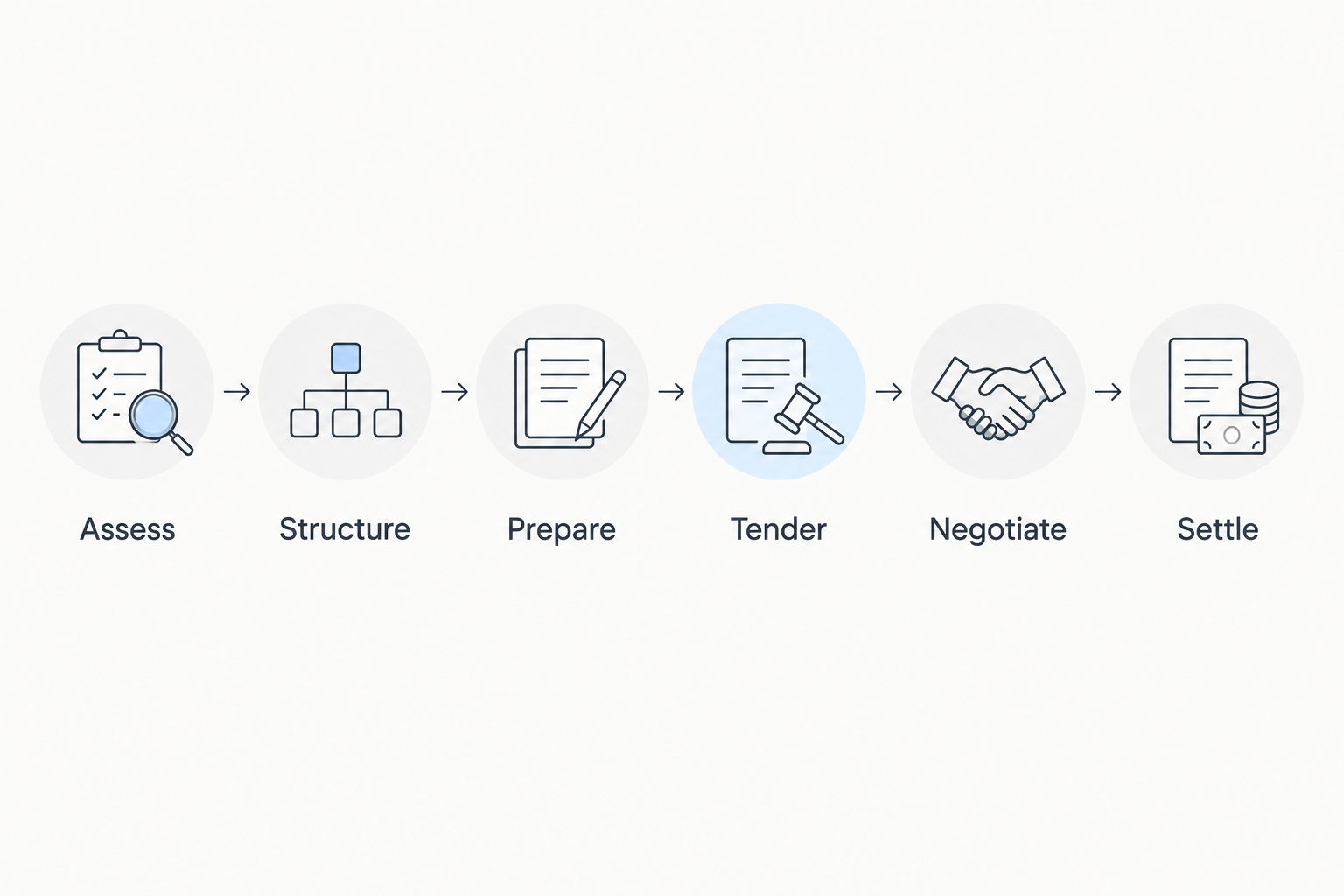
A useful tender starts with the business requirement and ends with executable documents. Use the following sequence to keep competing proposals comparable. Discuss the appropriate scope through the commercial finance services page before committing to a refinancing exercise.
Assess
Set out existing facilities, borrowing purposes and the problem you want solved. Gather current financial information, facility documents and details of assets supporting the debt. Distinguish an immediate funding need from a preference for different banking terms.
Structure
Define the requested facilities and their repayment sources. Separate working capital, equipment and property requirements where appropriate. State which security and guarantee arrangements need examination rather than leaving lenders to make different assumptions.
Prepare
Create a consistent lending brief. Explain the business, requested funding, financial position and proposed structure in plain language. Check that the supporting information matches the request before approaching lenders.
Tender
Ask suitable lenders to respond to the same brief. Record departures from the requested structure, including additional security, reporting obligations or conditions. A response that changes the brief needs explanation before comparison.
Negotiate
Compare complete proposals, not isolated interest margins. Clarify repayment obligations, covenants, guarantees, security and conditions that must be satisfied. Ask for material changes in writing.
Settle
Check the final documents against the agreed proposal. Coordinate repayment and release of existing facilities with the replacement funding arrangements. Do not treat an indicative proposal as completed refinancing.
What to compare before accepting a proposal
A 2026 refinancing decision needs a written comparison you can revisit after settlement. Record the following for the incumbent and each alternative.
| Compare | Question to resolve |
|---|---|
| Borrowing purpose | Does each facility fund the intended business requirement? |
| Repayments | Do repayment obligations match the expected source of cash? |
| Security | Which assets support the debt, and under what arrangements? |
| Guarantees | Who gives guarantees, and what obligations do they accept? |
| Covenants | What financial tests and reporting obligations apply? |
| Conditions | What must happen before funding can proceed? |
| Remuneration | How are brokerage and any debt advisory services paid? |
| Exit arrangements | What obligations apply when replacing the existing facilities? |
Do not rank a proposal first until you understand its conditions. An offer that relies on security you will not provide is not an actionable alternative, regardless of its headline appeal.
When staying with CommBank is the right call
Stay when CommBank's documented proposal meets your requirements and the alternatives do not justify changing the arrangement. An existing relationship is not a reason to avoid comparison, but neither is comparison a commitment to leave.
Ask the incumbent to address the same brief as other lenders. If the bank responds with an acceptable structure, security position and repayment arrangement, retaining it is a valid commercial decision.
FAQ
What's the best CommBank alternative for business refinancing?
Glenclair suits business owners seeking an independent commercial finance brokerage review across a panel of 60+ lenders. A direct approach to NAB is another route if you want to manage a competing bank application yourself.
Is a commercial finance broker a replacement for my bank?
A commercial finance broker arranges finance; it does not replace the lender's role. The selected lender assesses credit and provides the facilities, while the broker coordinates the finance process within the agreed scope.
Should I refinance or ask CommBank to review my existing facilities?
Ask CommBank to respond to your current requirements and compare that response with suitable alternatives. Refinancing is justified by the complete replacement arrangement, not simply by obtaining another lender's proposal.
Is more than A$2 million a minimum borrowing requirement?
More than A$2 million is the preferred focus for the established-business refinancing review discussed here, not a universal eligibility threshold. Suitability depends on the business, borrowing purpose and proposed engagement.
How is lender-paid brokerage different from debt advisory?
Lender-paid brokerage and debt advisory have different remuneration arrangements. Debt advisory uses a retainer and success-fee structure, so confirm the engagement scope and payment basis in writing.
Can equipment finance sit alongside a business refinancing review?
Equipment finance can form part of the review when it serves a defined commercial borrowing requirement. Assess repayment sources, security and any interaction with existing banking facilities before choosing a separate lender.
What should I compare when reviewing business finance in 2026?
Compare facility structure, repayment obligations, security, guarantees, covenants and funding conditions alongside interest costs. Use the same lending brief so differences between proposals are visible.
One last thing
Ask each shortlisted lender to identify where its proposal departs from your brief. That question is more useful than asking whether an offer is competitive: it exposes the conditions behind the offer before you commit.
The strongest outcome is an arrangement you understand and can operate—not necessarily a new bank.
Related guides
- Equipment finance options for construction businesses
- Truck finance options for Australian transport fleets
- Income requirements for commercial property finance
By the Glenclair Financial team.