
Best commercial property finance for childcare centres in 2026

Best overall for an existing childcare property loan: a broker-led refinance review through Glenclair. Best for buying your operating premises: an owner-occupied commercial property loan; best for a leased childcare investment: an investment property loan; best for construction: development finance matched to the project.
TL;DR
- For existing borrowers, review commercial property finance for childcare centres before choosing a replacement lender.
- Glenclair suits established business owners seeking a broker-led review of commercial property finance for childcare centres.
- Match refinancing, acquisition finance or development finance to the property's repayment source and borrowing purpose.
- Compare security, guarantees, covenants and exit conditions alongside interest and fees.
Why this matters
A childcare property and a childcare operating business are different lending propositions. An owner-operator repays debt from business cash flow. A property investor relies on rent, while a developer needs funding through construction and a credible repayment exit.
The best facility matches the source of repayment, not just the building. Mixing these borrowing purposes in a single comparison hides differences in security, repayment obligations and conditions.
This 2026 guide focuses on established Australian business owners, particularly those reviewing business-purpose borrowing above A$2 million. That is the intended audience, not a universal eligibility threshold. Suitability depends on the borrower, property, financial position and lender requirements.
What makes the best childcare property finance
Use these criteria before comparing lenders or accepting an indicative offer:
- Repayment fit: Business earnings, rental income or a development exit must support the proposed debt structure.
- Security boundaries: Identify the property, business assets and guarantees supporting each facility.
- Term certainty: Compare loan maturity, amortisation, review conditions and any residual repayment.
- Operating flexibility: Check restrictions affecting distributions, additional borrowing, renovations and asset sales.
- Execution requirements: Identify valuation, legal, documentation and approval conditions before committing.
- Whole-facility obligations: Read interest, fees, covenants and discharge requirements together.
A longer term does not automatically make a facility better. A structure that preserves cash today can leave a substantial repayment obligation at maturity.
Childcare property finance options at a glance
These are borrowing structures and purposes, not interchangeable products. The order prioritises existing banking reviews, followed by acquisition and project-specific needs.
| Option | Best for | Standout feature | Key limitation |
|---|---|---|---|
| Broker-led refinance review | Existing childcare property borrowers | Tests current arrangements against a consistent borrowing brief | Switching requires assessment of discharge and establishment obligations |
| Owner-occupied commercial property loan | Operators buying their premises | Connects property ownership with operating requirements | Business and property exposure sit together |
| Commercial investment property loan | Owners of leased childcare premises | Assesses the property through its rental arrangement | Tenant strength and lease terms affect the lending assessment |
| Property development finance | Construction or substantial redevelopment | Structures funding around project delivery | Drawdowns and repayment depend on project conditions |
| Commercial bridging finance | A defined timing gap | Connects an acquisition or transition with a documented exit | An uncertain exit creates repayment risk |
1. Refinance review: best for existing property borrowers
A refinance review compares the existing facility with alternatives before deciding whether to retain, renegotiate or replace it. Start with the current agreement, security documents and financial position—not a headline rate.
Glenclair is an independent commercial finance brokerage with a panel of 60+ lenders. Its commercial finance services include refinancing, business loans, equipment finance and property development finance. A panel provides a lender pool; it does not establish which lenders will consider a particular childcare property.
For a 2026 review, give each proposed lender the same borrowing brief. Otherwise, an attractive offer can simply reflect different security, repayment or guarantee assumptions.
Refinance review pros:
- Tests whether the existing structure still matches the business.
- Allows comparison of security, covenants and repayment terms together.
- Includes retaining the incumbent lender as a possible decision.
Refinance review cons:
- Requires current financial information and facility documentation.
- Discharge, valuation and establishment obligations can affect the decision.
Best for: Established borrowers whose banking arrangements no longer reflect their property, cash flow or plans.
Verdict: Hold the switching decision until the whole-facility comparison is complete.
2. Owner-occupied loans: best for buying operating premises
An owner-occupied commercial property loan funds premises used by the borrowing business or its related operating entity. For a childcare operator, the assessment connects the property acquisition with the business's capacity to service debt.
Separate the property purchase from any purchase of the childcare business. Goodwill, fitout, equipment and working capital are distinct funding needs; do not assume a property facility covers them.
Ask your accountant and solicitor to assess the proposed ownership and borrowing entities before documents are finalised. The entity buying the property, the operating entity and the guarantors need a coordinated structure.
Owner-occupied loan pros:
- Supports ownership of the premises used by the business.
- Allows property debt to be assessed alongside operating cash flow.
- Creates a clear basis for comparing acquisition funding proposals.
Owner-occupied loan cons:
- Concentrates operating and property exposure around the same business.
- Property ownership does not remove the need for operating liquidity.
Best for: Established childcare operators buying premises they intend to occupy.
Verdict: Buy only when the acquisition leaves sufficient liquidity for operations and ongoing property obligations.
3. Investment loans: best for leased childcare properties
A commercial investment property loan funds a property leased to a childcare operator. The assessment considers rental income, lease terms, tenant financial strength and the property offered as security.
A long lease is not a substitute for tenant due diligence. Read the rent review provisions, incentives, maintenance responsibilities, options and termination rights rather than relying on the lease's headline duration.
Distinguish contractual rent from cash actually received. If the landlord and operator are related entities, disclose that relationship and prepare evidence supporting the rental arrangement.
Investment loan pros:
- Separates the property investment purpose from operating-business borrowing.
- Supports comparison using rental income and lease obligations.
- Makes tenant and lease due diligence central to the decision.
Investment loan cons:
- Tenant financial weakness can affect rental continuity and lending assessment.
- Vacancy or lease expiry can change the property's repayment position.
Best for: Investors acquiring or refinancing childcare premises leased to an operator.
Verdict: Buy on verified rental and lease evidence, not the childcare label alone.
4. Development finance: best for construction and redevelopment
Development finance supports a project rather than treating an unfinished property as a completed investment. Funding conditions can address construction progress, the building contract, remaining costs and the intended repayment exit.
A childcare development needs separate attention to property delivery and readiness for the intended use. Confirm planning, building and relevant service approval requirements with the responsible authorities and advisers; a lender's credit approval does not replace them.
Before accepting a 2026 proposal, map the construction facility through to sale, refinance or another documented exit. Do not treat a hoped-for future loan as an approved takeout facility.
Development finance pros:
- Aligns funding assessment with the project's construction requirements.
- Makes the budget, delivery programme and exit explicit.
- Provides a framework for comparing drawdown conditions.
Development finance cons:
- Drawdowns depend on satisfying the facility's conditions.
- Delays and cost overruns can create additional equity requirements.
Best for: Borrowers constructing a childcare centre or undertaking substantial redevelopment.
Verdict: Wait until the delivery budget, funding obligations and exit are documented.
5. Bridging finance: best for a defined timing gap
Commercial bridging finance addresses a temporary mismatch between a funding requirement and an expected repayment event. Examples include purchasing before another property settles or completing a transition before longer-term funding begins.
The exit is the central credit question. Identify what repays the bridge, which conditions remain outstanding and what happens if the expected event is delayed.
Compare the consequences of extension or default as carefully as the initial repayment arrangement. A bridge does not solve a permanent shortfall in serviceability.
Bridging finance pros:
- Addresses a specific transaction timing problem.
- Separates temporary funding from the intended long-term structure.
- Makes the repayment event an explicit decision point.
Bridging finance cons:
- Delayed settlement or refinance can undermine the repayment plan.
- Extension requires assessment under the facility's terms, not an assumption.
Best for: Borrowers with a defined timing gap and a credible, documented exit.
Verdict: Skip bridging finance when repayment depends on an unconfirmed future event.
How these options are ranked
The ranking prioritises an existing borrower's decision sequence: review current arrangements before considering a replacement facility. Acquisition, investment, development and bridging options then occupy separate use cases.
The criteria are repayment fit, security boundaries, term certainty, flexibility, execution requirements and whole-facility obligations. This is not a ranking of lender rates, approval likelihood or credit appetite. Each proposal needs a case-specific assessment.
How a banking tender should work
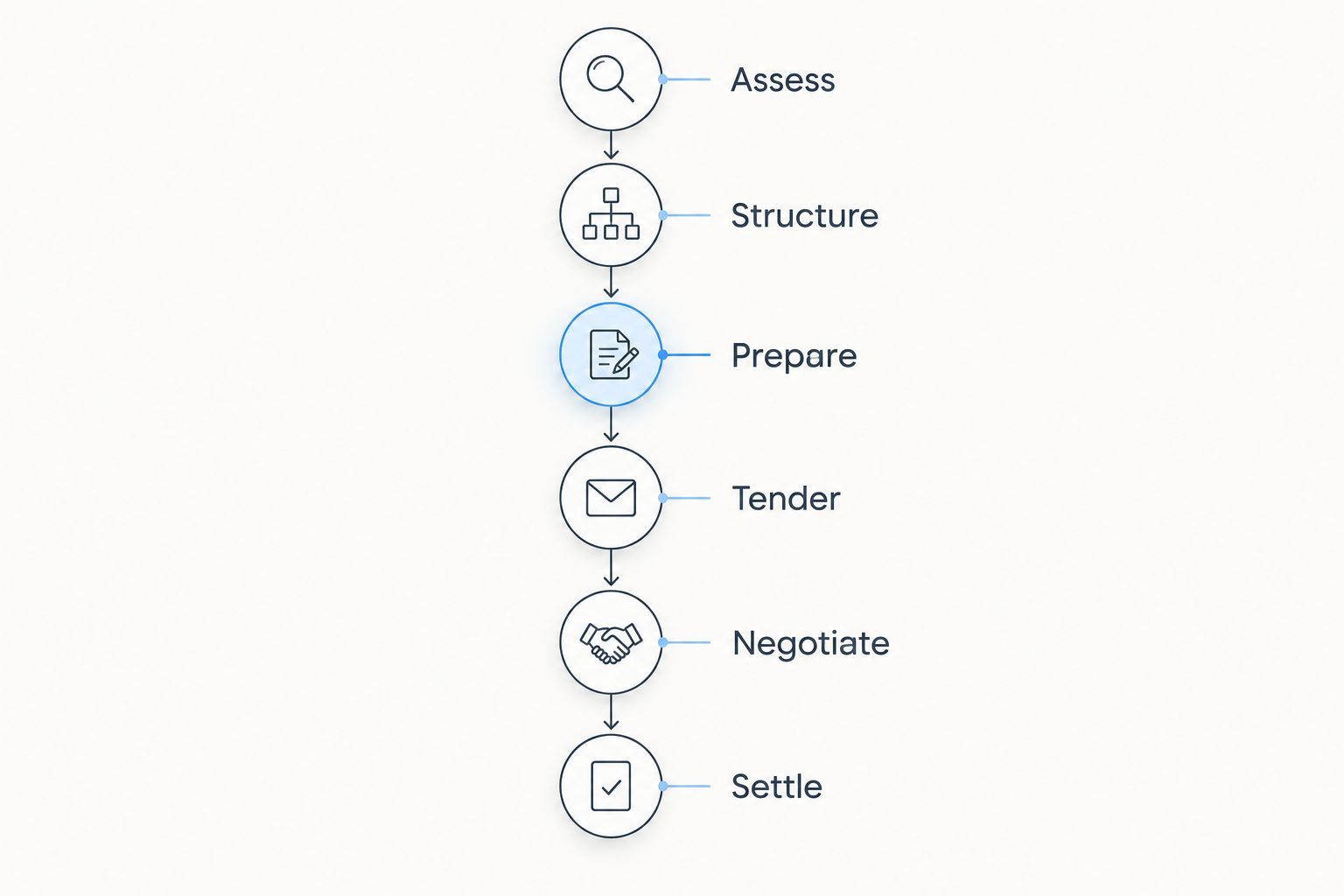
For a 2026 banking review, use a consistent process. A tender is useful only when competing proposals answer the same brief.
Assess
Establish the borrowing purpose, current facilities, financial position and upcoming commitments. Identify whether repayment depends on operating earnings, rent or a project exit.
Structure
Define the borrowing entities, proposed security, facility amounts and repayment profile. Separate property debt from equipment and working capital needs where the funding purposes differ.
Prepare
Assemble financial statements, current management accounts, facility agreements and relevant property documents. For leased premises, include the lease; for a development, include the project budget and delivery information.
Tender
Give suitable lenders a consistent brief. Record where proposals differ rather than presenting unlike facilities as direct substitutes.
Negotiate
Resolve the terms that affect the business: guarantees, covenants, repayment obligations, security releases and conditions. Distinguish indicative terms from approved and documented commitments.
Settle
Check conditions, discharge arrangements and final documents with the relevant advisers. Confirm the ongoing reporting and repayment obligations before settlement.
These six stages provide decision gates, not a promise of approval or settlement timing. Stop and resolve material differences before moving to the next stage.
Brokerage, advisory and lending obligations
Glenclair distinguishes lender-paid brokerage from debt advisory services, which use a retainer and success-fee structure. Ask which engagement applies to your work and obtain the terms in writing.
Lender-paid brokerage does not mean the loan has no other costs. Request disclosure of remuneration, lender charges, valuation requirements, legal expenses and discharge obligations without assuming every proposal uses the same arrangements.
Also establish the scope. A property refinance, a business banking tender and a complex debt advisory engagement involve different work. Your engagement should identify the facilities being reviewed, the deliverables and the responsibilities retained by your accountant and solicitor.
Review your existing banking arrangements
Discuss borrowing purpose, security and the scope of a commercial finance review.
Which childcare property finance should you choose?
Start with a refinance review if you already own the property and have existing debt. Decide whether to retain, renegotiate or replace the facility after comparing the complete obligations.
For a purchase, distinguish owner-occupation from a leased investment. For construction, assess development funding and its exit together. Reserve bridging finance for a documented timing gap rather than an unresolved long-term funding need.
In 2026, the right question remains specific: which facility fits this borrower, this property and this repayment source? A lender name alone does not answer it.
FAQ
What's the best commercial property finance for childcare centres?
The best structure depends on the borrowing purpose and repayment source. Existing borrowers should start with a refinance review; operators buying premises, property investors and developers need different assessments.
Can I refinance a childcare centre property without changing banks?
Yes, a banking review can result in retaining and renegotiating with the existing lender. Compare the incumbent proposal with alternatives on security, repayments, covenants and other obligations before deciding.
Is buying the childcare property the same as buying the business?
No. The property acquisition and the operating-business acquisition involve different assets and funding needs. Identify any goodwill, equipment, fitout and working capital requirements separately.
Does Glenclair only consider loans above A$2 million?
A$2 million is the preferred borrowing focus for this guide, not a universal eligibility rule. Glenclair assesses suitability case by case.
What documents should I prepare for a childcare property refinance?
Prepare financial statements, current management accounts, existing facility agreements and relevant property documents. Include the lease for an investment property and confirm any additional requirements for the proposed transaction.
Does lender-paid brokerage mean there are no loan costs?
No. Brokerage remuneration is separate from lender charges and other transaction expenses. Confirm whether the engagement is lender-paid brokerage or debt advisory, which uses a retainer and success-fee structure.
Can development finance automatically become a long-term property loan?
No automatic conversion should be assumed. Confirm whether the exit facility is approved, what conditions apply and how the development loan must be repaid.
One last thing
Ask each proposed lender what happens when the facility matures—not just what happens at settlement. A repayment profile can look manageable during the term while leaving a substantial balance due at the end.
Write the maturity obligation beside the repayment amount in your comparison. That makes a critical difference visible before you sign.
Related guides
Author: Glenclair Financial team.