
Business refinancing options ranked by exit cost in 2026

Best first step: review your existing bank terms. Best timing-led option: refinance at the end of a fixed period. Best flexibility-led option: compare variable-rate refinancing. Business refinancing exit costs depend on your contracts, security and settlement date—not the advertised replacement rate. Glenclair helps Australian business owners review existing borrowing through an independent commercial finance brokerage with a panel of 60+ lenders.
TL;DR
- Business refinancing exit costs require written payout figures; a lower replacement rate does not establish a better deal.
- Review existing bank terms before committing to a lender change.
- Compare fixed-period expiry, early repayment and security-release requirements on the same settlement date.
- Glenclair suits established Australian businesses seeking a structured commercial borrowing review.
Why this matters
Your refinancing decision in 2026 has two separate tests: what it takes to leave, and whether the replacement arrangement justifies leaving. Passing the second test requires more than comparing interest rates.
For established businesses seeking business-purpose finance greater than A$2 million, the review should also cover guarantees, linked facilities, working capital and security. That borrowing preference is not a universal eligibility threshold; suitability requires individual assessment.
Glenclair is best suited to established Australian business owners seeking a structured review of commercial finance. Its commercial finance services cover business loans, refinancing, equipment and property development finance.
What makes the best refinancing option?
Rank the choices against these criteria before choosing a lender:
- Documented exit amount: obtain a written payout figure for the proposed settlement date, including any separately payable charges.
- Contractual triggers: identify fixed-rate break provisions, early repayment terms and notice requirements.
- Security release: establish which mortgages, asset securities and guarantees need release or replacement.
- Replacement terms: compare repayment structure, covenants, guarantees and security—not just rate.
- Whole-business fit: check whether moving one facility affects overdrafts, equipment funding or other borrowing.
- Timing control: separate dates you can choose from deadlines imposed by maturity, a purchase or another commitment.
For your 2026 review, the ranking below orders the investigation from a change within the existing arrangement through to a wider restructure. It is not a universal ranking of dollar costs. Only contract-specific payout figures establish that order.
Refinancing options at a glance
| Rank and option | Best for | Standout feature | Key limitation |
|---|---|---|---|
| 1. Existing-lender amendment | Testing whether switching is necessary | Reviews terms without first committing to discharge | Does not provide an independent competing offer |
| 2. Refinance at fixed-period expiry | Borrowers with control over timing | Aligns the proposed move with a contractual milestone | Expiry does not remove every exit requirement |
| 3. Variable-rate refinance | Borrowers without a fixed-rate period to unwind | Focuses the review on payout, repayment terms and security | Variable does not mean fee-free |
| 4. Early fixed-rate refinance | Businesses needing change before expiry | Tests an immediate move against the cost of waiting | Requires a dated break-cost calculation |
| 5. Multi-facility restructure | Businesses changing the broader banking arrangement | Reviews connected debt and security together | Requires coordination across affected facilities |
1. Existing-lender amendment: best for testing whether to switch
An existing-lender amendment changes an arrangement without automatically replacing the lender. Ask the bank to identify which requested changes it can document within the current facilities and which require new lending or security documents.
This is the first comparison point, not a refinance in itself. It gives you a stay-put alternative against which to assess external offers.
Existing-lender amendment pros:
- Establishes whether your objectives require a lender change.
- Separates dissatisfaction with pricing from problems with structure.
- Gives an external tender a defined incumbent proposal to beat.
Existing-lender amendment cons:
- The bank's offer is not evidence of competing lender terms.
- Amendment, documentation or other charges still require confirmation.
- Retaining the lender does not automatically change guarantees or security.
Ask for the revised terms in writing, including anything that remains unchanged. A verbal indication is not a documented alternative to refinancing.
Best for: businesses whose existing facilities broadly fit but need a review of terms. Verdict: Hold the existing arrangement while obtaining a written amendment offer and external comparisons.
2. Refinance at fixed-period expiry: best for timing flexibility
This pathway aligns settlement with the end of a fixed-rate period. It targets a specific contractual issue: whether repaying before that date triggers a break calculation.
Read the facility documents rather than treating expiry as a clean exit. A fixed-rate expiry date and a loan maturity date are not interchangeable.
Fixed-period expiry refinance pros:
- Makes the contractual timing question explicit.
- Allows a comparison between moving now and moving at expiry.
- Provides a defined date around which to organise the tender.
Fixed-period expiry refinance cons:
- Other discharge and settlement requirements still need checking.
- Waiting must fit your business objectives and obligations.
- Replacement finance requires its own assessment and approval.
For a 2026 decision, obtain figures for both the proposed early settlement date and the relevant expiry date. Ask the lender to explain what changes between them.
Best for: borrowers who can align a move with the contract rather than an urgent business deadline. Verdict: Wait only when the documented comparison supports waiting and the business can accommodate it.
3. Variable-rate refinance: best for reviewing repayment flexibility
Variable-rate refinancing replaces an existing variable-rate facility with another arrangement. Start with the early repayment provisions, payout statement and security-release requirements.
The absence of a fixed-rate period does not establish the absence of exit costs. Nor does it establish that the replacement loan offers better repayment flexibility.
Variable-rate refinance pros:
- Allows direct examination of the facility's repayment provisions.
- Supports a comparison of current and proposed borrowing structures.
- Keeps attention on discharge, security and replacement conditions.
Variable-rate refinance cons:
- Variable-rate facilities can still contain contractual charges.
- A new lender can require different security or guarantees.
- A lower rate does not resolve unsuitable repayment terms.
Request the proposed facility's rules for extra repayments, reductions and future discharge. You are assessing the next exit as well as the current one.
Best for: businesses reviewing variable-rate debt where the repayment structure or bank terms need changing. Verdict: Hold commitment until both the current payout and replacement conditions are documented.
4. Early fixed-rate refinance: best for a time-critical change
Early fixed-rate refinancing tests a move before the fixed period ends. It requires a lender-issued calculation for the intended repayment date, not an estimate derived from another borrower's experience.
A business acquisition, property transaction or necessary restructure can set the timetable. That timetable does not remove the need to compare the immediate move with alternatives.
Early fixed-rate refinance pros:
- Tests a change against the business's actual deadline.
- Makes the cost of leaving before expiry explicit.
- Allows immediate refinancing and waiting to be compared separately.
Early fixed-rate refinance cons:
- A quoted break amount requires its own validity conditions.
- Linked hedging or other contracts need separate examination where applicable.
- An attractive replacement offer alone does not justify early exit.
Ask what happens if settlement moves outside the quote's stated conditions. Do not carry an old payout figure into a revised transaction without reconfirmation.
Best for: businesses with a defined reason to move before fixed-period expiry. Verdict: Skip a rate-only switch; assess early exit against the full business requirement.
5. Multi-facility restructure: best for connected borrowing
A multi-facility restructure reviews several connected arrangements together. Depending on your existing documents, that review can involve business loans, property-backed debt, equipment facilities and working capital.
Its distinguishing issue is coordination, not an assumed level of exit charges. Identify which obligations and security arrangements connect before deciding what moves.
Multi-facility restructure pros:
- Examines borrowing across the business rather than loan by loan.
- Makes shared security and guarantee questions explicit.
- Allows the proposed banking arrangement to reflect different funding purposes.
Multi-facility restructure cons:
- Each affected facility needs its own contractual review.
- Payouts and releases require coordinated settlement instructions.
- Moving every facility is not automatically the right outcome.
For property development borrowing, distinguish the refinance from any proposed changes to project funding. For equipment and working capital, check whether a separate facility remains suitable.
Best for: businesses whose existing banking structure no longer matches their borrowing needs. Verdict: Hold individual switches until the connected facilities and release requirements are mapped.
Compare the full cost, not just the exit statement
Use the same assumptions for every proposal. For a 2026 comparison, choose a common settlement date and show a 12-month view alongside a 24-month view. These are comparison horizons, not predictions of savings or recommended loan terms.
Separate the assessment into distinct categories:
- Leaving the current arrangement: payout adjustments, applicable break amounts, discharge requirements and professional work needed for release.
- Entering the replacement arrangement: lender charges, valuations, documentation and other transaction requirements stated in the proposal.
- Operating the new facilities: interest, ongoing charges, repayments and reporting obligations under the proposed terms.
- Changing business constraints: security, guarantees, covenants and restrictions that affect how you operate.
Avoid double-counting a charge already included in the payout statement. Equally, do not assume the payout statement includes every amount payable to other parties.
Compare like-for-like debt balances and repayment assumptions. A proposal that reduces principal faster needs to be assessed differently from one that defers principal repayment. Cash leaving the business and financing expense are not the same measure.
Run a banking tender around the exit requirements
Give competing lenders the same borrowing brief. Otherwise, differences in loan size, security or repayment structure obscure the comparison.
Use this sequence to organise the review:
- Assess: document existing facilities, business objectives and contractual dates.
- Structure: define what the borrowing arrangement needs to achieve.
- Prepare: assemble financial information, facility documents and payout requirements.
- Tender: request proposals against a consistent brief.
- Negotiate: resolve differences in terms, security and conditions.
- Settle: coordinate funding, repayments and required releases.
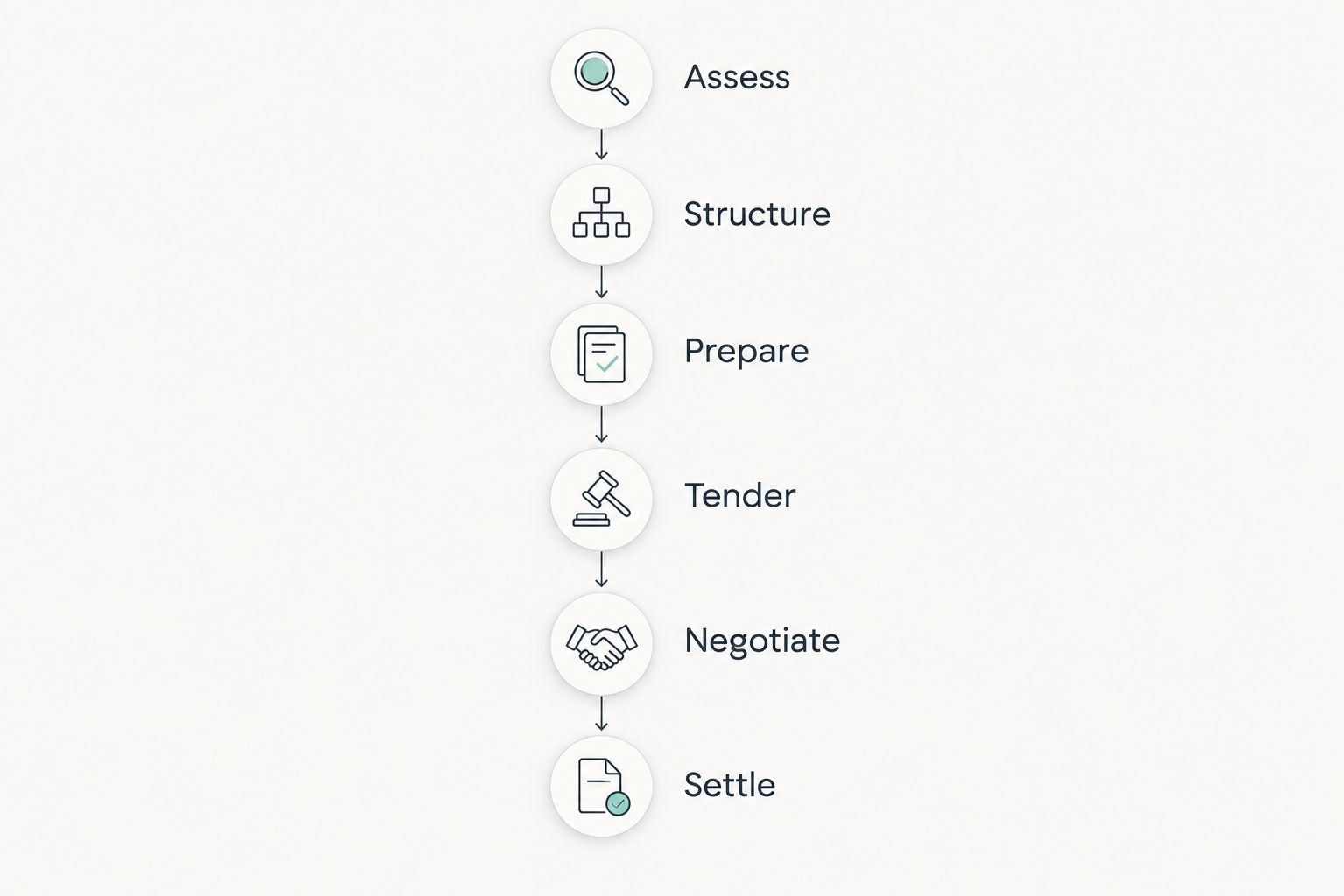
Keep a written record of unresolved conditions before accepting an offer. An indicative proposal is not a substitute for confirming what must happen before settlement.
Glenclair's lender-paid brokerage and debt advisory services use different remuneration structures. Debt advisory uses a retainer and success-fee structure; confirm which service applies, who pays and what the engagement covers before proceeding.
Review your commercial borrowing
Assess existing facilities, exit requirements and the scope of a banking tender.
How the options are ranked
The ranking starts with testing whether a lender change is necessary, then separates refinancing by contractual timing and scope. It uses the criteria above: documented payout, repayment triggers, security release, replacement terms, business fit and timing.
It does not rank lenders, quote market averages or claim one pathway always has the lowest exit amount. Move an option up your own shortlist only when the written evidence supports it.
Which refinancing option should you choose?
Start with an existing-bank review and a written payout request. Then compare an external proposal against the documented stay-put alternative.
If timing is flexible, examine fixed-period expiry before committing to early repayment. If borrowing is connected across facilities, assess the whole arrangement before authorising an isolated switch.
For your 2026 decision, the right option is the one that meets the business requirement on acceptable documented terms—not the one with the most attractive headline rate.
FAQ
What are business refinancing exit costs?
Business refinancing exit costs are the contractual and transaction amounts associated with leaving existing borrowing. Review the payout statement, applicable break provisions, discharge requirements and any separately payable professional costs.
Which business refinancing option has the lowest exit cost?
The lowest-cost option can only be established from your contracts and dated payout figures. An existing-lender amendment is a useful comparison, but it is not itself refinancing and can involve charges.
Does waiting until my fixed rate ends remove all exit costs?
No. Fixed-period expiry does not establish that discharge, documentation or other exit requirements disappear. Confirm the fixed-period expiry date separately from the loan maturity date.
Can a variable-rate business loan have exit charges?
Yes. Variable-rate pricing does not mean the facility has no contractual charges or discharge requirements. Obtain a written payout statement and check the repayment provisions.
Should I refinance just because another lender offers a lower rate?
No. Compare the exit requirements, replacement terms, repayments, security and guarantees before deciding. A lower rate alone does not establish a better borrowing arrangement.
Does Glenclair charge the borrower for every finance service?
Glenclair distinguishes lender-paid brokerage from debt advisory services, which use a retainer and success-fee structure. Confirm the applicable engagement and remuneration before proceeding.
Is borrowing above A$2 million a universal eligibility requirement?
No. Glenclair prioritises established Australian businesses seeking business-purpose finance greater than A$2 million, but suitability is assessed case by case. The preferred borrowing size is not a universal eligibility rule.
One last thing
Repaying the loan and releasing the security are separate checks. Ask for written confirmation of what will be discharged, what will remain and which guarantees require attention. Put those requirements into the settlement plan rather than leaving them until after funds move.
Related guides
- Equipment finance options for construction businesses
- Truck finance options for Australian transport fleets
- Income requirements for commercial property finance
Author: Glenclair Financial team.