
Can an SMSF borrow 100% for a commercial property purchase?

An SMSF can, in principle, seek a 100% loan-to-value ratio because superannuation borrowing law does not prescribe a numerical LVR ceiling. That is not an entitlement to finance: a lender must accept the structure, security and repayment capacity. Even a loan covering the purchase price does not automatically cover duty, legal work, borrowing expenses or the fund’s ongoing cash needs.
TL;DR
- SMSF commercial property loan LVR has no universal statutory ceiling; 100% funding still requires lender approval.
- LVR uses the lender’s accepted property value, which can differ from the purchase price.
- A compliant borrowing structure does not replace cash-flow assessment or the fund’s need for liquidity.
- Glenclair is best suited to established business owners reviewing commercial borrowing, with suitability assessed case by case.
Why this matters
A legal borrowing structure and an acceptable loan application are different tests. Passing one does not settle the other. For a 2026 purchase, you need to establish both before treating the property as funded.
Glenclair is an independent commercial finance brokerage with a panel of 60+ lenders. A panel gives a broker lenders to assess; it does not mean every lender accepts SMSF commercial property security or a particular LVR.
For business owners, there is another distinction. A property that suits your operating business must also satisfy the SMSF’s investment and compliance requirements. Business convenience does not replace the trustees’ obligations.
Can an SMSF borrow 100% for a commercial property purchase?
There is no universal statutory LVR cap, but there is no universal right to borrow 100% either. Section 67A of the Superannuation Industry (Supervision) Act 1993 sets conditions for a limited recourse borrowing arrangement, commonly called an LRBA. It does not prescribe a maximum lending percentage.
The Australian Taxation Office’s SMSF borrowing guidance explains the limited circumstances in which an SMSF can borrow to acquire an asset. Those rules concern the arrangement’s structure and use of borrowed money, not a promise that a lender will fund the entire purchase.
Separate these three questions when assessing a transaction in 2026:
| Question | What it establishes | What it does not establish |
|---|---|---|
| Is the borrowing legally permitted? | Whether the proposed arrangement meets the relevant superannuation rules | Whether a lender will approve it |
| Does the lender accept the requested LVR? | Whether the debt fits the lender’s security assessment | Whether the fund can afford repayments |
| Can the fund complete and retain liquidity? | Whether cash and funding cover settlement and ongoing obligations | Whether the property is a suitable investment |
A lender’s maximum LVR is a lending policy, not the statutory borrowing limit. Ask for the applicable policy and transaction conditions rather than relying on a general claim that SMSFs can borrow a particular percentage.
What does 100% LVR actually mean?
LVR is the loan amount divided by the property value accepted by the lender, multiplied by 100. At 100% LVR, the loan equals that accepted value. It does not necessarily equal the purchase price or the total amount needed to complete the transaction.
If the accepted valuation is below the agreed purchase price, funding measured against that valuation leaves a purchase-price gap. Transaction expenses and the fund’s cash reserve sit outside that calculation unless the proposed facility expressly addresses them.
A seller agreeing to a price does not oblige a lender to accept that price as security value. Get the valuation basis confirmed before calculating the fund’s contribution.
What determines your SMSF commercial property loan LVR?
There is no single percentage that applies to every commercial property, fund and lender. The following factors belong in your assessment, not just the headline LVR.
- Accepted valuation. The lender’s valuation establishes the denominator in the LVR calculation. A lower accepted value increases the funding gap for the same purchase price.
- Property and lease. Property use, tenant arrangements, lease terms and saleability form part of the security assessment. The lender needs to understand what supports rent and repayment.
- Repayment capacity. Rental income, fund cash flow, permitted contributions and existing obligations affect the ability to service debt. Security value alone does not pay instalments.
- Fund liquidity. Settlement expenses, property outgoings, vacancies and member benefit obligations require cash planning. A fund that completes with no reserve has less capacity to absorb disruption.
- Borrowing structure. The acquisition, holding arrangement and loan documents must work together. An acceptable LVR does not correct a defective LRBA.
- Lender policy. Each lender decides which transactions it will consider and on what conditions. Confirm the policy for your actual property and fund, rather than another borrower’s deal.
For a 2026 application, ask which factor limits the proposed loan. A valuation issue requires a different response from a repayment-capacity issue or a compliance problem.
Which funding approach should you assess?
Start with the fund’s position, not the highest borrowing percentage you can request. Each approach has a benefit and a constraint.
| Approach | Best for | Benefit | Constraint |
|---|---|---|---|
| Seek 100% LVR | Trustees checking whether full-value borrowing is legally and commercially workable | Tests whether the purchase can preserve more existing fund cash | Requires lender acceptance; does not automatically fund expenses or establish affordability |
| Borrow less and contribute fund cash | Funds with sufficient cash after allowing for ongoing obligations | Reduces the debt requested against the property | Commits more fund cash to the acquisition |
| Purchase without borrowing | Funds able to acquire the property while retaining appropriate liquidity | Avoids loan repayments and an LRBA borrowing structure | Concentrates cash in the property and still requires investment and compliance assessment |
Choose the structure the fund can sustain, not the percentage that makes the deposit look smallest. A lower loan does not automatically make a property suitable. A cash purchase does not remove the need to assess concentration, liquidity or related-party rules.
How should you prepare an SMSF property borrowing enquiry?
Use a staged process so you identify restrictions before committing to the purchase. For a 2026 enquiry, keep legal compliance, lender assessment and settlement readiness as separate workstreams.
- Assess. Establish the purchase purpose, property details, fund position and intended borrower structure. Identify any connection between the tenant, seller, members and their businesses.
- Structure. Obtain appropriate advice on the LRBA and holding arrangement. Confirm the intended purchaser and document sequence before signing binding documents.
- Prepare. Assemble financial statements, fund information, lease documents, property details and evidence of available cash. Make the repayment case explicit.
- Tender. Give suitable lenders a consistent funding request. Ask each to identify its accepted valuation basis, LVR conditions, security requirements and outstanding information.
- Negotiate. Compare the full proposed terms, not just the borrowing percentage. Examine guarantees, repayment structure, covenants and conditions before accepting an offer.
- Settle. Coordinate lender, legal and fund requirements. Confirm cash contributions, execution requirements and remaining conditions before assuming settlement is ready.
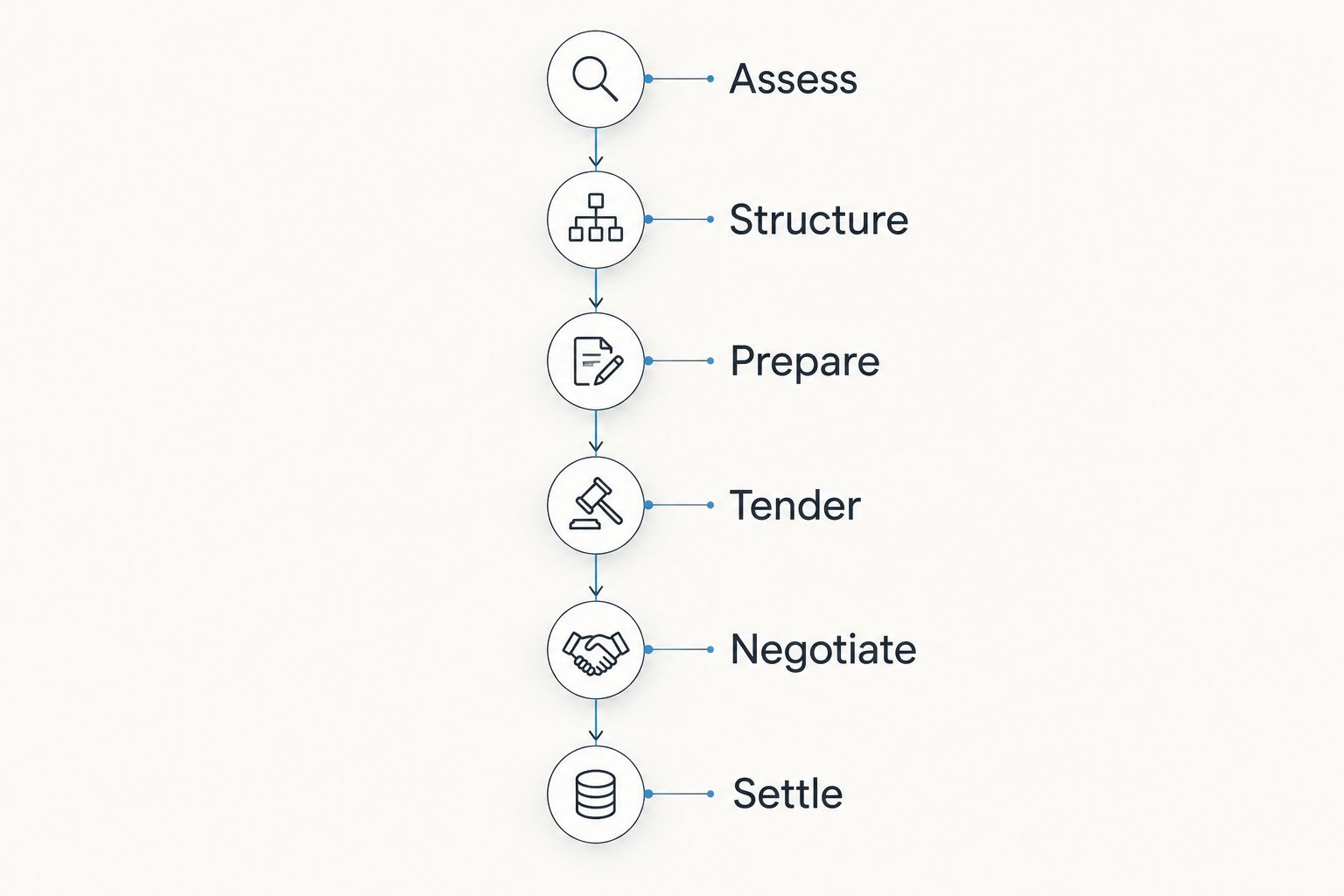
The process is not an approval promise. A lender can require further information, and professional advice can identify a reason not to proceed with the proposed acquisition.
What should you ask an independent broker?
Ask whether the broker handles the proposed transaction, which lenders will be considered and what information supports the recommendation. A broad lender panel is useful only when the relevant lenders fit the security and borrowing structure.
Glenclair’s commercial finance services cover business loans, refinancing, equipment and property development finance. For an SMSF enquiry, establish transaction fit before assuming that a general commercial property service includes your specific borrowing arrangement.
Also confirm the engagement model. Lender-paid brokerage and debt advisory are different services; debt advisory uses a retainer and success-fee structure. Get the scope and remuneration arrangements in writing so you know which service you are engaging.
Can my business lease commercial property from my SMSF?
A business can lease qualifying business real property from a related SMSF, subject to the relevant superannuation rules and arm’s-length terms. The ATO’s business real property guidance explains the distinction; not every property qualifies simply because a business uses it.
The lease needs to stand on commercial terms, including rent and payment obligations. Your business occupying the property does not remove the fund’s investment obligations or the lender’s assessment of rental income.
If the fund is buying from a related party, get advice on the acquisition rules as well as the lease. These are separate compliance questions. Do not treat an acceptable lease as confirmation that the purchase itself is permitted.
Can a related-party loan provide the full purchase funding?
A related-party loan does not bypass the LRBA rules or the requirement to consider arm’s-length dealing. The ATO’s Practical Compliance Guideline PCG 2016/5 sets out safe-harbour terms for certain related-party LRBAs, including requirements concerning LVR and other loan terms.
An arrangement outside those safe harbours is not automatically non-compliant. It requires appropriate evidence and advice about the actual terms and potential non-arm’s-length income consequences; a loan agreement alone does not settle that assessment.
Do not replace an unavailable bank loan with informal related-party funding. Confirm the structure, evidence and tax treatment before money moves.
Does a higher LVR remove the need for fund cash?
A 100% LVR does not establish that the SMSF needs no cash contribution. LVR measures debt against accepted property value; it does not measure the fund’s complete settlement requirement or its cash position after settlement.
Prepare a settlement funding schedule and a separate operating cash-flow forecast. The first shows whether the purchase can complete. The second shows whether the fund can meet repayments, property expenses and its other obligations afterwards.
For a 2026 decision, include a vacancy scenario and identify which cash flows depend on the operating business. If that business both pays rent and supports member contributions, assess those connected exposures together rather than treating them as unrelated income sources.
FAQ
Can an SMSF borrow 100% to buy commercial property?
A 100% LVR is not prohibited solely by a universal statutory LVR ceiling, because the LRBA provisions do not set one. The borrowing must still satisfy superannuation law and the lender’s requirements; full funding is not guaranteed.
What is the maximum SMSF commercial property loan LVR?
There is no single maximum SMSF commercial property loan LVR that applies across all lenders. Confirm the limit for the actual property, fund and borrowing structure, including how the lender determines value.
Does 100% LVR include stamp duty and legal expenses?
A 100% LVR describes debt relative to accepted property value, not automatic coverage of duty and legal expenses. Confirm the facility’s permitted use and prepare a separate settlement funding schedule.
Can my business pay rent to my SMSF?
Your business can pay rent to your SMSF for qualifying business real property under an arrangement that satisfies the relevant rules. The lease must be on arm’s-length terms, and the property and acquisition require their own compliance assessment.
Can I lend money to my SMSF instead of using a bank?
A related-party loan can be part of an LRBA, but it must be properly structured and assessed for arm’s-length terms. Consider the ATO’s related-party LRBA guidance and obtain advice on potential non-arm’s-length income consequences.
Can borrowed SMSF money pay for property improvements?
LRBA borrowings cannot be used to improve the acquired asset. The ATO distinguishes repairs and maintenance from improvements; obtain advice before assuming proposed works can be funded through the borrowing.
Who should check an SMSF commercial property purchase?
Trustees should obtain advice appropriate to the investment, legal, tax and lending questions involved. A lender’s approval does not confirm that the purchase satisfies every SMSF obligation.
One last thing
Ask for two answers: how much the lender will advance, and how much cash the fund must retain. The first is a lending decision. The second is part of making the investment workable.
Before signing a 2026 purchase contract, put the accepted valuation, proposed debt, settlement expenses and remaining fund cash on the same page. That exposes the gap a headline LVR can hide.
This article provides general information, not personal financial, tax or legal advice. Obtain advice for the fund’s circumstances before committing to a transaction.
Related guides
Written by the Glenclair Financial team.