
Can you buy your own business premises through an SMSF loan?

Yes. Your self-managed super fund can borrow to buy business premises and lease them to your business, provided the property, borrowing structure and lease satisfy superannuation law. The purchase must serve the fund’s retirement purpose, not give your business preferential access to super money, and lender approval does not establish compliance.
TL;DR
- SMSF loan business premises rules allow qualifying commercial property purchases, including premises leased to a member’s business.
- The Australian Taxation Office requires related-party property transactions to meet strict business real property and arm’s-length rules.
- A limited recourse borrowing arrangement needs the correct holding structure before the purchase proceeds.
- Compare fund liquidity, lease obligations and borrowing terms before committing your retirement savings to the property.
Why this matters
Buying your premises through super changes both your property ownership and your business obligations. Your business becomes the tenant. Your SMSF becomes the investor. You must manage those interests separately, even when the same people control both.
Glenclair is best suited to the commercial borrowing assessment, not a substitute for SMSF legal or tax advice. Glenclair is an independent commercial finance brokerage with a panel of 60+ lenders; that panel size is not a count of SMSF property lenders.
For established business owners reviewing their banking arrangements in 2026, the question is broader than whether an SMSF lender will approve the purchase. You also need to establish whether moving the premises into super fits your retirement strategy and leaves enough cash in both the fund and the business.
Can you buy your own business premises through an SMSF loan?
Yes, including premises your business already occupies or qualifying property you own outside super. The transaction must satisfy the applicable acquisition rules, and borrowing generally requires a limited recourse borrowing arrangement, or LRBA.
The Australian Taxation Office’s guidance on business real property, related-party acquisitions and limited recourse borrowing arrangements provides the starting framework for a 2026 assessment. The crucial distinction is between a permitted property investment and using super to support your business outside the rules.
| Proposed arrangement | When it can work | Main benefit | Main constraint |
|---|---|---|---|
| SMSF buys premises from an unrelated seller | The investment and borrowing comply with super law | Separates property ownership from the trading business | Fund liquidity and the holding structure need careful planning |
| SMSF buys premises from you or a related entity | The business real property exception applies and acquisition is at market value | Allows qualifying existing premises to move into super | Related-party acquisition rules restrict what the fund can buy |
| SMSF leases its property to your business | The applicable business real property exception applies and dealings are arm’s length | Your business can occupy a fund investment | Rent and lease enforcement cannot favour the business |
Best for: owners whose retirement strategy, fund resources and business tenancy support the same property investment. It is not an automatic fit simply because your business needs somewhere to operate.
What counts as business real property?
Business real property generally requires the property to be used wholly and exclusively in one or more businesses, subject to specific exceptions. A commercial address or commercial zoning alone does not settle the question.
An office, warehouse or workshop needs its actual use assessed. Mixed business and private use requires particular care, especially where you are relying on an exception to the related-party acquisition or in-house asset rules.
Ask your SMSF adviser and solicitor to examine the property’s use before signing. A lender’s willingness to accept the security does not answer the superannuation question.
How does an SMSF property loan work?
An LRBA allows an SMSF trustee to borrow under specific conditions. A separate holding trustee holds legal title to the acquired asset, while the SMSF has the beneficial interest and the right to obtain legal ownership after the borrowing is repaid.
The lender’s recourse under the arrangement is limited to rights relating to the acquired asset. That does not mean the borrowing has no consequences outside the property: personal guarantees can create separate obligations, so have any guarantee reviewed independently.
Use this sequence to organise the purchase:
- Assess. Confirm the retirement objective, fund investment strategy, available cash and whether the property qualifies.
- Structure. Have the SMSF adviser and solicitor establish the required trustees, holding arrangements and purchaser details.
- Prepare. Assemble fund accounts, business financials, property information, lease evidence and the proposed funding position.
- Tender. Seek suitable lender proposals against the same borrowing requirement and supporting information.
- Negotiate. Compare repayment structure, security, guarantees, conditions and refinancing restrictions, not just the headline rate.
- Settle. Coordinate the lender, solicitor and advisers so the documents and funds match the approved structure.
The order matters. Correcting purchaser details or restructuring ownership after signing can create legal and duty issues. Obtain advice before entering a binding contract.
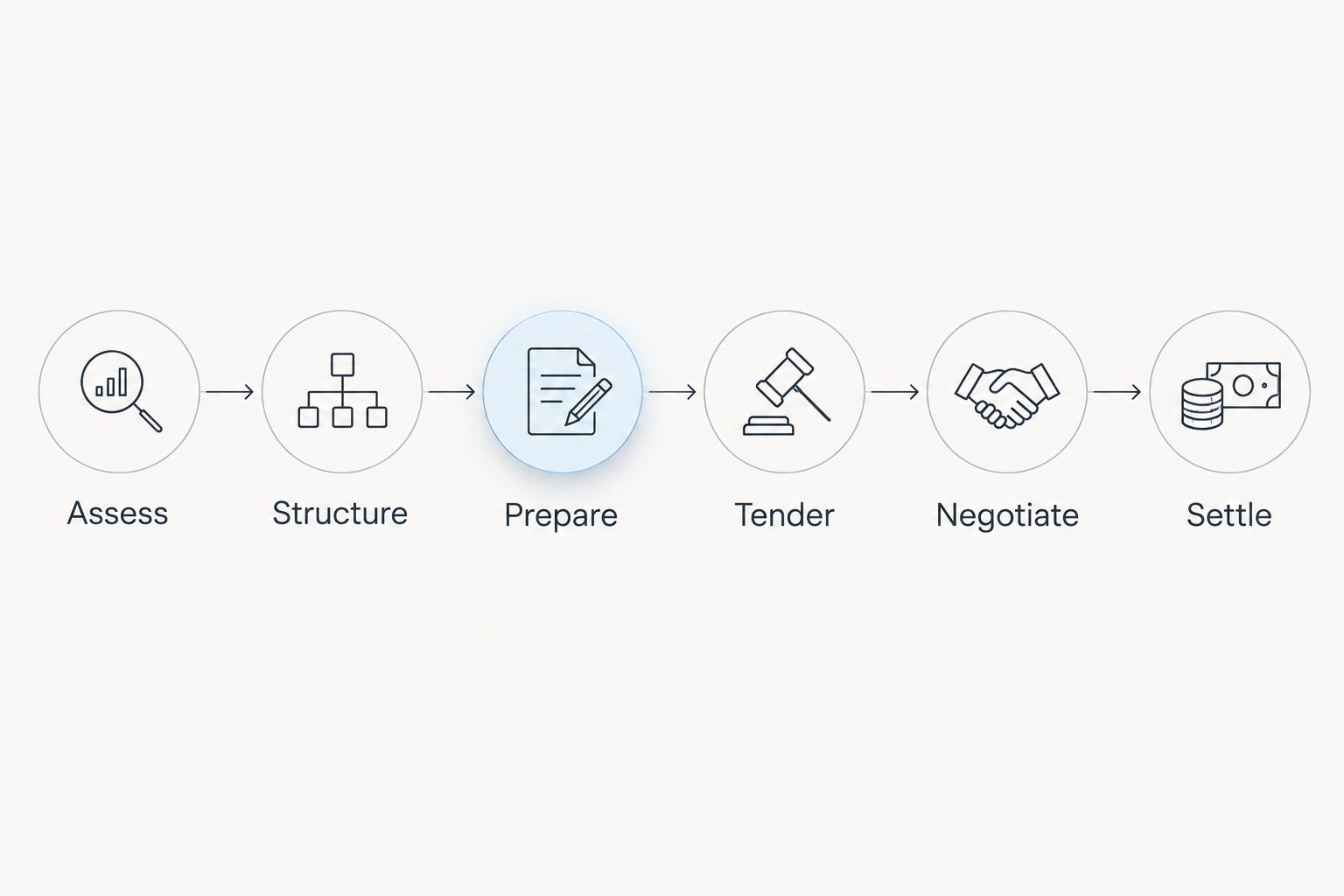
A banking tender should compare genuinely equivalent proposals. If lenders assess different lease assumptions, loan terms or guarantees, their offers do not provide a clean comparison.
Can your business rent the property from your SMSF?
Yes, where the property and arrangement satisfy the relevant rules. Your business must pay market rent under an arm’s-length arrangement, and the trustees must manage the lease as an investment rather than an informal agreement between related parties.
Use a properly documented lease. Record how market rent was established, allocate outgoings clearly and retain evidence of payments and reviews.
The business must be able to meet the lease without preferential treatment from the fund. Rent-free occupation or tolerating arrears because you control both entities can create compliance problems.
For your 2026 review, test the lease against business cash flow as well as fund cash flow. The arrangement does not remove a property expense from the business; it changes who receives the rent and who carries the property obligations.
Why SMSF business premises suitability varies
The same property can be suitable security for a lender but unsuitable for a particular SMSF. These factors need separate answers:
- Property use. Actual use determines whether you can rely on the business real property exceptions; zoning is not enough.
- Fund liquidity. The SMSF needs cash for repayments, property expenses, administration and member benefits when payable.
- Tenant strength. If your business is the tenant, its capacity to pay rent supports the fund’s income and debt servicing.
- Investment concentration. A single premises purchase can concentrate retirement savings in one property and one tenant.
- Loan structure. Repayment obligations, guarantees and lender conditions affect the fund’s flexibility and your personal exposure.
- Member circumstances. Retirement plans, pension payments and contribution limits influence whether the arrangement remains workable.
For a 2026 banking review, consider existing commercial debt alongside the proposed SMSF borrowing. Moving property ownership does not automatically improve the overall position if it leaves the operating business short of cash.
Glenclair’s commercial finance services cover business borrowing, refinancing, equipment and property development finance. Assess an SMSF property request separately; those other borrowing purposes do not establish that a fund can finance the same expenditure.
What can you renovate using SMSF borrowed money?
An LRBA distinguishes repairs and maintenance from improvements. Borrowed money can meet qualifying repair and maintenance expenditure, but cannot fund improvements to the acquired asset.
The SMSF can use other fund money for certain improvements, provided the work does not change the asset into a different asset for LRBA purposes. The boundary depends on the work and the property, not the label on a builder’s invoice.
Before planning a fit-out, extension or redevelopment, separate the building works from equipment and tenant expenditure. Ask the solicitor and SMSF adviser which entity should incur each obligation and which funds can legally pay it.
A development plan needs its own assessment. Do not assume a standard SMSF premises purchase structure accommodates demolition, subdivision or a materially different property.
What tax treatment should you check before buying?
A complying SMSF generally pays 15% tax on ordinary investment income in accumulation phase. That is not a personalised tax forecast: deductions, income classification, pension arrangements and non-arm’s-length income rules can change the outcome.
A complying super fund can generally claim a one-third capital gains tax discount on an eligible asset held for at least 12 months. Selling a property still requires a separate calculation; the discount does not make the sale tax-free.
For a 2026 transaction, obtain advice on GST, transfer duty, the seller’s tax position and the fund’s treatment of rental income. Buying premises from a related entity is still a transaction with tax and legal consequences.
The ATO’s guidance on SMSF tax rates and capital gains tax discounts explains these general rules. Have your accountant apply them to the actual entities, property and transaction before relying on a projected benefit.
What should you compare in a lender proposal?
Compare the whole obligation. A proposal with an attractive headline rate can still impose restrictive conditions, an unsuitable repayment profile or guarantees you do not want to provide.
Request a written comparison covering:
- The approved borrower and holding trustee structure.
- The loan term, repayment basis and required cash contribution.
- The property valuation and rental assumptions.
- Security, guarantees and any additional conditions.
- Ongoing reporting requirements and refinancing restrictions.
- Establishment, legal, valuation and ongoing charges.
Keep brokerage and advisory engagements distinct. Lender-paid brokerage is different from debt advisory work under a retainer and success-fee structure. Ask which engagement applies, who pays whom and what work is included before proceeding.
What happens if your business stops paying rent?
The SMSF still has its loan and property obligations if the business stops paying rent. Trustees must address arrears consistently with their duties and the arm’s-length lease, rather than treating the fund as an emergency source of business support.
Test a vacancy or interruption scenario before purchase. Identify how the fund would meet repayments and expenses, whether another tenant could use the property, and what would happen if a member needed benefits paid.
Your business and retirement savings can depend on the same income source. That concentration deserves as much attention as the lender’s approval conditions.
FAQ
Can my SMSF buy the commercial premises I already own?
Yes, an SMSF can acquire qualifying business real property from a related party at market value under the relevant exception. Confirm the property’s use, valuation, tax consequences and borrowing structure before committing.
Can my business pay rent to my SMSF?
Yes, your business can rent qualifying business real property from your SMSF under an arm’s-length arrangement. Document the lease, support the market rent and manage payments as a genuine investment obligation.
Can an SMSF borrow to buy residential premises for my business?
A business purpose alone does not make a residential property eligible for related-party use or acquisition. The actual use and applicable superannuation rules determine the position; private occupation by members or relatives is not permitted.
Does lender approval mean my SMSF property purchase is compliant?
No, lender approval is not confirmation that the purchase complies with superannuation law. Obtain separate advice on the acquisition, holding structure, lease and fund investment strategy.
Can I use SMSF borrowed money to improve the building?
No, LRBA borrowed money cannot fund improvements to the acquired asset. Qualifying repairs and maintenance are treated differently, and work funded from other SMSF money still needs assessment.
Can I refinance an existing SMSF property loan?
Yes, an existing LRBA can be refinanced if the replacement arrangement satisfies the applicable rules. Check the documents, asset, security and replacement borrowing conditions before changing lenders.
Is buying business premises through super always better than buying outside super?
No, SMSF ownership is not automatically better than ownership outside super. Compare tax, liquidity, diversification, control, retirement needs and borrowing obligations across the proposed structures.
One last thing
Before asking how much the fund can borrow, ask whether the property remains a sound retirement investment without your business as the tenant. A specialised premises that suits only your operation creates a different risk from a property another tenant can readily occupy.
Make that question part of your 2026 decision, not a problem to revisit after settlement. General information is not personal financial, tax or legal advice; obtain advice specific to your fund and transaction.
Related guides
Author: Glenclair Financial team.