
Can you get development finance without pre-sales?

Yes, you can get development finance without pre-sales in Australia in 2026, but approval depends on the project, your equity, delivery capability and a credible repayment strategy. Some development lenders will assess a project without contracted sales; others require qualifying pre-sales before construction funding can be drawn. Removing the pre-sale requirement does not remove valuation, security, construction or repayment conditions.
TL;DR
- Development finance without pre-sales is possible, but the lender still needs a credible repayment strategy.
- Compare construction funding conditions, not just whether a lender accepts projects without contracted sales.
- Retained properties require a supported refinance exit; forecast sales alone do not establish repayment capacity.
- Glenclair suits established Australian business owners seeking a commercial finance review, with project suitability assessed individually.
Can you get development finance without pre-sales?
Yes. The distinction is between a lender accepting sales risk and a lender accepting an unsupported project. Without qualifying pre-sales, the assessment puts greater weight on the development's feasibility, available equity, construction arrangements and exit.
Start by separating the funding routes. These are structures to assess, not interchangeable offers.
| Funding route | Best for | Main advantage | Main constraint |
|---|---|---|---|
| Construction funding without pre-sales | Developers seeking to commence construction before contracting sales | Removes a contractual sales hurdle where the lender agrees | Leaves the lender assessing greater exposure to unsold stock |
| Pre-sale-dependent construction funding | Projects able to secure acceptable contracts before drawing construction funds | Provides contracted evidence supporting the sales exit | Contract conditions and settlement risk still matter |
| Land or bridging finance | Borrowers funding an interim stage before construction funding is ready | Separates the immediate land requirement from the construction facility | Does not itself establish funding for the build |
For a review across these structures, commercial finance services should address the whole funding requirement, not just the initial advance.
What does a lender mean by no pre-sales?
Ask whether the lender requires no sales at application, at approval or at the first construction drawdown. Those are different positions. An initial indication that sales are unnecessary is not enough if the final facility introduces a sales condition before funds are released.
Also check whether sales targets apply later. A facility can permit construction to start without pre-sales while still imposing conditions on extensions, property releases or repayment.
Why this matters for a development in 2026
A pre-sale requirement affects when you can start construction and how much capital remains committed before funding is available. Removing that requirement changes the allocation of sales risk. It does not make that risk disappear.
You need to know who funds the project if settlement proceeds arrive later than the loan matures. That question belongs in the feasibility before you commit to a funding structure.
Compare the facility against the development's cash flow, not just its advertised lending category. A loan that funds the land but leaves construction unresolved does not answer the same need as a committed construction facility.
What lenders assess instead of pre-sales
A no-pre-sales application needs evidence that the project can be completed and the debt repaid without relying on assumptions that have not been tested. Prepare the following material as a connected case, rather than a collection of documents.
Equity and remaining cash requirements
Show the equity already committed, the source of further contributions and the cash needed to complete the project. Distinguish cash contributions from land value and from anticipated value increases.
Ask how the lender recognises land equity and when borrower funds must be contributed. A feasibility can show a surplus while the borrower still faces a cash shortfall before a progress payment is released.
Feasibility and valuation
Present the development budget, expected realisations and the assumptions behind them. Reconcile those assumptions with the valuation used for the credit decision.
Keep construction expenditure, finance costs, selling expenses and applicable taxes visible. A development margin is not a cash reserve, and an expected end value is not money available to meet today's invoices.
Approvals and construction arrangements
Explain the approval status, outstanding conditions, building contract and delivery programme. The lender needs to understand what remains unresolved before construction starts.
Identify exclusions and provisional amounts in the building contract. A contract described as fixed-price still needs to be read alongside its scope, variations provisions and responsibilities for unexpected work.
Borrower and builder capability
Document relevant project experience, financial capacity and the responsibilities of the development team. Experience needs to relate to the proposed development, not simply to owning property.
The builder's ability to deliver also matters. Address the consequences of delay or replacement rather than treating appointment of a builder as the end of the construction assessment.
Repayment and contingency planning
Explain whether repayment comes from completed-property sales, refinancing or another documented source. Match the proposed exit to the facility maturity and the expected timing of receipts.
Then test what happens if that exit is delayed. An extension is a separate lender decision, not a repayment strategy you can assume at approval.
Why development finance without pre-sales varies
For a 2026 funding review, use these factors to explain differences between proposals. Compare equivalent project information and drawdown assumptions.
- Sales exposure: Without contracted sales, the lender must assess the market evidence supporting the proposed end values and repayment timing.
- Borrower equity: The amount, form and timing of equity affect the lender's exposure and the borrower's remaining cash obligations.
- Construction uncertainty: Unresolved scope, approval conditions and contract exclusions affect confidence in the completion budget.
- Security structure: Existing mortgages, guarantees and other secured facilities affect how a new lender can take and enforce security.
- Exit evidence: Selling completed stock and refinancing retained property require different supporting evidence.
- Facility mechanics: Interest treatment, progress claims, property releases and extension conditions affect how the facility operates throughout the project.
Do not reduce this assessment to a single lending ratio. Ask which valuation basis the lender uses, which costs qualify for funding and which expenses you must meet separately.
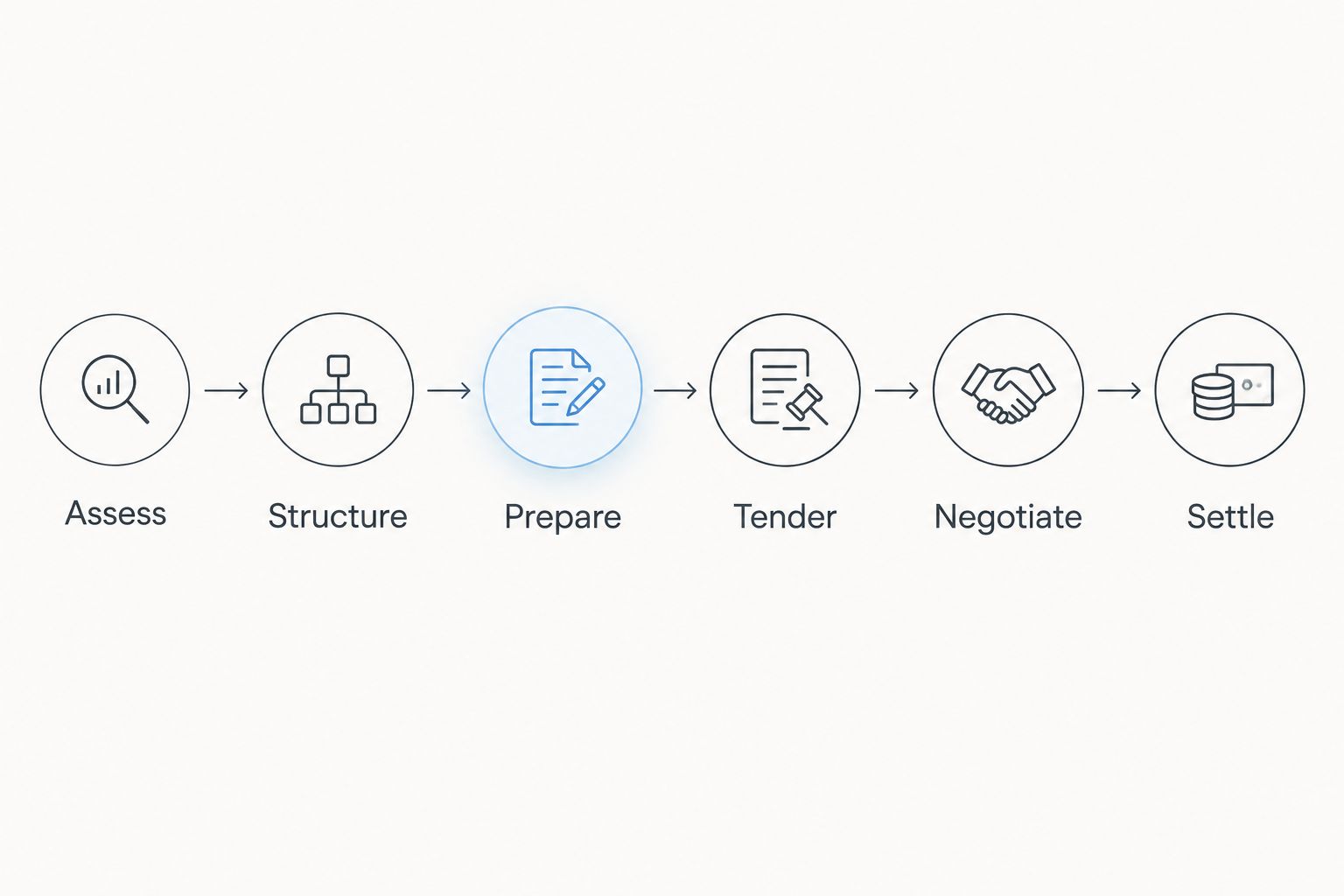
How to prepare a no-pre-sales funding request
Use this sequence to make proposals comparable. It is a preparation framework, not a promise of approval or a statement that every lender follows identical procedures.
- Assess. Define the project, borrowing entities, existing debt, approvals and required funding. Identify whether the immediate need is land settlement, construction or refinancing.
- Structure. Set out the proposed security, equity contributions, construction funding and repayment source. Resolve how the development interacts with existing business banking.
- Prepare. Assemble the feasibility, financial information, valuation material, building documentation and exit evidence. Explain gaps and unresolved conditions directly.
- Tender. Request proposals against the same project scope and assumptions. Ask each lender to specify whether pre-sales are required at any stage.
- Negotiate. Compare conditions, security, guarantees, drawdown requirements and repayment flexibility alongside finance costs. Record agreed changes in the formal documentation.
- Settle. Check conditions precedent, equity requirements and the process for construction claims before committing to settlement arrangements.
A structured banking tender gives you a basis for comparing offers. It does not require you to change lenders: an existing lender's revised proposal belongs in the same comparison if it addresses the funding requirement.
What should you compare in a 2026 lender proposal?
Request written answers before selecting a preferred proposal. A headline approval is less useful than a clear account of when money becomes available and what must happen before each drawdown.
Funding and interest treatment
Confirm whether interest is paid from operating cash or added to the facility under its terms. Where interest is funded within a facility limit, understand how that affects the amount remaining for other project costs.
Ask who monitors expenditure and what evidence accompanies progress claims. The construction cash flow should reflect the actual payment process, not an assumption that the full approved limit is immediately accessible.
Security and guarantees
Identify every property and entity supporting the facility. Check whether existing business assets or guarantees become part of the development funding arrangement.
This matters when reviewing an established banking relationship. Refinancing a development loan without examining linked securities can leave the wider business exposed to conditions the borrower did not intend to retain.
Sales, releases and maturity
Ask how sale proceeds are applied and what must be paid to release individual properties. Do not assume every settlement leaves cash available for distribution.
Check the maturity date against construction completion, marketing and settlement timing. Ask what an extension requires, while treating approval of any future extension as uncertain.
Brokerage and debt advisory scope
Glenclair is an independent commercial finance brokerage with access to a panel of 60+ lenders. Panel size does not mean every lender suits a development without pre-sales; project fit and current credit requirements determine the appropriate shortlist.
Distinguish lender-paid brokerage from debt advisory services. Debt advisory uses a retainer and success-fee structure; confirm the engagement scope, remuneration and any potential conflicts before proceeding.
Can you refinance a development loan without pre-sales?
Refinancing without pre-sales is possible, but the replacement lender must assess the current project and its remaining risks. An existing approval does not establish that another lender will accept the same structure.
Provide the current payout position, facility conditions, construction progress, remaining costs and updated exit evidence. Explain the refinancing objective: approaching maturity, revised project requirements or a review of existing banking arrangements.
For a 2026 refinance, compare the consequences of staying with the existing lender against moving. Include security releases, outstanding conditions and the cash required to complete the transition, rather than judging the proposals on one term alone.
Can you keep the completed properties instead of selling them?
Keeping the completed properties requires a supported repayment plan, usually involving a refinance or another documented source of funds. A construction lender's approval does not establish that a long-term investment lender will approve the completed assets.
Test the proposed holding structure, expected rental income, valuation and debt-servicing position before relying on that exit. Allow for the distinction between a property's expected rent and income a prospective lender will accept in its assessment.
A retention strategy also changes the business decision. You remain exposed to property ownership and ongoing debt rather than receiving the sale proceeds assumed in a sell-down feasibility.
Is no-pre-sales funding suitable for your project?
Best for: an established borrower with a documented feasibility, sufficient equity and a credible exit who needs a lender willing to assess uncontracted sales risk. The benefit is flexibility around when sales are contracted. The drawback is that the borrower retains exposure to sales timing and the terms needed to fund that risk.
It is not a substitute for fixing an incomplete budget or an unsupported exit. If the project only works when every property sells at the forecast value on the forecast date, test those assumptions before seeking funding.
Glenclair's commercial finance work is relevant to established Australian business owners reviewing borrowing requirements above A$2 million. That is a preferred client focus, not a universal eligibility threshold; suitability requires an individual assessment.
Review your development funding structure
Assess the project, existing banking arrangements and repayment strategy before comparing lender proposals.
FAQ
Can I get development finance without pre-sales in Australia?
Yes, some development lenders assess projects without pre-sales. Approval depends on the project, equity, construction arrangements, security and supported repayment strategy.
Do all development lenders require pre-sales?
No, pre-sale requirements differ between lenders and facilities. Confirm whether sales conditions apply at approval, construction drawdown or a later stage.
Does no-pre-sales finance mean I need no deposit?
No, removing a pre-sale requirement does not remove borrower equity requirements. Ask how the lender treats land equity and when cash contributions must be paid.
Can I start building as soon as the loan is approved?
Loan approval does not automatically authorise a construction drawdown. Check the facility's conditions precedent, approvals, equity obligations and progress-payment requirements.
Can I refinance instead of selling the completed development?
Refinancing can provide an exit if the replacement lender accepts the completed property and borrowing structure. Test valuation, income and debt-servicing requirements before relying on that outcome.
Is development finance without pre-sales suitable for a first project?
Suitability depends on the individual project and borrower, not simply whether it is a first development. Relevant capability, professional support, equity and construction arrangements form part of the assessment.
Does Glenclair guarantee development finance approval?
No, Glenclair does not promise finance outcomes. Lenders make their own credit decisions and set the conditions attached to any approval.
One last thing
Ask for a cash-flow schedule that runs beyond construction completion to the actual repayment date. Practical completion does not repay a development loan; settled sales, completed refinancing or another documented funding source does.
Before accepting a 2026 facility, identify who funds the interval between those events. That answer is more useful than an approval described only as no pre-sales required.
Related guides
- Income requirements for commercial property finance
- Equipment finance options for construction businesses
Author: Glenclair Financial team.