
How much does a commercial finance broker cost?

Commercial finance broker cost depends on whether you engage a lender-paid broker or a debt adviser charging a retainer and success fee; there is no single fee that applies to every commercial borrowing. Brokerage remuneration is separate from your loan’s interest, lender fees and transaction expenses. Before you appoint anyone, get the payment arrangement, scope and any borrower-paid obligations in writing.
TL;DR
- Commercial finance broker cost depends on the engagement: distinguish lender-paid brokerage from retainer-and-success-fee debt advisory.
- Glenclair suits established Australian businesses seeking independent commercial finance broking and a review of existing banking arrangements.
- Compare refinancing proposals on total borrowing costs, security and conditions, not brokerage remuneration alone.
- Ask who pays, when payment becomes due and what happens if the finance does not settle.
Why this matters
A broker’s remuneration tells you how the intermediary gets paid. It does not tell you whether the proposed finance suits your business. Your commercial finance services engagement should define both the work being performed and the payment obligations attached to it.
For established Australian businesses reviewing borrowing above A$2 million in 2026, the decision extends beyond the broker’s invoice. You need to assess the banking arrangement: repayment commitments, security, guarantees, reporting obligations and the practical cost of changing lenders. Suitability still requires a case-by-case assessment; that borrowing amount is not a universal eligibility threshold.
How much does a commercial finance broker cost?
Start with the remuneration model, not an assumed standard fee. Lender-paid brokerage and debt advisory are different engagements. Ask which service you are being offered before comparing proposals.
| Engagement | How payment works | Best for | Main limitation to check |
|---|---|---|---|
| Lender-paid brokerage | The lender pays the broker under the applicable remuneration arrangement | Borrowers seeking finance broking with lender-paid remuneration | Lender-paid remuneration does not establish that every part of the engagement is free of borrower charges |
| Debt advisory | The client pays under a retainer and success-fee structure | Borrowers seeking a defined advisory engagement with agreed deliverables | Payment triggers and the meaning of success need to be explicit |
Neither structure proves that a recommendation is suitable. A lender-paid arrangement still needs clear remuneration disclosure. A debt advisory engagement still needs a clear scope and an explanation of what triggers each payment.
When comparing commercial finance broker cost in 2026, request a written engagement proposal before authorising substantive work. Read it alongside the proposed loan terms, not as a substitute for them.
Lender-paid brokerage: check the borrower obligations
Under lender-paid brokerage, the lender remunerates the broker. That describes the source of brokerage payment; it does not describe every expense connected with arranging, documenting or refinancing a loan.
Ask the broker to separate lender remuneration from any amount payable by your business. Do not treat the absence of a broker invoice as evidence that the loan itself has no establishment, valuation, legal or other transaction expenses.
Your written questions should include:
- Who pays the broker? Identify the payer and the remuneration arrangement.
- Does the borrower owe anything separately? Request confirmation of any engagement-specific charges.
- When is remuneration earned? Distinguish approval, acceptance and settlement.
- What happens if the transaction changes? Ask about a different lender, revised structure or withdrawn application.
- What happens after settlement? Clarify whether any ongoing service is included.
The advantage is a payment structure funded by the lender rather than a borrower-funded advisory retainer. The limitation is that payment source alone says nothing about lender coverage, recommendation quality or the obligations in your engagement agreement.
Compare the recommendation and its conditions, not just who pays the broker.
Debt advisory: define the retainer and success fee
Debt advisory uses a retainer and success-fee structure. The engagement agreement should explain what work the retainer covers and the event that makes the success fee payable.
Do not leave success undefined. Ask whether the agreement ties payment to obtaining an offer, accepting terms, signing documents or completing settlement. Those events are not interchangeable, particularly when a conditional offer still requires substantial work.
A useful advisory scope identifies:
- The facilities and borrowing entities included in the review.
- The analysis and documents you will receive.
- The lender engagement and negotiation work included.
- The point at which the assignment is complete.
- The treatment of a postponed, changed or cancelled transaction.
The advantage is an expressly agreed advisory assignment with defined deliverables. The limitation is the need to understand your payment commitments if the transaction changes or does not complete. Agree the scope and payment triggers together. A fee description without a clear scope is not enough to compare engagements.
Why commercial finance broker cost varies
Different engagements involve different work. For a 2026 banking review, establish the assignment before asking whether competing fee proposals cover the same service.
- Remuneration model. Lender-paid brokerage and borrower-funded debt advisory place payment obligations with different parties.
- Scope of the review. Reviewing an existing facility is not the same assignment as reviewing the broader banking relationship.
- Finance purpose. Business loans, equipment finance and property development finance involve different borrowing requirements and documents.
- Refinancing requirements. A refinance review needs to account for the existing facilities as well as the proposed replacement.
- Advisory deliverables. Assessment, structuring, lender engagement, negotiation and settlement support need clear boundaries.
- Completion conditions. The agreement needs to explain the effect of changed instructions, deferred settlement or a transaction that stops.
These are reasons to request a tailored scope, not evidence that a particular fee is reasonable. Compare written proposals against the same brief. If the deliverables differ, resolve that difference before comparing remuneration.
How should you assess a broker’s process?
Use a process-led review to understand what you are buying. Ask each broker to explain the work at every stage and identify where the engagement ends.
- Assess. Establish the borrowing purpose, current facilities, financial position and business constraints. For refinancing, include what you want to change and what you need to preserve.
- Structure. Define the proposed facilities, repayment approach and security requirements. Separate essential requirements from negotiable preferences.
- Prepare. Agree the information needed for lender assessment. Check who prepares the submission and who resolves missing or inconsistent information.
- Tender. Establish which lenders will receive the proposal and why. Ask how the incumbent lender will be considered alongside alternatives.
- Negotiate. Compare written offers across interest, fees, security, guarantees and conditions. Record unresolved differences before selecting an offer.
- Settle. Confirm responsibilities for satisfying conditions and completing the transaction. Check whether post-settlement work sits inside or outside the engagement.
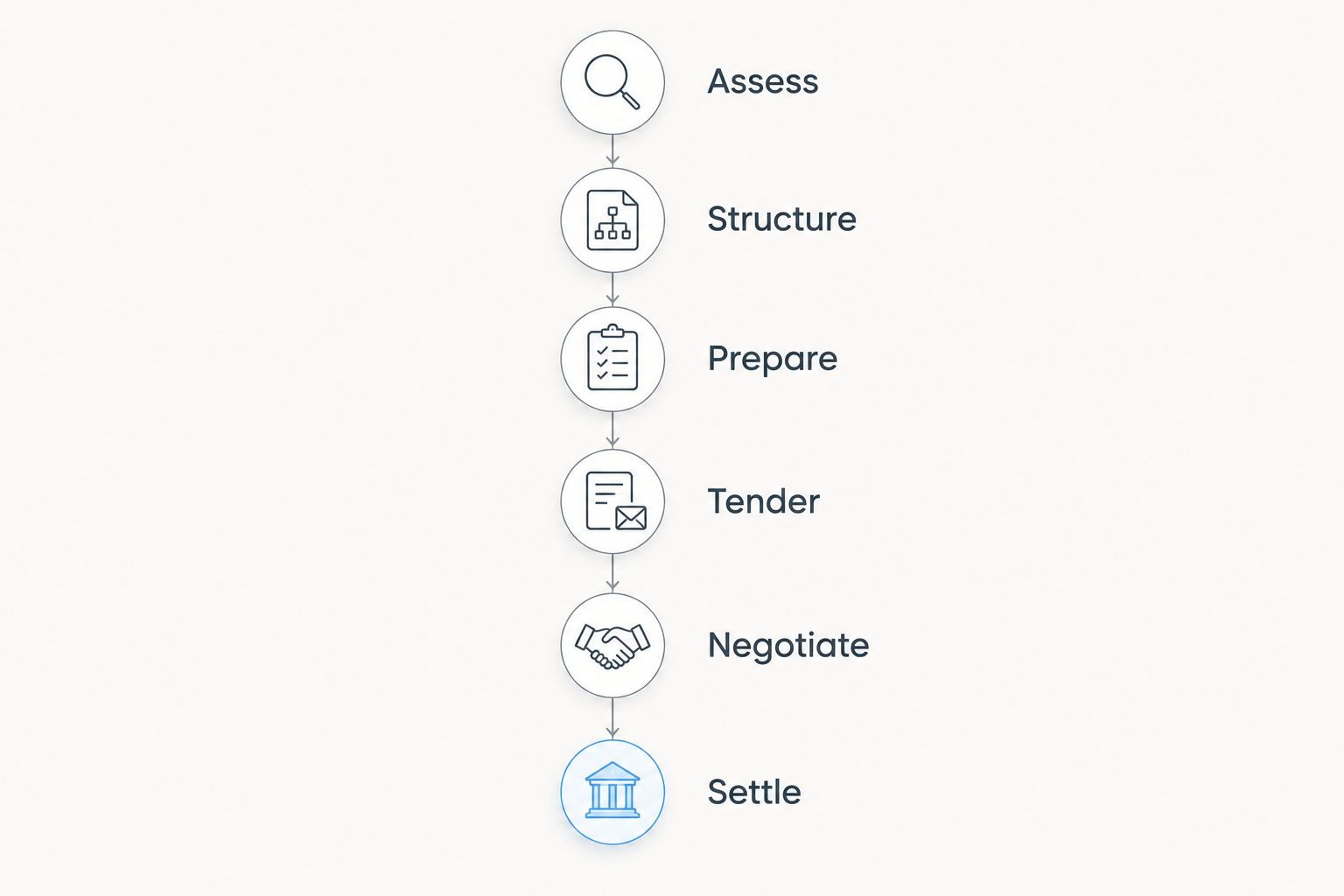
A detailed process gives you something concrete to compare. It does not guarantee lender approval, a particular rate or savings. Ask for the deliverables associated with each stage rather than accepting a list of activities without defined outputs.
What should a refinancing comparison include?
For a 2026 refinance, compare the existing arrangement with the proposed replacement on a consistent basis. A lower interest rate does not, by itself, establish a better overall banking arrangement.
Request a written comparison covering:
- Interest and repayments. Compare the repayment structure and the assumptions behind any borrowing-cost calculation.
- Transaction expenses. Identify applicable establishment, discharge, valuation, legal and documentation expenses.
- Security and guarantees. Record the assets and parties supporting each proposal.
- Conditions and reporting. Compare financial reporting requirements, covenants and other continuing obligations.
- Flexibility. Check how each arrangement treats early repayment, additional borrowing and changes to the business.
- Execution requirements. Identify outstanding conditions and responsibilities before settlement.
Ask the adviser to distinguish confirmed amounts from estimates in any comparison. Do not accept a savings calculation that leaves out relevant switching expenses or assumes that unconfirmed terms are agreed.
The practical question is whether the proposed structure justifies its full cost and obligations. A refinance that changes security or repayment requirements needs that change explained, even when the headline interest terms look attractive.
Where does Glenclair fit?
Glenclair is best suited to established Australian business owners seeking independent commercial finance broking and a review of existing banking arrangements. Its stated service scope includes business loans, refinancing, equipment finance and property development finance through a panel of 60+ lenders.
Glenclair’s focus on business-purpose borrowing above A$2 million is a suitability focus, not a universal eligibility rule. A panel of 60+ lenders provides a stated lender base; it does not mean every lender will suit your transaction or receive your application.
Ask which remuneration model applies to your proposed engagement. Distinguish lender-paid brokerage from debt advisory using a retainer and success-fee structure, then assess the agreed work against your banking objectives. Neither the panel size nor the engagement model promises a finance outcome.
Review your commercial finance requirements
Discuss your existing facilities, refinancing objectives and the scope of a commercial finance review.
Does lender-paid brokerage mean the loan has no fees?
Lender-paid brokerage means the lender pays the broker; it does not mean the loan has no fees. Review lender charges and transaction expenses separately from brokerage remuneration, and ask which amounts your business must pay.
Is debt advisory the same as commercial finance broking?
Debt advisory and commercial finance broking are different engagement models. For the arrangements described here, debt advisory uses a retainer and success fee, while lender-paid brokerage receives remuneration from the lender; the written scope should explain the actual work included.
Should you choose the broker with the lowest borrower charge?
The lowest borrower charge is not enough to establish the most suitable engagement. Compare the scope, remuneration, lender-selection process and proposed finance terms before deciding; an unclear engagement is difficult to assess regardless of its payment model.
FAQ
How much does a commercial finance broker cost in Australia?
Commercial finance broker cost depends on the engagement model and written scope. Distinguish lender-paid brokerage from debt advisory using a retainer and success fee, then check any separate borrower obligations.
Do I pay a commercial finance broker or does the lender?
The lender pays under a lender-paid brokerage arrangement, while the client pays under a debt advisory engagement. Your agreement should identify the applicable model and any separate charges payable by your business.
What should I ask before signing a broker engagement?
Ask who pays, what work is included, when payment becomes due and what happens if the transaction changes or stops. Get those answers in writing before authorising the work.
Is a broker success fee payable only at settlement?
The engagement agreement determines when a success fee becomes payable. Check whether the trigger is an offer, acceptance, documentation or settlement rather than assuming those events have the same treatment.
Will refinancing through a broker save my business money?
Refinancing does not guarantee savings. Compare the existing and proposed arrangements across interest, transaction expenses, security, guarantees and continuing obligations.
Does Glenclair only consider loans above A$2 million?
Borrowing above A$2 million is Glenclair’s preferred client focus, not a universal eligibility rule. Suitability requires a case-by-case assessment of the business-purpose finance requirement.
What documents should I request for a banking review in 2026?
Request a written engagement scope, remuneration disclosure and a comparison of the proposed finance terms. The comparison should distinguish confirmed terms from estimates and identify outstanding conditions.
One last thing
Before signing a 2026 engagement, ask this question: What would my business owe if the finance did not settle? The answer should identify the relevant payment triggers and contractual obligations, not rely on a verbal assurance.
Then ask the same question about the proposed loan: what obligations arise before settlement, and which expenses remain payable if it stops? Keeping the advisory agreement and loan transaction separate makes both easier to assess.
Related guides
- Income requirements for commercial property finance
- Equipment finance options for construction businesses
- Truck finance options for Australian transport fleets
Written by the Glenclair Financial team.