
SMSF trust deed to settlement: commercial property finance workflow

Instead of sending trust deeds, property documents and lender requests back and forth, build one controlled file for your SMSF commercial property loans workflow: confirm the borrowing structure, prepare a consistent lender submission, then clear the legal conditions before settlement. Settle the structure before you commit to the property contract—not after a lender approves the loan.
TL;DR
- SMSF commercial property loans need legal structure checks before an unconditional purchase commitment.
- Glenclair suits established business owners seeking independent commercial finance broking, with borrowing suitability assessed case by case.
- Use one document register for the SMSF trust deed, property evidence, lender conditions and settlement instructions.
- A lender approval does not establish SMSF compliance; trustees need separate legal and tax advice.
Why this matters
An SMSF property purchase brings together separate decisions: whether the fund can make the investment, whether the borrowing arrangement complies, and whether a lender will fund it. Approval of one does not establish the others.
For a 2026 transaction, have your advisers assess the proposed limited recourse borrowing arrangement against the Superannuation Industry (Supervision) Act, including sections 67A and 67B. These provisions govern the borrowing exception; a commercial loan approval is not a substitute for that assessment.
Glenclair's commercial finance services cover independent broking through a panel of 60+ lenders. That panel size does not establish how many lenders will accept a particular SMSF transaction. This workflow is written for established business owners, particularly those reviewing business-purpose borrowing above A$2 million; suitability remains case by case.
Before you start
- Appoint the right advisers. Identify the SMSF trustee decision-maker, accountant or SMSF adviser, property solicitor and finance broker. Give each adviser authority to receive the relevant documents. Keep investment advice, legal advice and credit assessment separate.
- Gather the source documents. Collect the executed SMSF deed and amendments, trustee details, financial statements, investment strategy, fund balances, proposed contract, lease and available property records. For refinancing, add the existing facility and holding-trust documents.
- Resolve the purchaser-name trap before signing. The SMSF trustee, holding trustee and contract purchaser are not interchangeable descriptions. Ask your solicitor to confirm the required entities, execution order and purchaser wording under the relevant state's rules before you sign or pay a deposit.
Do not use this checklist to select an investment. It organises a proposed transaction after you have engaged the advisers responsible for assessing its suitability and compliance.
Set up the trustee and property file
Assess
- Create a shared document register. Use your own column labels: Document, Entity, Version date, Owner, Status and Next action. These are suggested spreadsheet labels, not settings in a particular application.
- Upload the executed deed and every amendment. Match trustee names against identification and company records. Record discrepancies instead of editing a signed document.
- Ask the relevant advisers to assess the deed's borrowing powers, trustee authority and proposed investment against the fund's strategy. Request written advice identifying unresolved issues.
- Record the property purpose, seller relationship, tenant relationship and intended use. Include any proposed owner occupation, works or subdivision so advisers assess the actual transaction.
Expected result: one identifiable set of entities, one current document file and a written list of matters requiring advice.
Structure
- Have the solicitor document the proposed SMSF trustee, borrower, holding trustee, legal owner and beneficial ownership arrangements. Do not assume the same entity fills every role.
- Confirm whether the proposal meets the single acquirable asset requirement. Multiple titles, separately transferable interests and proposed changes to the property need specific assessment.
- Ask the accountant and solicitor to review related-party issues. Business real property has specific exceptions under superannuation law; a commercial address alone does not establish that an exception applies.
- Agree on the contract and trust-document sequence before execution. Add the solicitor's requirements to the register and share them with the broker.
Expected result: a documented structure that the legal adviser can carry into contract preparation and the broker can present consistently to lenders.
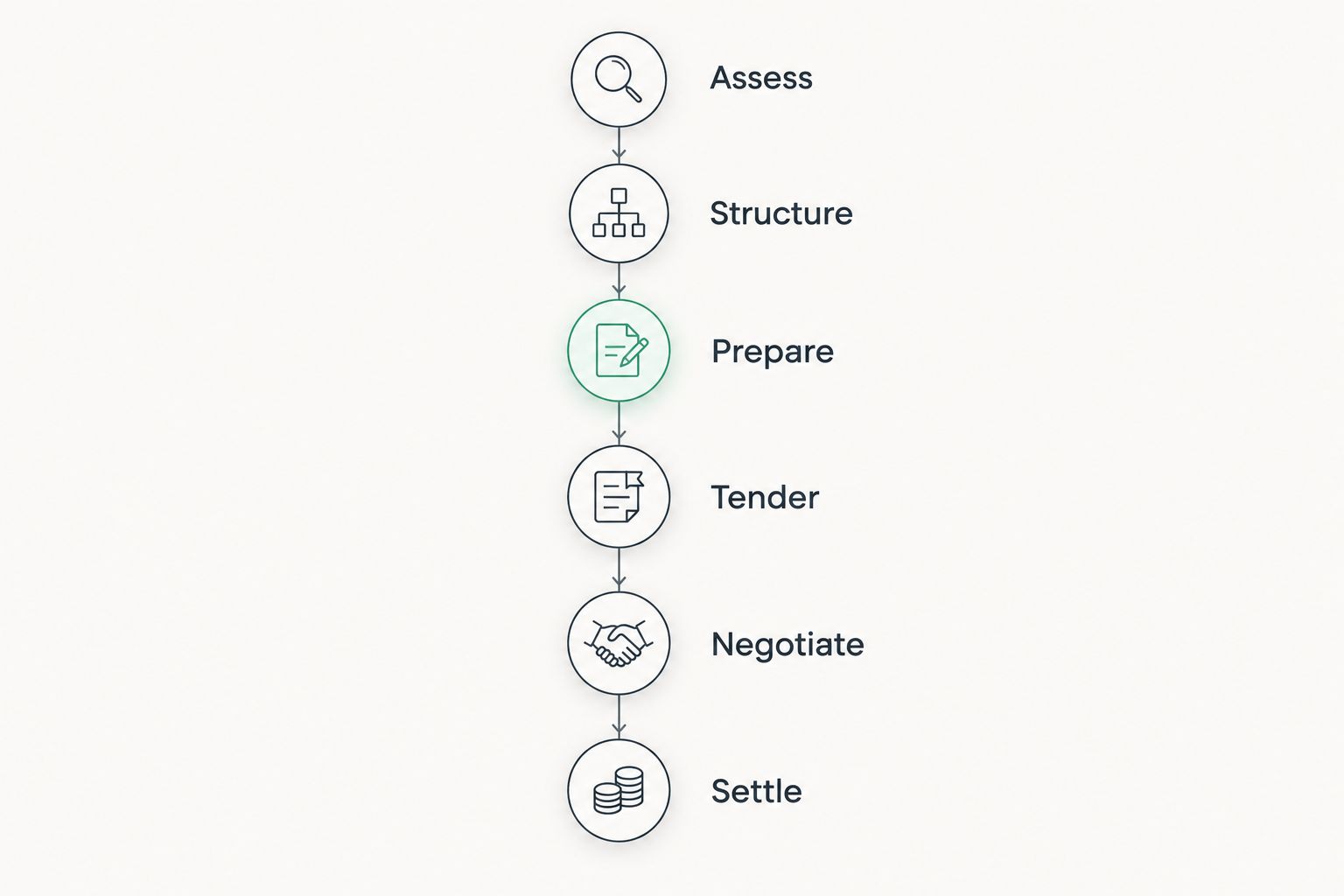
The working sequence for a 2026 file is Assess, Structure, Prepare, Tender, Negotiate, Settle. Each stage closes a different risk. Moving straight to lender selection leaves structural questions inside the settlement timetable.
Prepare the lender submission
Prepare
- Build a financial pack using the documents the proposed lenders request. Separate fund assets, existing liabilities, rental income, expenses and proposed contributions. Identify estimates rather than presenting them as received income.
- Assemble the property evidence: contract or draft contract, title information, lease, tenancy details and available outgoings records. Flag lease expiries, incentives, arrears or vacant space where relevant.
- Reconcile names and amounts across the contract, lease, financial statements and application. Explain differences in a covering schedule. Do not make lenders reconstruct the transaction from inconsistent attachments.
- Create a funding schedule covering the purchase, transaction costs, available fund cash and proposed borrowing. Have the accountant assess the fund's liquidity after settlement and its ability to meet ongoing obligations.
- Record proposed works separately. Under an LRBA, borrowed money can fund permitted repairs and maintenance, but not improvements. Have advisers classify the actual work and assess any change to the asset before including it in the proposal.
Expected result: a submission that explains the borrower, asset, repayment sources and remaining questions without concealing assumptions.
For a 2026 review, use financial and tenancy information relevant to the application date. An older lease summary does not establish today's rental position. Keep original documents alongside the summary so each adviser can check the underlying evidence.
Configure the tender and approval register
Tender
- Agree with the broker which lenders will receive the submission and why. Ask which accept the proposed SMSF structure, property type and tenancy arrangement before authorising applications.
- Issue a consistent transaction brief. Record changes and circulate material corrections to every participating lender so responses remain comparable.
- Compare written responses in one register. Include borrower entity, security, guarantees, loan term, repayment basis, covenants, valuation requirements and conditions precedent.
- Mark each response as indicative, conditional or formally documented according to the lender's wording. Do not turn an indicative discussion into an approval in your internal notes.
Expected result: a comparable set of lender positions, with exclusions and outstanding conditions visible.
Negotiate
- Identify which terms affect the fund's actual plans. These include repayment requirements, refinancing flexibility, guarantee scope, reporting obligations and treatment of proposed works.
- Ask the broker to clarify ambiguous conditions in writing. Have your solicitor assess the security and recourse provisions rather than relying on a verbal explanation.
- Record who must satisfy each condition, what evidence is required and who confirms acceptance. Keep a separate entry for valuation, insurance, legal documentation and funds to complete.
- Confirm the engagement and remuneration arrangements. Glenclair distinguishes lender-paid brokerage from debt advisory services, which use a retainer and success-fee structure. Establish which service applies before proceeding.
Expected result: a selected facility with understood obligations and a condition register that assigns responsibility.
A banking tender compares lender terms; it does not validate the SMSF investment. Keep the trustee's investment decision and professional advice separate from the credit comparison.
Complete the settlement controls
Settle
- Have the solicitor reconcile the loan documents, holding-trust documents and purchase contract. Confirm that entity names and execution capacities match the approved structure.
- Obtain written confirmation that lender conditions have been accepted. An uploaded document is not the same as an accepted condition.
- Confirm funds to complete, deposit treatment, insurance requirements and settlement instructions through the responsible professionals. Independently verify changed payment instructions using a trusted contact method.
- Obtain the settlement statement and executed documents. Store these with the final approval, adviser correspondence and trustee resolutions relevant to the transaction.
- Assign responsibility for post-settlement records, including lease administration, lender reporting and information required by the fund's accountant and auditor.
Expected result: a completed transaction file, not merely confirmation that funds moved.
Before a 2026 settlement, ask each professional to identify what remains outside their scope. This exposes gaps between credit approval, conveyancing, tax advice and ongoing SMSF administration while there is still time to address them.
Variant: review or refinance an existing SMSF property loan
For refinancing, start with the existing arrangement rather than rebuilding the purchase workflow from scratch. A refinance can fall within the LRBA rules, but the replacement borrowing and associated changes still require assessment.
Add the existing loan agreement, security documents, holding-trust deed, current balance, repayment history and lease to the register. Ask the solicitor whether the proposed transaction changes trustees, security, ownership or recourse. Do not combine a refinance with additional borrowing for improvements without specific advice.
| Workflow | Best for | Advantage | Limitation |
|---|---|---|---|
| Purchase workflow | Trustees assessing a proposed property acquisition | Resolves contract and structure questions before commitment | Finance approval does not establish investment suitability |
| Refinance workflow | Trustees reviewing an existing compliant arrangement | Focuses the lender comparison on current obligations and proposed changes | Existing documents still need legal review |
For either workflow, compare written terms against the fund's needs. Do not treat a different lender as a reason to skip the structure review.
Troubleshooting
The contract uses an unexpected purchaser name
Stop further execution and refer the contract to the solicitor. Do not replace a name yourself or assume a nomination will resolve the issue. The remedy depends on the documents and applicable state rules.
The lender requests documents already supplied
Check whether the request concerns a different entity, an unsigned copy or a superseded version. Return the exact document with its register reference and ask the lender to confirm acceptance. Repeatedly forwarding the entire folder obscures the issue.
The lease income does not support the application
Reconcile the executed lease, actual receipts, incentives, vacancy and outgoings. Ask the lender which income evidence and assessment assumptions it uses. Do not increase forecast rent simply to make the borrowing request fit.
Proposed renovations change during the application
Pause the funding assessment and send the revised scope to the legal and tax advisers. Repairs, improvements and changes to the asset raise different LRBA questions. A contractor's description does not settle their legal treatment.
Approval arrives but settlement cannot proceed
Compare the approval conditions against the solicitor's settlement requirements. Find the specific unresolved item: execution, valuation, insurance, funds or another condition. Assign an owner and obtain written clearance rather than relying on an anticipated settlement date.
Customise your workflow
Use the same register for a broader banking review, but keep SMSF obligations separate from the operating business's facilities. Record guarantees and security connections for professional assessment rather than assuming a business refinance automatically changes the fund's borrowing.
Glenclair commercial finance broking is relevant to business owners seeking an independent review of borrowing arrangements. Its panel provides a lender-selection process, not a promise of approval or a substitute for SMSF advice. For an SMSF proposal, establish the broker's transaction scope and the lenders prepared to consider it.
For a 2026 review, nominate a register owner and require every material change to show its source, decision-maker and next action. That keeps the workflow usable when the property, lease or proposed facility changes.
FAQ
What should I do first for an SMSF commercial property loan?
Have your advisers confirm the proposed investment and borrowing structure before making an unconditional purchase commitment. The contract purchaser wording and document sequence need legal attention before signing.
Does lender approval mean my SMSF property purchase complies?
No. Lender approval addresses the lender's credit requirements, not every obligation under superannuation, tax and property law. Trustees need advice on those separate obligations.
Can my business lease commercial property owned by my SMSF?
A related-party lease can be permitted where the property qualifies as business real property and the arrangement meets the applicable rules. Have your advisers assess the property, lease and arm's-length terms rather than assuming all commercial premises qualify.
Can an SMSF property loan fund improvements?
Borrowed money under an LRBA cannot fund improvements. Repairs and maintenance have different treatment, and changes to the asset can raise additional issues, so obtain advice on the actual scope of works.
Can I refinance an existing SMSF commercial property loan?
Refinancing can be permitted within the LRBA rules. Have the existing arrangement and replacement terms reviewed, including any proposed changes to trustees, security or borrowing purpose.
Does Glenclair's lender panel mean every lender offers SMSF loans?
No. The stated panel of 60+ lenders covers commercial finance generally; it does not establish SMSF participation by every lender. Ask which lenders will consider your specific structure and property.
One last thing
The most useful settlement question is not whether the loan is approved. It is who has accepted each remaining condition. Keep lender acceptance, legal clearance and trustee decisions as separate entries. One completed column must not conceal an unresolved obligation elsewhere.
This guide provides general information, not personal financial, legal or tax advice. Obtain advice on your fund, proposed property and borrowing arrangement before acting.
Related guides
Author: Glenclair Financial team.