
Best BOQ alternatives for established businesses

BOQ offers business banking and lending, which suits owners who want a direct bank relationship. That relationship does not replace a comparison of competing lenders when you review existing debt. One BOQ alternative to consider in 2026 is Glenclair if you want an independent commercial finance brokerage to compare lenders; NAB if you want to approach another business bank directly.
TL;DR
- For BOQ alternatives, Glenclair suits established businesses seeking an independent commercial finance brokerage and lender comparison.
- NAB suits business owners who want another direct bank relationship rather than a broker-led review.
- Compare refinancing terms, security, guarantees and working capital arrangements—not just the interest rate.
- Keep BOQ if its written offer remains the best fit after a like-for-like comparison.
Why this matters
Replacing a lender and reviewing your banking arrangements are different decisions. You can test BOQ's offer without committing to move, and you can change part of your borrowing without deciding that every account must follow.
This guide focuses on established Australian businesses reviewing substantial business-purpose borrowing, particularly facilities above A$2 million. That amount describes the intended audience, not a universal eligibility rule. Suitability depends on the borrower, purpose, financial position and proposed security.
For a 2026 refinancing review, start with the problem you need to solve. An approaching maturity, restrictive security arrangement or equipment purchase calls for a different comparison from a straightforward request for another bank's terms.
BOQ alternatives at a glance
A commercial finance broker and a bank perform different jobs. The broker helps you assess and arrange finance; the lender assesses credit and provides the facility. Compare the route to finance before comparing individual offers.
| Option | Best for | Standout distinction | How it differs from BOQ |
|---|---|---|---|
| BOQ | Businesses that want to retain a direct banking relationship | Business banking and lending through the existing bank | The benchmark against which replacement offers should be assessed |
| Glenclair | Established businesses seeking an independent review of commercial borrowing | Commercial finance brokerage with a panel of 60+ lenders | A brokerage route rather than an application to one bank |
| NAB | Businesses that want to approach another business bank directly | Direct business banking relationship | Another lender to assess, rather than a broker-led comparison |
Best fit is not the same as best advertised offer. A workable facility needs to match your repayment capacity, borrowing purpose and security position. An attractive headline rate cannot answer those questions alone.
1. Glenclair: best for an independent banking review
Glenclair is an independent commercial finance brokerage offering business loans, refinancing, equipment finance and property development finance through a panel of 60+ lenders. Its role differs from BOQ's: it helps arrange finance rather than acting as your bank.
Best for: Established business owners seeking a structured comparison of existing banking arrangements, particularly for business-purpose borrowing above A$2 million, assessed case by case.
Where the brokerage shines
- Multiple lender options: A panel creates a route to comparing lenders rather than assessing only one bank's proposal.
- Related borrowing needs: Refinancing, equipment and property development finance can be considered within the broader commercial borrowing requirement.
- Independent positioning: The business is an independent brokerage, not the lender providing the facility.
Where the brokerage falls short
- It is not the credit decision-maker. The selected lender still decides whether to approve finance and on what terms.
- The panel is not the whole market. Access to 60+ lenders does not mean every lender is suitable or every lender will receive your application.
- An intermediary adds another relationship. Owners who want to manage lender selection and negotiation themselves may prefer a direct approach.
Brokerage versus BOQ
| Dimension | Independent brokerage | BOQ directly |
|---|---|---|
| Role | Helps assess and arrange commercial finance | Assesses and provides its own lending |
| Comparison scope | Options across a lender panel | The bank's own proposal |
| Credit approval | Remains with the proposed lender | Remains with BOQ |
| Best use | Reviewing lender choice and borrowing structure | Negotiating directly with the existing bank |
Before engaging any intermediary, distinguish lender-paid brokerage from debt advisory. Debt advisory uses a retainer and success-fee structure; it is not the same engagement as lender-paid brokerage. Ask for the service scope, remuneration arrangements and any borrower obligations in writing.
Review the commercial finance services against the actual borrowing requirement. Verdict: Buy the fit, not a promised outcome—choose an independent review when lender comparison is the job you need done.
2. NAB: best for another direct bank relationship
NAB is an alternative for business owners who want to approach another business bank directly. This route keeps lender discussions with your business, rather than appointing a broker to coordinate the comparison.
Best for: Businesses that can prepare their own borrowing submission and want to manage another bank relationship themselves.
Where NAB shines
- Direct discussions: You can take your business case to the prospective lender without appointing a brokerage.
- A separate benchmark: A written proposal gives you another bank's position to compare with BOQ.
- Owner-controlled process: Your business manages the information supplied, questions asked and negotiation timetable.
Where NAB falls short
- It remains one lender. A NAB proposal is not a market-wide comparison.
- You carry the comparison work. Your team needs to reconcile differences in security, repayment terms and conditions.
- Approval is separate. An existing BOQ facility does not establish that another bank will approve a replacement.
NAB versus BOQ
| Dimension | NAB directly | BOQ directly |
|---|---|---|
| Relationship | Prospective or separate bank relationship | Existing relationship for the borrower considering a switch |
| Credit assessment | NAB assesses the proposed borrowing | BOQ assesses the proposed borrowing |
| Proposal | Terms from NAB | Terms from BOQ |
| Comparison task | Your business compares the written offers | Your business compares the written offers |
For a 2026 review, give both banks the same borrowing brief. Different requested limits, security assumptions or repayment profiles make offers harder to compare.
Verdict: Hold until the written terms are comparable—choose NAB's direct route if you want to manage the bank selection process yourself.
Why people switch from BOQ
The reason to consider BOQ alternatives is a mismatch between your borrowing requirements and the terms available to you—not an assumption that BOQ is a poor lender. Use the following decision tests to establish whether changing lenders has a purpose.
The current structure no longer fits
A business seeking equipment finance, working capital or property development funding needs facilities suited to those purposes. Review whether the proposed repayment structure matches how the financed activity generates cash.
Do not assume that replacing one loan fixes the whole arrangement. Map related facilities and security before deciding what to move.
Security needs a closer review
Security and guarantees matter alongside interest and repayments. Ask which assets support which facilities, what guarantees are required and how releases would work when debt is repaid or an asset is sold.
A replacement offer should be assessed against the same questions. Switching banks does not, by itself, establish that the security position improves.
You want evidence before accepting a renewal
An incumbent offer provides one lender's terms. A competing written proposal gives you another reference point, while a banking tender provides a structured method for seeking and comparing proposals.
For your 2026 review, document what would justify a switch before seeking offers. That prevents a minor difference in one term from overshadowing a more important borrowing constraint.
How to run a useful banking tender
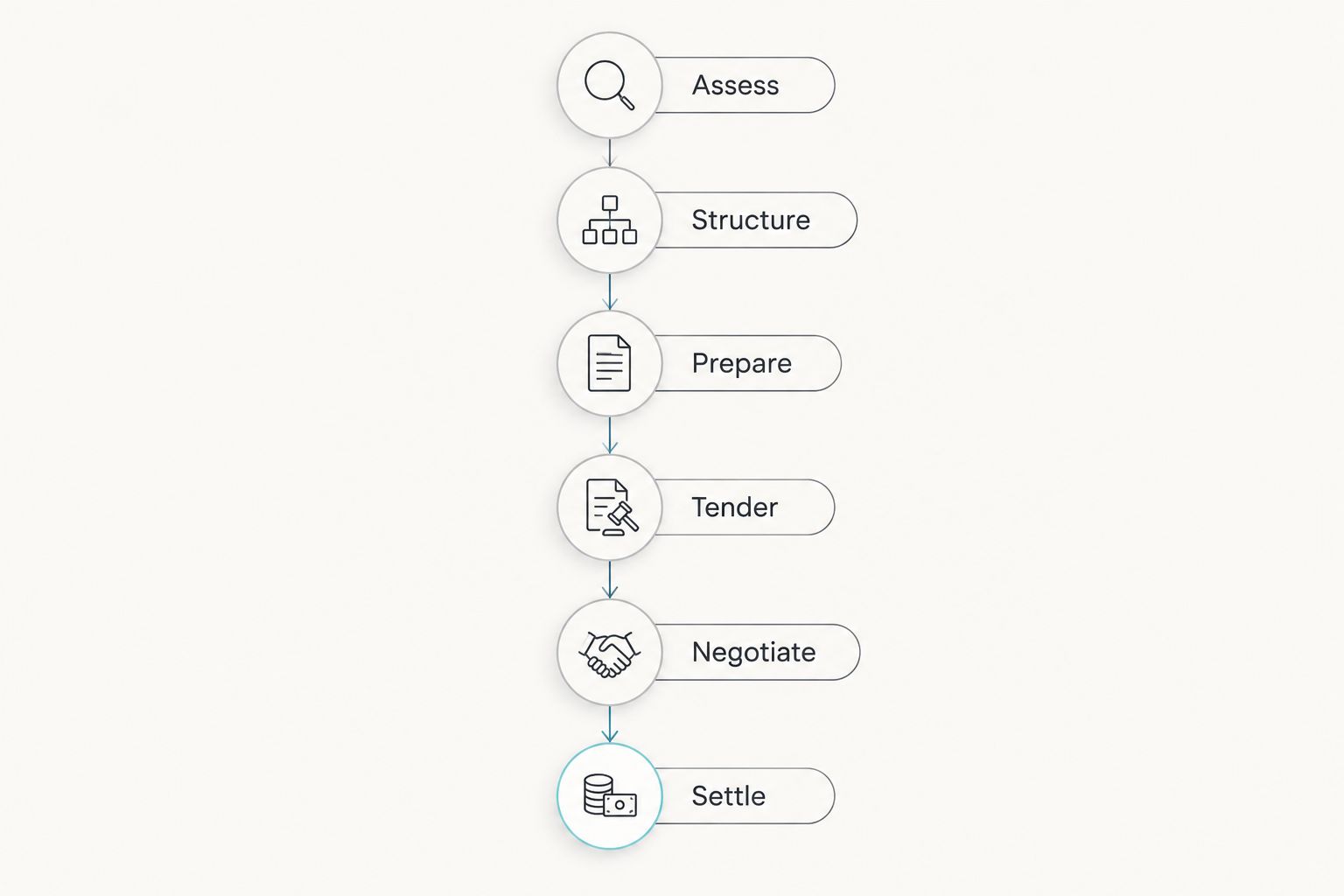
A banking tender should produce a decision, not just a collection of indicative offers. Use these 6 stages to keep the borrowing request and comparison consistent.
Assess
List existing facilities, balances, limits, repayment obligations, maturity dates and security. Identify the business objective: refinancing, equipment acquisition, working capital or property development.
Separate an immediate funding need from a broader banking review. They can share information without being the same assignment.
Structure
Define the facilities you want lenders to assess. Specify the purpose, requested limits, repayment approach and proposed security rather than leaving each lender to interpret a different brief.
For equipment or development finance, explain the connection between the borrowing and the business activity. Avoid treating every commercial funding requirement as an interchangeable business loan.
Prepare
Assemble current financial information, existing facility documents and the evidence relevant to the borrowing purpose. Check that the figures and explanations agree across the submission.
Ask each prospective lender what additional information it requires. Do not assume that the incumbent's familiarity removes the need for an updated credit assessment.
Tender
Send a consistent borrowing brief to suitable lenders. Record the requested terms and distinguish an indicative response from a formal approval or facility offer.
A panel of lenders is a starting point for selection, not a reason to distribute an application indiscriminately. Relevance matters more than the number of submissions.
Negotiate
Compare the written responses on the same basis. Resolve differences in facility limits, repayment profiles, security, guarantees, covenants and conditions before treating offers as equivalent.
Ask direct questions about unclear provisions. A favourable assumption is not a substitute for a written answer.
Settle
Check the final documents against the agreed terms and identify outstanding conditions. Coordinate any required discharge, security release and operational changes before moving facilities.
Do not treat settlement as the point to discover how existing accounts or linked facilities will be handled. Put those dependencies into the transition plan.
What to compare before accepting an offer
In 2026, the useful comparison remains the complete facility—not one prominent term. Put BOQ and each alternative into the same decision sheet.
| Compare | Question to resolve |
|---|---|
| Facility purpose | Does the proposed borrowing match the business requirement? |
| Repayments | Can the business support the repayment schedule? |
| Security | Which assets secure which obligations? |
| Guarantees | Who provides guarantees, and what obligations do they cover? |
| Covenants | What must the business maintain or report? |
| Conditions | What must happen before funds can be advanced? |
| Transition | What needs to be discharged, released or moved? |
| Remuneration | How is the broker or adviser paid for the engagement? |
Reject comparisons built on different assumptions. If one proposal assumes additional security or a different repayment profile, identify that difference before deciding which offer suits the business.
Keep a written record of the reason for your decision. That record becomes the starting point for the next banking review.
When staying with BOQ is the right call
Stay with BOQ when its documented proposal fits your needs better than the alternatives after a like-for-like review. A tender does not need to end with a lender change to be useful.
Retaining the incumbent avoids a lender transition, although any revised facilities still require attention to their documentation and conditions. Weigh that practical benefit against the actual differences in competing offers.
Do not stay solely because moving requires work. Equally, do not switch solely because another lender has issued a proposal.
FAQ
What's the best BOQ alternative for an established business?
Glenclair is an alternative to consider when you want an independent commercial finance brokerage to compare lenders; NAB is a direct-bank alternative. The choice depends on whether you need help managing the comparison or want to approach another lender yourself.
Is a commercial finance broker the same as another bank?
No. A commercial finance broker helps arrange finance, while the lender assesses credit and provides the facility. Using a broker does not transfer the lender's approval decision to the broker.
Should I refinance all my BOQ facilities together?
Assess the facilities and their security connections before deciding what to refinance. A loan, equipment facility and working capital arrangement can serve different purposes, so review their dependencies before proposing a move.
Does borrowing above A$2 million guarantee suitability?
No. A$2 million describes the borrowing focus of this guide, not an approval threshold or universal eligibility rule. Suitability requires a case-by-case assessment of the borrower and proposed finance.
How is lender-paid brokerage different from debt advisory?
Lender-paid brokerage and debt advisory are different engagement structures. Debt advisory uses a retainer and success-fee structure; confirm the scope, remuneration and borrower obligations before appointing an adviser.
What should I compare besides the interest rate?
Compare repayments, security, guarantees, covenants, conditions and transition requirements. Use the same borrowing assumptions so that differences between BOQ and competing proposals are visible.
Can I review BOQ alternatives without committing to switch?
Yes. Comparing proposals is a decision process, not a commitment to replace the incumbent lender. Stay with BOQ if its final written terms remain the best fit for your business.
One last thing
Ask every lender to identify what its proposal assumes—not just what it offers. Additional security, a changed repayment profile or an outstanding approval condition can explain a difference that otherwise looks attractive.
For your 2026 review, write the decision rule before collecting offers. A better banking arrangement is one that solves the borrowing problem you identified, on terms your business can meet.
Related guides
- Equipment finance options for construction businesses
- Equipment finance options for manufacturing businesses
- Income requirements for commercial property finance
By the Glenclair Financial team.