
Best commercial property finance for industrial warehouses in 2026

Best for reviewing existing warehouse debt: a Glenclair banking tender. Best for buying your operating premises: owner-occupied commercial lending. Best for a tenanted investment: investment property lending. This 2026 guide compares commercial property finance for industrial warehouses by borrowing purpose, repayment source, security and exit strategy.
TL;DR
- Glenclair suits established businesses reviewing commercial property finance for industrial warehouses, particularly business-purpose borrowing above A$2 million.
- Owner-occupied warehouse loans depend on business cash flow; investment warehouse loans also require scrutiny of lease income.
- Development finance funds construction, while bridging finance requires a defined repayment exit.
- Compare security, covenants, fees and repayment terms before choosing warehouse refinancing or a new facility.
Why this matters
A warehouse purchase, refinance and redevelopment are different credit decisions. Choosing a facility before defining the purpose leaves you comparing offers that solve different problems.
For established Australian businesses considering borrowing above A$2 million, the warehouse also sits within a wider banking relationship. Property security, equipment facilities, working capital and guarantees need to be assessed together. That preferred borrowing size is a focus for this guide, not a universal eligibility rule.
Glenclair is best suited to established Australian business owners seeking a structured review of existing commercial property borrowing. Its independent brokerage draws on a panel of 60+ lenders; suitability still depends on your circumstances and the proposed transaction.
What makes the best warehouse finance in 2026?
Judge each proposal against these criteria before comparing lender names:
- Purpose fit: The facility must match an acquisition, refinance, investment holding, construction project or temporary funding gap.
- Repayment capacity: Identify whether repayments come from trading cash flow, rent, a property sale or another documented source.
- Security scope: Compare the property mortgage, guarantees, additional security and links to other business facilities.
- Operating flexibility: Check repayment requirements, covenants, reporting obligations and conditions affecting future borrowing.
- Total commitment: Read fees, expiry dates, review provisions and discharge conditions alongside the interest terms.
- Execution requirements: Identify valuation, lease, financial reporting and legal requirements before committing to transaction dates.
The best structure is the one your business can service and manage throughout its intended holding period. A headline interest rate does not answer that question.
Warehouse finance options at a glance
These 5 approaches serve different needs. A banking tender is a selection process; the other entries are facility types that process can assess. The ranking follows the decision an established warehouse borrower faces, rather than claiming one loan suits every property.
| Approach | Best for | Standout feature | Key limitation |
|---|---|---|---|
| Glenclair-led banking tender | Reviewing existing warehouse debt | Structured assessment and comparison across a lender panel | A tender does not guarantee approval or improved terms |
| Owner-occupied commercial loan | Buying premises for your operating business | Assesses property ownership alongside business repayment capacity | Property ownership ties capital and debt obligations to the business |
| Investment property loan | Holding a warehouse for rental income | Examines the lease and property income supporting the debt | Tenant departure or lease expiry can weaken repayment capacity |
| Property development facility | Building or substantially redeveloping a warehouse | Funding structure reflects construction milestones | Requires project documentation and management of completion risk |
| Bridging finance | Managing a defined purchase or refinance timing gap | Temporary funding linked to a documented exit | An uncertain exit makes the structure unsuitable |
1. Glenclair-led banking tender: best for refinancing reviews
A banking tender starts with the borrowing problem, not an application to a single lender. Glenclair's process follows Assess, Structure, Prepare, Tender, Negotiate and Settle, giving you a way to compare the existing arrangement with alternative proposals.
For warehouse refinancing in 2026, the review should cover the whole facility package. Ask whether the mortgage supports other debt, whether guarantees remain appropriate and whether current covenants suit how the business now operates. The commercial finance services provide the starting point for that discussion.
Glenclair-led banking tender pros:
- Brings the existing lender's proposal into the comparison.
- Creates a structured opportunity to assess security and facility terms together.
- Provides access to a panel of 60+ lenders, without implying every lender suits the transaction.
Glenclair-led banking tender cons:
- Requires current financial records and clear information about existing debt.
- Changing lenders involves legal, valuation and settlement requirements.
- A lender panel does not guarantee an acceptable offer.
Best for: Established businesses reviewing warehouse debt, particularly business-purpose borrowing above A$2 million, assessed case by case.
Verdict: Buy the process, not a promised outcome. Start with a structured review before deciding whether to refinance.
2. Owner-occupied loans: best for buying operating premises
An owner-occupied commercial loan supports a warehouse your business uses. The credit assessment considers the premises and the trading business that must meet repayments.
Separate the property decision from the funding decision. A suitable building can still create an unsuitable debt commitment if repayments restrict inventory purchases, payroll or other operating needs.
Owner-occupied loan pros:
- Aligns the borrowing purpose with a long-term operating asset.
- Lets you assess ownership against the business's expected use of the premises.
- Creates an opportunity to review property debt alongside existing business facilities.
Owner-occupied loan cons:
- Commits business resources to property ownership rather than other uses.
- A business downturn can affect the same cash flow servicing the property debt.
- Security conditions can affect future funding choices.
Best for: Established businesses buying a warehouse they intend to occupy and can service from trading cash flow.
Verdict: Buy only after testing repayments against operating cash needs. Do not treat the property valuation as a substitute for repayment capacity.
3. Investment loans: best for tenanted warehouse holdings
Investment warehouse lending assesses property held for rental income. Lease terms, tenant obligations, property outgoings and the borrower's financial position all belong in the assessment.
For a 2026 acquisition or refinance, compare the lease timetable with the proposed facility timetable. A lease expiry close to a loan review creates a different risk from a continuing lease with the same current rent.
Investment warehouse loan pros:
- Links the funding assessment to an identifiable rental income source.
- Encourages close examination of the lease before purchase or refinance.
- Supports comparison of repayment terms against the intended holding strategy.
Investment warehouse loan cons:
- Vacancy interrupts rental income while debt obligations continue.
- Tenant obligations and landlord expenses require careful reading.
- Reletting or property works can require additional cash.
Best for: Borrowers purchasing or refinancing a warehouse held for rental income.
Verdict: Buy on sustainable property cash flow, not advertised rent alone. Read the executed lease and account for expenses the owner retains.
4. Development facilities: best for warehouse construction
A development facility funds construction or substantial redevelopment rather than simply holding a completed warehouse. The lender assesses the project, construction arrangements, borrower contribution and intended repayment exit.
The exit matters from the outset. Selling the completed property and retaining it under longer-term investment or owner-occupied debt require different preparation.
Development facility pros:
- Matches funding assessment to a construction project.
- Provides a framework for staged funding and project reporting.
- Brings construction and exit assumptions into the credit discussion early.
Development facility cons:
- Requires more project documentation than a completed-property transaction.
- Delays and variations can change the funding requirement.
- Completion does not itself establish eligibility for a replacement loan.
Best for: Experienced commercial borrowers undertaking a defined warehouse construction or redevelopment project.
Verdict: Hold until the construction budget and exit are documented. Include contingencies and approval requirements before treating the project as funded.
5. Bridging finance: best for a defined timing gap
Bridging finance addresses a temporary gap between a funding requirement and an identifiable repayment event. It is not a substitute for a sustainable long-term loan.
For a warehouse transaction, the central question is what repays the bridge. A planned sale or replacement facility needs supporting evidence, timing and an alternative response if the expected event is delayed.
Bridging finance pros:
- Separates a temporary timing problem from the long-term funding need.
- Focuses the assessment on a specific repayment event.
- Supports a transaction plan where settlement dates do not align.
Bridging finance cons:
- An uncertain sale or refinance weakens the exit.
- Delays can extend exposure beyond the original plan.
- The replacement lender's requirements still need to be satisfied.
Best for: Borrowers with a genuine timing mismatch and a documented repayment exit.
Verdict: Skip without an evidenced exit. A deadline to complete a purchase is not a repayment strategy.
How these approaches were ranked
The ranking uses purpose fit, repayment capacity, security scope, operating flexibility, total commitment and execution requirements. It prioritises an existing-debt review because this guide addresses established businesses considering warehouse refinancing as well as acquisitions.
It is not a lender league table or an assessment of individual credit offers. Owner-occupied, investment, development and bridging facilities each occupy a distinct use case; moving between them changes what the lender needs to assess.
Run a warehouse banking tender in 6 stages
A useful 2026 tender gives lenders a consistent borrowing proposal. Comparing responses becomes harder when each lender receives a different transaction description or financial picture.
Assess
Document existing facilities, repayment obligations, security, guarantees and expiry dates. Identify why the arrangement needs review: the business, property use or funding requirement must drive the brief.
Structure
Define the borrower, property owner, repayment source and required facilities with your advisers. Separate warehouse debt from equipment and working capital needs where appropriate, rather than assuming one facility should fund everything.
Prepare
Assemble financial statements, current management accounts, existing facility documents and property information. Include executed leases for investment premises and project information for development transactions.
Tender
Present a consistent proposal to suitable lenders. Ask for comparable responses covering the requested structure, security, conditions and information still required.
Negotiate
Compare the whole proposal, including guarantees, covenants, reporting and discharge requirements. Resolve material differences before choosing a preferred offer.
Settle
Check that final documents reflect the agreed arrangement. Coordinate the incoming lender, outgoing lender and legal advisers around the conditions that must be satisfied.
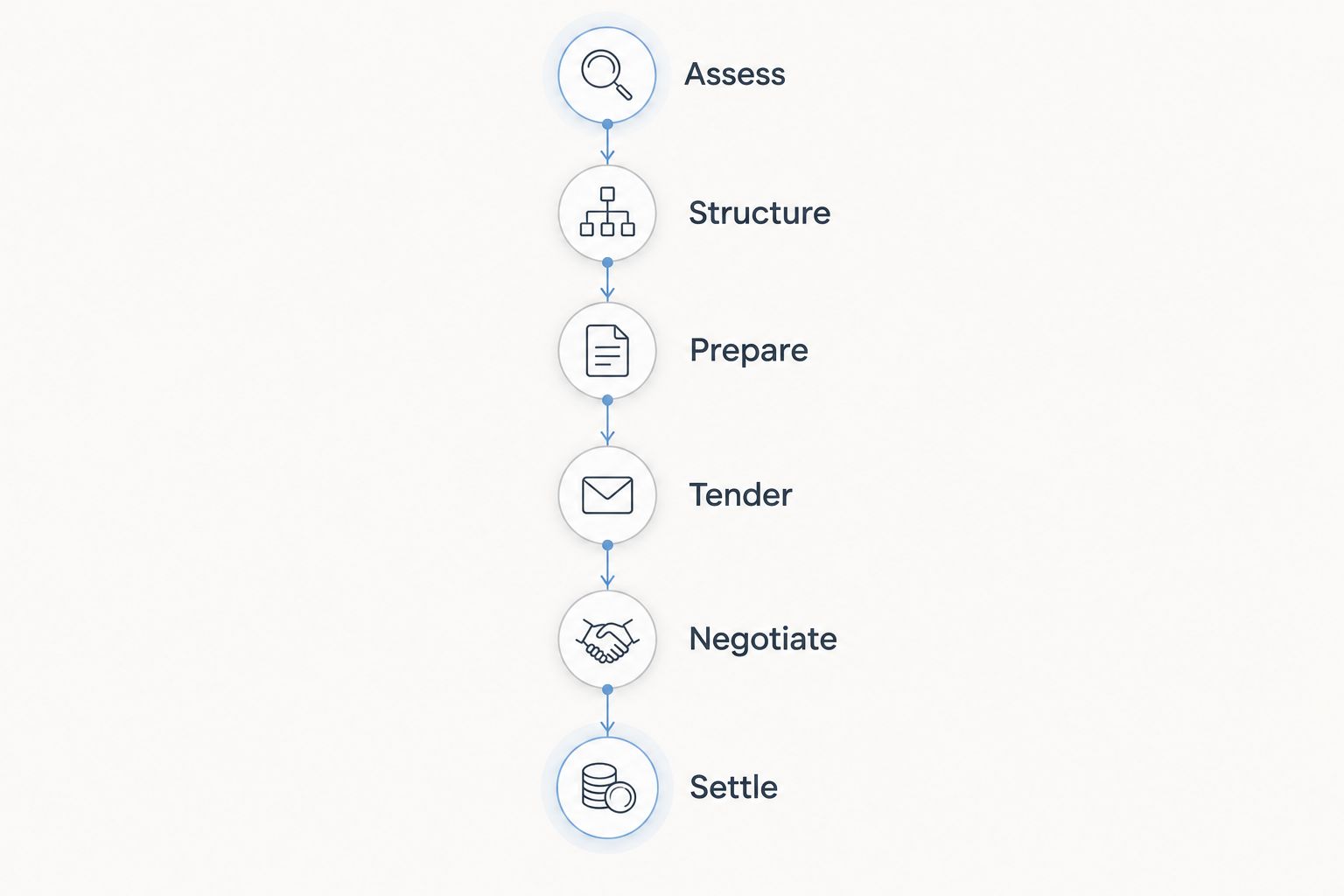
The sequence matters because negotiation cannot repair an unclear borrowing purpose. Before approaching lenders, write down the required facility, repayment source and security you are prepared to offer.
Compare brokerage and debt advisory engagements
Glenclair distinguishes lender-paid brokerage from debt advisory services, which use a retainer and success-fee structure. Confirm the engagement type before work starts and read the written scope and remuneration disclosure.
Do not assume those arrangements cover identical work. Ask what assessment, tender preparation, negotiation and settlement support the engagement includes, and what remains your responsibility.
For any warehouse refinance, also ask which transaction expenses sit outside the engagement. Lender, valuation and legal requirements belong in the decision even when they are separate from the broker's remuneration.
Review your warehouse borrowing
Discuss the existing facilities, security and repayment needs behind your next banking review.
Which warehouse finance approach should you choose?
If you already own the warehouse, start by reviewing the existing arrangement rather than assuming you need a new lender. A tender can compare retention, restructuring and refinancing against the same brief.
For a purchase, choose the assessment path that matches the property use. Owner-occupied lending belongs with operating-business cash flow; investment lending belongs with the lease and rental position. Construction needs a development assessment, while temporary funding needs an evidenced exit.
Your 2026 decision should leave you able to explain the repayment source, security commitment and next review point in plain language. If those remain unclear, hold before accepting an offer.
FAQ
What's the best commercial property finance for industrial warehouses?
The best approach matches the warehouse's use and repayment source. Existing owners should start with a banking review; buyers need an owner-occupied, investment or development assessment that fits the transaction.
Is a warehouse investment loan different from an owner-occupied loan?
Yes. An investment loan assesses property held for rent, while owner-occupied lending assesses premises used by the borrower's business. Lease income and trading cash flow require different examination.
Can I refinance my warehouse without changing banks?
Yes, an existing lender can be asked to review the arrangement. Compare its written proposal with suitable alternatives before deciding whether retention or refinancing meets your requirements.
Does Glenclair only consider loans above A$2 million?
A$2 million is a preferred business-purpose borrowing focus, not a universal eligibility rule. Suitability is assessed case by case, including the borrowing purpose and financial circumstances.
What documents should I prepare for warehouse finance?
Start with financial statements, current management accounts, existing facility documents and property information. Investment transactions also need lease information, while construction requires project documentation; the lender determines the final requirements.
Should warehouse equipment use the same facility as the property?
Do not assume equipment and property should share a facility. Compare their purposes, repayment needs and security requirements before deciding whether separate facilities make sense.
How are brokerage and debt advisory services paid?
Lender-paid brokerage and debt advisory are different engagement structures. Glenclair's debt advisory services use a retainer and success-fee structure; confirm the written scope and remuneration before proceeding.
One last thing
Ask what security remains after the warehouse loan is repaid. A mortgage discharge and the release of related guarantees or other security are separate questions to resolve in the documents.
Make that a written tender question, not a settlement-day assumption. It helps you assess the arrangement you are entering and the steps required to leave it.
This article provides general information, not a recommendation for your circumstances. Obtain financial, legal and tax advice relevant to the proposed transaction.
Related guides
- Income requirements for commercial property finance
- Equipment finance options for manufacturing businesses
- Truck finance options for Australian transport fleets
Author: Glenclair Financial team.