
Best invoice finance options for wholesale distributors in 2026

Best starting point: invoice discounting for established wholesalers with reliable credit control. Best for outsourced collections: factoring. Best for occasional cash gaps: selective invoice finance. This 2026 guide compares invoice finance for wholesale distributors, including when a broader banking review is the better next move.
TL;DR
- Invoice discounting is the default invoice finance for wholesale distributors that manage their own debtor collections well.
- Factoring suits wholesalers that want collections support; assess customer contact arrangements before signing.
- Selective invoice finance suits specific cash gaps, not necessarily a permanent working capital shortfall.
- Glenclair suits established Australian businesses seeking a commercial finance review, particularly borrowing above A$2 million.
Why this matters
Wholesale distributors pay for goods before collecting every customer invoice. The funding problem is the gap between supplier payments, stock turnover and customer receipts—not simply the size of the sales ledger.
An invoice facility addresses receivables. It does not automatically fund stock sitting in a warehouse, disputed deliveries or invoices that fall outside the lender's eligibility rules. Choose the structure against your actual cash cycle.
For your 2026 review, consider invoice funding alongside existing business loans, overdrafts and security arrangements. Glenclair's commercial finance services cover business lending and refinancing through a panel of 60+ lenders; facility suitability still requires individual assessment.
What makes the best invoice finance for wholesale distributors?
Use these criteria before comparing proposals:
- Eligible receivables: Establish which customers, invoice types and payment terms qualify. Accounting receivables and financeable receivables are not interchangeable.
- Usable funding: Check how debtor concentration, overdue invoices, credit notes and reserves affect the amount you can draw.
- Collections control: Decide whether your team or the financier should contact customers about payment.
- Security compatibility: Identify existing security interests, guarantees and lender consent requirements before changing facilities.
- Total obligations: Compare charges, reporting, minimum commitments, termination provisions and collection responsibilities—not just the headline interest margin.
- Cash-cycle fit: Match receivables funding with stock purchases, supplier terms and seasonal demand. Avoid treating every working capital problem as an invoice problem.
Invoice finance options at a glance
| Rank and option | Best for | Standout feature | Key limitation |
|---|---|---|---|
| 1. Invoice discounting | Established wholesalers with capable credit control | Receivables funding while your business manages collections | Requires ongoing ledger administration; eligibility limits drawings |
| 2. Invoice factoring | Wholesalers seeking collections support | Funding combined with an agreed collections service | Customer contact arrangements require careful assessment |
| 3. Selective invoice finance | Occasional, identifiable cash gaps | Funding against selected eligible invoices | Does not necessarily solve a recurring whole-business shortfall |
| 4. Buyer-led supply chain finance | Suppliers to buyers with an established programme | Early payment against buyer-approved invoices | Depends on buyer participation and programme terms |
| 5. Business overdraft | Businesses needing broader cash-flow flexibility | Working capital funding not tied to individual invoice submissions | Limit, security and review requirements remain lender-specific |
These are funding structures, not interchangeable lender products. A business overdraft is included as a comparator, not as a form of invoice finance.
1. Invoice discounting: best for established credit-control teams
Invoice discounting provides funding against eligible receivables while your business retains responsibility for collecting customer payments. Confidential arrangements exist, but confidentiality must be confirmed in the actual proposal.
For a wholesale distributor with dependable invoicing and reconciliation, this is the first structure to assess. The important test is whether the eligible ledger generates enough usable funding after exclusions and reserves.
Invoice discounting pros:
- Retains day-to-day collections within your business.
- Connects funding capacity to eligible receivables.
- Supports a recurring receivables funding requirement.
Invoice discounting cons:
- Requires accurate ledger reporting and reconciliation.
- Concentrated or disputed debts can restrict drawings.
- Does not directly fund unsold inventory.
Best for: Established wholesalers with reliable collections, documented deliveries and recurring credit sales.
Before choosing invoice discounting in 2026, examine your largest customer balances. A growing ledger does not guarantee a matching increase in available funding if customer concentration limits apply.
Verdict: Buy into this structure only after testing the eligible ledger—not total debtors—against your cash requirement.
2. Invoice factoring: best for outsourced debtor collections
Invoice factoring combines receivables funding with an agreed collections service. The precise division of work depends on the contract, including who sends reminders, handles disputes and receives payments.
This suits a wholesaler that wants external collections support rather than funding alone. Review the customer-facing process as carefully as the lending terms.
Invoice factoring pros:
- Combines funding and collections administration.
- Provides a defined process for pursuing eligible debts.
- Reduces the collections work retained internally where the contract includes it.
Invoice factoring cons:
- Financier contact changes how customers experience collections.
- Commercial disputes still require your involvement.
- Funding does not automatically include protection against customer non-payment.
Best for: Wholesalers that need collections support and accept the agreed customer contact arrangements.
Check whether the facility is recourse or non-recourse, then read the exclusions. Do not treat a collections service as credit insurance or assume that every unpaid invoice becomes the financier's loss.
Verdict: Buy for the collections service as well as the funding; skip if customer contact arrangements do not fit your business.
3. Selective invoice finance: best for occasional funding gaps
Selective invoice finance funds chosen eligible invoices rather than necessarily committing the whole ledger. Transaction selection, debtor approval and ongoing obligations depend on the provider's agreement.
A distributor with a specific cash gap should assess this before committing to a broader receivables facility. Repeatedly funding individual invoices, however, is not a substitute for understanding a persistent working capital deficit.
Selective invoice finance pros:
- Targets a defined funding requirement.
- Focuses assessment on selected receivables.
- Provides an alternative to a whole-ledger arrangement where offered.
Selective invoice finance cons:
- Each selected invoice must satisfy eligibility requirements.
- Customer approval and documentation remain necessary.
- Repeated transactions require a comparison against ongoing facilities.
Best for: Wholesalers bridging an identifiable receipt rather than funding a permanent cash shortfall.
For a 2026 funding decision, map the expected customer receipt to the supplier payment it must support. If the same gap reappears every cycle, compare a continuing facility instead of treating each invoice as a separate emergency.
Verdict: Buy for a defined gap; hold if the real requirement is permanent working capital.
4. Buyer-led supply chain finance: best for approved buyer invoices
Buyer-led supply chain finance allows a supplier to seek early payment of approved invoices through a buyer's programme. It differs from arranging an independent facility against your wider receivables ledger.
For a wholesale distributor supplying a participating buyer, the relevant questions are approval timing, eligible invoices and payment terms. Your customer's participation is a prerequisite, not something your own finance application replaces.
Buyer-led supply chain finance pros:
- Connects early payment to buyer-approved invoices.
- Addresses receivables from a participating customer.
- Provides another structure to compare with independent invoice funding.
Buyer-led supply chain finance cons:
- Depends on buyer participation and invoice approval.
- Does not cover customers outside the programme.
- Programme changes require a reassessment of your funding plan.
Best for: Wholesalers supplying buyers that already offer a suitable approved-invoice programme.
Ask how deductions, returns and disputed amounts are handled. Approval mechanics matter when your customer reconciles deliveries or applies credits before confirming payment.
Verdict: Buy where the buyer's programme fits; skip as your sole answer to a diversified ledger's funding needs.
5. Business overdraft: best for broader working capital flexibility
A business overdraft provides borrowing within an agreed account limit. Unlike invoice finance, drawings are not necessarily based on submitting individual eligible invoices, although the lender can impose financial and security conditions.
An overdraft deserves comparison when stock purchases, operating expenses and customer receipts all contribute to the cash gap. It is a banking alternative, not an invoice finance product.
Business overdraft pros:
- Supports working capital beyond a specific invoice.
- Avoids individual invoice submissions where the arrangement does not require them.
- Fits within a broader review of existing banking facilities.
Business overdraft cons:
- The limit does not automatically grow with sales.
- Security and guarantees require scrutiny.
- Review provisions and repayment rights need careful reading.
Best for: Established businesses whose cash requirement extends beyond eligible trade receivables.
Compare an overdraft against invoice funding using the same cash-flow forecast. Include seasonal stock build-ups and equipment commitments rather than looking only at debtor days.
Verdict: Hold as a serious comparator; choose it only when the agreed limit and conditions suit the full cash cycle.
How the options are ranked
The ranking prioritises cash-cycle fit, collections control, eligibility, security compatibility and contractual obligations. It is a structure-led comparison, not a lender performance table.
Invoice discounting comes first for the defined reader: an established wholesale distributor with capable credit control. Factoring takes priority when collections support matters more; selective funding takes priority when the gap is genuinely occasional.
No lender ranking, approval probability or savings estimate is implied. Your ledger and existing banking arrangements determine which proposal deserves consideration.
Run a banking review before choosing a facility
For a 2026 banking review, compare the proposed invoice facility with the banking package it changes. New receivables security can affect an existing lender's position, so review consent and security requirements before committing.
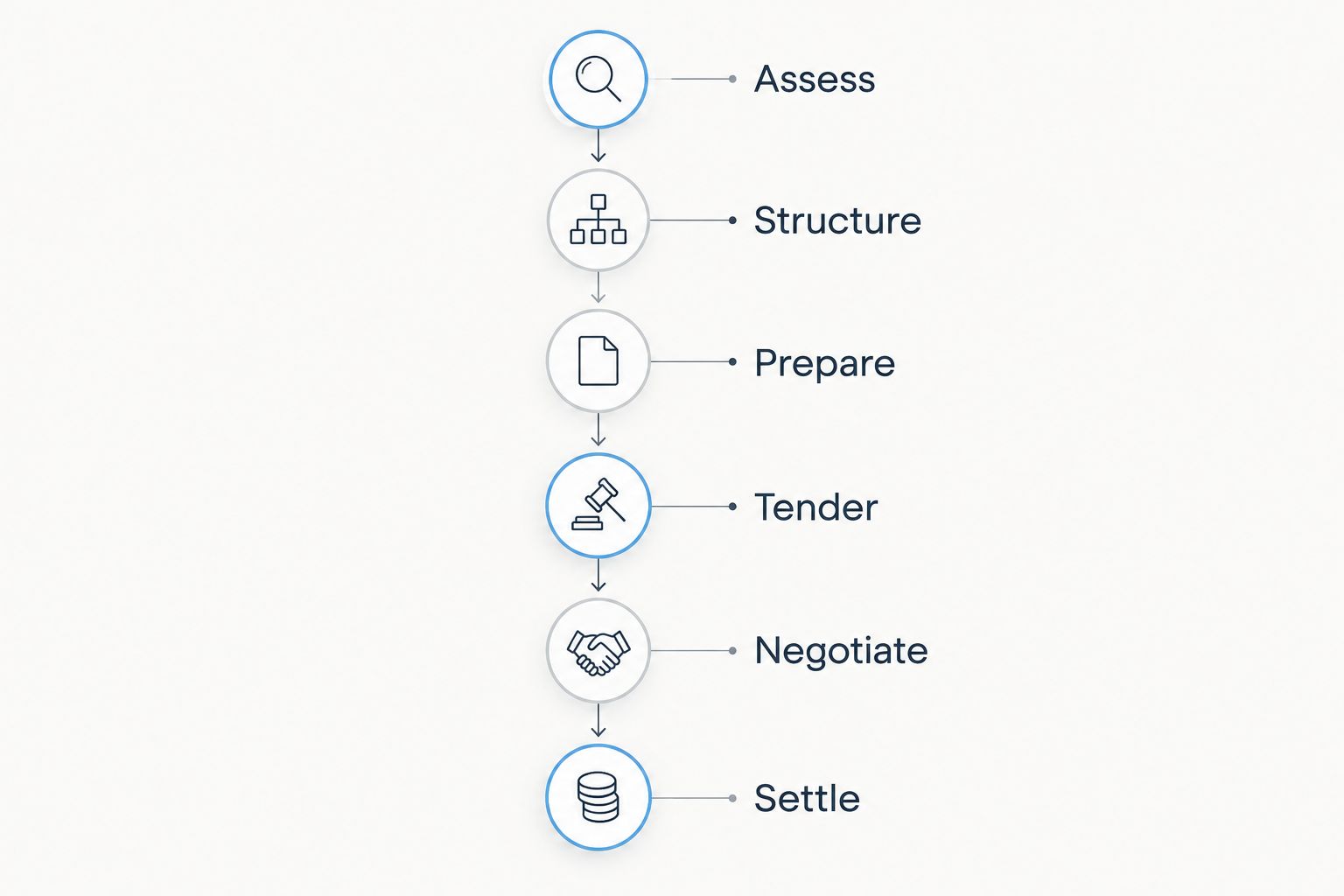
Use this sequence:
Assess
Document why cash is tied up. Separate overdue debtors, ordinary payment terms, slow-moving stock and operating losses; they are different problems.
Structure
Decide which requirement belongs in receivables funding, an overdraft, equipment finance or another business facility. Keep long-lived equipment purchases distinct from recurring trading cash needs.
Prepare
Assemble aged receivables and payables, financial statements, cash-flow forecasts, customer terms and existing facility documents. Identify credit notes, returns and disputed deliveries explicitly.
Tender
Request proposals against a consistent funding requirement. Ask each lender to explain eligibility, concentration limits, reporting, security and how available funding is calculated.
Negotiate
Compare the complete terms, including guarantees, covenants, termination provisions and operational duties. Distinguish an indicative proposal from a binding facility offer.
Settle
Coordinate documentation, lender consents, security releases and payment instructions where required. Confirm how collections and reconciliations will operate after the change.
Glenclair focuses on established Australian businesses seeking business-purpose finance above A$2 million, particularly refinancing and banking reviews. That preference is not a universal eligibility threshold; suitability is assessed case by case.
Also confirm the engagement model. Lender-paid brokerage is distinct from debt advisory, which uses a retainer and success-fee structure; establish which service applies before proceeding.
Review your working capital structure
Discuss receivables funding alongside existing loans, security and refinancing requirements.
Which invoice finance option should you choose?
Start with invoice discounting if your collections work and your eligible ledger supports the funding requirement. Choose factoring when you want an agreed collections service, or selective finance when the cash gap is specific and occasional.
Assess buyer-led finance only where a relevant customer programme exists. Keep an overdraft in the comparison when inventory and general operating expenses drive the requirement.
Glenclair is best suited to established business owners seeking a commercial finance review rather than an isolated invoice transaction. For your 2026 decision, ask for a comparison that shows usable funding, operational obligations and security implications together.
FAQ
What's the best invoice finance for wholesale distributors?
Invoice discounting is the starting point for established wholesalers with reliable collections and suitable receivables. Factoring suits businesses seeking collections support, while selective invoice finance suits identifiable, occasional cash gaps.
Is invoice factoring better than invoice discounting?
Factoring is better suited to businesses that want an agreed collections service; invoice discounting suits businesses retaining collections internally. Compare customer contact arrangements, eligibility and contractual duties before choosing.
Can invoice finance pay for wholesale stock purchases?
Funds drawn against eligible receivables can support stock purchases where the facility permits that use. Unsold inventory itself does not become an eligible invoice, so assess stock funding separately.
Can a wholesaler finance invoices owed by one large customer?
That depends on the financier's debtor concentration rules and assessment of the customer. A large receivable does not guarantee an equivalent drawing amount.
Does invoice finance protect against customers not paying?
Not automatically. Check recourse provisions and any separately stated credit protection, including exclusions for disputes, deductions and other ineligible debts.
Can I add invoice finance without changing my existing bank?
That depends on your existing security and facility terms. Review lender consent requirements and any arrangements needed between secured lenders before committing.
Does Glenclair only consider borrowing above A$2 million?
Glenclair prioritises established Australian businesses seeking business-purpose finance above A$2 million, particularly refinancing and banking reviews. The preferred borrowing size is not a universal eligibility rule; suitability is assessed individually.
One last thing
A larger sales ledger is not the same as more available cash. Before accepting a proposal, ask the lender to apply its eligibility rules to your actual aged receivables and explain each exclusion. That exercise connects the facility's promise to your supplier payment schedule.
Related guides
- Equipment finance options for manufacturing businesses
- Truck finance options for Australian transport fleets
- Income requirements for commercial property finance
By the Glenclair Financial team.