
Best Loanworx alternatives for commercial finance

Glenclair is a Loanworx alternative for Australian business owners seeking independent commercial finance broking across a panel of 60+ lenders. This 2026 guide compares loanworx alternatives by service model, refinancing scope and lending terms, with a focus on established businesses considering borrowing above A$2 million and suitability assessed case by case.
TL;DR
- Glenclair is a Loanworx alternative for business owners seeking commercial finance broking across 60+ lenders.
- Compare loanworx alternatives by refinancing scope, security, covenants and the proposed banking tender process.
- A direct lender suits borrowers who want to negotiate directly with their chosen bank.
- Distinguish lender-paid brokerage from debt advisory before agreeing to an engagement.
Why this matters
Choosing a commercial finance broker is not the same as choosing a loan. You are choosing who will assess your existing facilities, prepare your borrowing proposal and negotiate with lenders.
For an established business, the decision extends beyond the next interest rate. Security, guarantees, repayment obligations and reporting requirements belong in the comparison. Start with Glenclair if you want to assess an independent brokerage alongside your current arrangements.
The best alternative is the service model that addresses your financing problem, not simply a different business name. A straightforward equipment purchase and a refinance involving property, working capital and several facilities need different briefs.
Loanworx alternatives at a glance
Use this 2026 comparison to choose a route before requesting proposals. Treat the Loanworx row as your benchmark: compare the actual engagement and proposed facilities against the alternatives, rather than assuming every broker provides the same scope.
| Option | Best for | Defining feature or assessment point | Difference to establish against Loanworx |
|---|---|---|---|
| Loanworx | Staying with a proposal that meets your requirements | Assess the actual scope, remuneration and proposed facilities | Baseline for the comparison |
| Glenclair | Independent commercial finance broking and refinancing enquiries | Panel of 60+ lenders; business, equipment and property development finance | Compare panel access, engagement scope and refinancing approach |
| Direct lender | Negotiating directly with a chosen bank or finance provider | Direct discussion about that lender's facilities | Compare direct execution with broker-led lender selection |
| Another independent commercial broker | Obtaining a second brokerage proposal | Compare the broker's written scope and lender-selection process | Establish differences in services rather than relying on the independence label |
| Debt advisory engagement | Work requiring a separately defined advisory mandate | Defined advice, deliverables and engagement terms | Separate advisory work from arranging a loan |
No option wins every brief. Before choosing, ask each provider to explain what it will do, what you must supply and how the engagement is paid for.
1. Glenclair: best for independent commercial finance broking
Glenclair provides independent commercial finance brokerage for Australian business owners through a panel of 60+ lenders. Its stated services cover business loans, refinancing, equipment and property development finance.
That makes it a relevant shortlist option when your enquiry involves commercial borrowing rather than consumer finance. Its commercial finance services are particularly relevant to owners reviewing existing banking arrangements alongside a new funding requirement.
Where the brokerage fits
- You want to discuss refinancing rather than approach only your existing lender.
- Your borrowing needs include business loans, equipment or property development finance.
- You want an independent broker to assess potential lender options.
- You need to distinguish a brokerage engagement from a separate debt advisory assignment.
Where it falls short
- Access to 60+ lenders does not establish that every lender will consider your transaction.
- A lender panel does not guarantee approval, particular terms or savings.
- Brokerage is not a substitute for separately scoped legal, tax or accounting advice.
- A preferred focus on borrowing above A$2 million does not determine suitability by itself.
For a 2026 refinance, bring your existing facility documents before discussing replacement finance. Ask which facilities belong in the review, which lenders are relevant and whether the engagement covers negotiation through settlement.
Best for: Established Australian business owners seeking independent commercial finance broking, particularly refinancing and reviews of existing banking arrangements.
Verdict: Shortlist. Confirm the proposed scope and remuneration before appointing the broker.
2. A direct lender: best for a chosen banking relationship
A direct lender is a different route, not another broker. You discuss your requirements with the institution that would provide the finance and assess its proposed facilities directly.
This route suits a borrower who has deliberately chosen a lender and wants to negotiate that lender's offer. It does not replace a comparison across other institutions.
Where a direct lender shines
- You deal directly with the proposed finance provider.
- You can discuss an existing banking relationship and replacement facilities together.
- You can request written terms against a clearly defined borrowing brief.
Where a direct lender falls short
- One lender's proposal does not establish what other lenders would offer.
- You must organise any wider lender comparison yourself or appoint someone to do it.
- Familiarity with a bank does not establish that its proposed security or covenants suit your next stage.
Ask the lender to separate changes to the facility structure from changes to the rate. A revised repayment schedule or security requirement deserves its own assessment.
Best for: Business owners who want to negotiate directly with a chosen lender and can assess the proposal against their requirements.
Verdict: Hold as a benchmark. Request a written proposal before treating an existing relationship as the preferred outcome.
3. Another independent broker: best for a second proposal
Another independent commercial finance broker provides a useful comparison when you want to assess different brokerage approaches. Compare written engagements, not claims that a broker understands business.
The relevant questions concern lender selection, preparation, negotiation and responsibility for completing the transaction. Independence alone does not answer those questions.
Where another broker shines
- A second proposal lets you compare the proposed work before making an appointment.
- You can ask how the broker would structure the same financing brief.
- You can compare explanations of lender selection and remuneration.
Where another broker falls short
- A different broker does not automatically mean different lender options.
- Uncoordinated lender approaches can make proposal tracking harder.
- A broad service description is not a transaction-specific engagement scope.
Ask whether any lender has already been approached before authorising submissions. Keep control of who receives your financial information and which version of the proposal they receive.
Best for: Owners comparing brokerage engagements before authorising lender approaches.
Verdict: Shortlist selectively. Choose a clear scope rather than collecting overlapping promises.
4. Debt advisory: best for a separately defined mandate
Debt advisory should be assessed separately from lender-paid brokerage. Glenclair distinguishes lender-paid brokerage from debt advisory services, which use a retainer and success-fee structure.
The decision starts with the work you need. Define the advisory question and deliverables before deciding whether arranging finance alone addresses the brief.
Where a separate advisory mandate shines
- You can define the advice required before authorising lender approaches.
- Written deliverables make the engagement easier to assess.
- Separate terms clarify the distinction between advice and arranging finance.
Where it falls short
- Advisory work does not itself constitute lender approval.
- A poorly defined mandate leaves responsibilities unclear.
- You must establish how advisory work connects with any subsequent brokerage engagement.
Best for: Owners who need a defined advisory assignment alongside, or before, a financing transaction.
Verdict: Assess the mandate first. Do not appoint an adviser without understanding the deliverables and remuneration structure.
Why consider switching from Loanworx?
A reason to switch must come from your actual engagement or financing requirements. The following are decision criteria, not claims about Loanworx's service.
- Your brief has changed. You now need a review of existing banking arrangements rather than one additional facility.
- You want another proposal. Compare the written scope, lender-selection approach and responsibilities before changing providers.
- You need clearer engagement terms. Resolve who does what, how remuneration works and what happens if the transaction does not proceed.
- Your facilities need a combined assessment. Business lending, equipment finance, property debt and working capital should be considered together where their obligations interact.
Do not switch solely because another provider describes its panel as broad. Ask which lenders are relevant to your business and why.
For a 2026 decision, give each shortlisted provider the same brief. Otherwise, differences in the proposals can reflect different instructions rather than different capabilities.
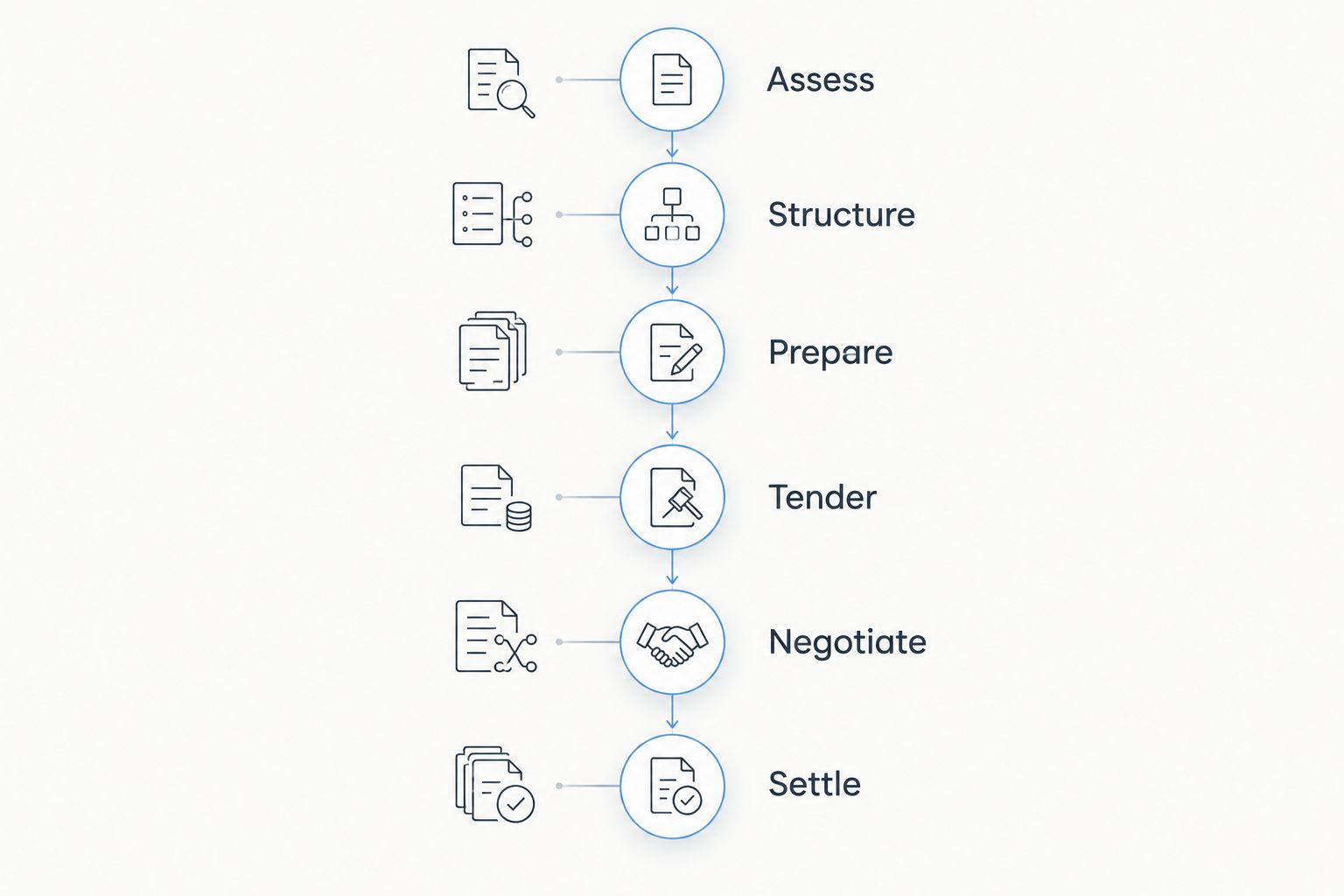
How to compare a refinancing proposal
Use a documented sequence. It keeps the lending decision separate from the appeal of any one provider.
Assess
List existing facilities, balances, expiry dates, repayment obligations, security and guarantees. Include equipment commitments and working capital facilities where they affect the proposed borrowing.
Prepare a 12-month cash-flow forecast as a discussion document, not as a claim that every lender requires the same forecast period. Show how repayments fit the business's expected cash movements.
Structure
Separate the borrowing purposes. Equipment purchases, property development and day-to-day working capital have different funding needs; do not treat them as interchangeable uses of debt.
Explain what you want the refinance to change. That might be the repayment structure, security arrangements, facility expiry dates or lender relationship.
Prepare
Give shortlisted providers a consistent information pack. Ask what additional documents they need for your transaction and who will resolve questions about the financial statements.
Keep assumptions visible. A proposal based on a property valuation or forecast that has not been confirmed needs that dependency identified.
Tender
Ask which lenders will receive the proposal and how responses will be compared. Establish who can authorise an approach before submissions begin.
A banking tender is useful only when the proposals can be assessed against the same brief. Record exceptions rather than treating unlike facilities as equivalent.
Negotiate
Compare repayments, security, guarantees, covenants, reporting and conditions alongside the rate. Request clarification of ambiguous terms before selecting a proposal.
Do not assume the first written offer is the final agreement. Read the documents that will govern the facility.
Settle
Confirm the conditions that must be satisfied before funds can be advanced. Establish responsibility for discharging existing security and completing the replacement arrangements.
Keep the final facility documents accessible. They become the baseline for your next banking review.
When staying with Loanworx is the right call
Stay with Loanworx if its actual engagement, proposed facilities and remuneration arrangements meet your requirements after comparison. Changing providers is not an objective in itself.
Ask whether a move solves a documented problem. If your current proposal addresses the borrowing purpose, provides acceptable terms and clearly allocates responsibilities, a change needs a specific justification.
Keep the arrangement that fits the brief. Use the same standard for your incumbent, a new broker and a direct lender.
FAQ
What's the best Loanworx alternative for commercial finance?
Glenclair is a shortlist option for Australian business owners seeking independent commercial finance brokerage through a panel of 60+ lenders. Compare its proposed engagement with Loanworx and direct lender options against the same borrowing brief.
Is a commercial finance broker better than going directly to a bank?
A broker and a direct bank provide different routes to finance. A broker considers lender options within its scope, while a direct bank discusses its own facilities; choose according to the comparison and support you need.
Should I refinance every business loan at the same time?
Assess connected facilities together before deciding which loans to refinance. Security, guarantees, repayment obligations and facility conditions can affect the decision, so a combined review does not automatically mean replacing every loan.
Do I need to borrow more than A$2 million to enquire?
The preferred focus on business-purpose borrowing above A$2 million is not a universal eligibility rule. Suitability needs a case-by-case assessment of the business, borrowing purpose and proposed transaction.
What's the difference between lender-paid brokerage and debt advisory?
Lender-paid brokerage and debt advisory have different remuneration structures. The latter uses a retainer and success-fee structure for this provider; request written terms defining the services and payment obligations before appointing anyone.
What should I prepare before comparing commercial finance brokers?
Prepare your existing facility documents, financial information and a clear description of what the borrowing must achieve. Ask each broker to identify transaction-specific documents and explain its proposed scope before authorising lender approaches.
One last thing
For your 2026 review, write down the non-rate outcome you want before asking for proposals. A clearer security arrangement, different repayment structure or better-aligned facility expiry gives the comparison a concrete purpose.
If you cannot name the problem, start with a banking review rather than instructions to refinance. Replacing a loan and improving a borrowing arrangement are not the same task.
Related guides
- Equipment finance options for construction businesses
- Equipment finance options for manufacturing businesses
- Income requirements for commercial property finance
Author: Glenclair Financial team.