
Best property development finance for small lot subdivisions 2026

Best overall structure: senior development debt for an approval-ready subdivision. Best for complex applications: non-bank development finance. Best for separating project phases: staged land and civil works finance. This 2026 guide compares property development finance for small lot subdivisions; Glenclair is an independent commercial finance brokerage for Australian business owners reviewing funding and existing banking arrangements.
TL;DR
- Senior development debt is the starting point for approval-ready property development finance for small lot subdivisions.
- Non-bank development finance deserves consideration when the application needs a different credit assessment.
- Match subdivision funding to civil works, title registration and the actual repayment exit.
- Glenclair suits established business owners seeking a broker-led review, with suitability assessed case by case.
Why the funding structure matters
A small lot subdivision needs funding that follows the project, not just the land purchase. Civil works, service connections, title registration and lot settlements create different funding requirements. An acquisition loan does not automatically fund the work needed to create saleable lots.
For a 2026 funding decision, distinguish the lender's commitment from the amount you can actually draw. An approved facility still has conditions. If those conditions require work you cannot fund, the structure has a gap before construction starts.
Choose the facility around the next funded milestone and the repayment exit. Then compare lender proposals on that same basis.
What makes the best small lot subdivision finance
Use these criteria before choosing a lender or accepting a refinance proposal:
- Project-stage fit: The facility covers the acquisition, approval or civil works stage you actually need to fund.
- Drawdown conditions: You understand what evidence, equity contribution and approvals each advance requires.
- Security boundaries: The proposal identifies the land, guarantees and other assets supporting the borrowing.
- Funding coverage: The structure addresses civil works, consultant costs, contingency and interest treatment rather than land alone.
- Repayment alignment: The term and lot-release conditions match the proposed sales or refinance exit.
- Execution requirements: Valuation, legal documentation and settlement conditions fit the project's contractual obligations.
A larger facility is not automatically a better facility. Unavailable drawdowns, restrictive release conditions or an unrealistic repayment date can make the headline limit irrelevant.
Small lot subdivision finance at a glance
These are funding structures, not interchangeable products. A project can use different structures at different stages, but each transition needs a clear funding plan.
| Funding structure | Best for | Standout feature | Key limitation |
|---|---|---|---|
| Senior development debt | Approval-ready subdivisions | Project funding under a senior secured facility | Drawdowns depend on documented conditions |
| Non-bank development finance | Applications requiring a different credit assessment | An alternative credit process outside a bank | Terms and lender requirements need individual assessment |
| Staged land and civil works finance | Projects with distinct acquisition and works phases | Funding aligned to separate milestones | Later-stage funding is not secured by an earlier approval |
| Bridging finance | A defined timing gap before a documented exit | Short-term funding tied to a specific transition | Repayment depends on the exit occurring on time |
1. Senior development debt: best for approval-ready subdivisions
Senior development debt funds a project under a facility secured in a senior position. For a subdivision, the assessment centres on the land, approvals, works budget, borrower contribution and repayment strategy. Funding conditions determine when money becomes accessible.
This is the default starting point when your project is ready for a development assessment. It keeps the discussion focused on the complete subdivision rather than treating each invoice as a separate borrowing problem.
Senior development debt pros:
- Brings the project budget and repayment plan into the same assessment.
- Allows you to compare proposals against a consistent scope of works.
- Makes drawdown and lot-release requirements part of the initial negotiation.
Senior development debt cons:
- Conditions can prevent access to funds until specified requirements are met.
- Changes to scope, valuation or completion timing can require further lender consent.
- Security and guarantee requirements need careful review.
Before accepting a 2026 proposal, ask how equity must be contributed and what supports each progress claim. Confirm whether the facility covers all agreed project costs or leaves particular expenses outside its scope.
Glenclair offers property development finance brokering through a panel of 60+ lenders. That provides a route for comparing lender requirements; it does not mean every panel lender funds every subdivision or that approval is assured.
Best for: Approval-ready projects with a documented budget and credible exit.
Verdict: Choose senior development debt as the comparison baseline.
2. Non-bank development finance: best for complex applications
Non-bank development finance is funding from a lender outside the banking sector. Consider it when the project needs an alternative assessment of its structure, borrower circumstances or repayment plan. A different credit process is not an exemption from credit assessment.
Ask the lender to identify what it accepts and what remains conditional. A proposal only becomes useful when its requirements fit your project, not simply because it comes from a different type of lender.
Non-bank development finance pros:
- Adds another lending route to a properly scoped finance tender.
- Lets you test a project against different credit policies.
- Provides an alternative where a particular bank's policy does not fit the application.
Non-bank development finance cons:
- Funding conditions still require detailed scrutiny.
- Additional flexibility in one area does not establish flexibility elsewhere.
- Extension rights, default provisions and repayment requirements need individual review.
For your 2026 comparison, use the same works budget, security schedule and exit assumptions across bank and non-bank proposals. Otherwise, you risk comparing a complete facility with an indicative offer that excludes part of the funding requirement.
Do not treat an indicative term sheet as committed funding. Identify the valuation, legal and credit conditions still outstanding before making decisions that depend on settlement.
Best for: Projects requiring an alternative credit assessment, with enough information to support it.
Verdict: Consider non-bank development finance when its documented terms fit better.
3. Staged finance: best for separate land and civil works phases
Staged land and civil works finance separates the initial land funding from the facility needed to deliver the subdivision. This approach recognises that a purchase-ready site is not necessarily ready for development funding.
The central issue is the transition. Approval for the land acquisition does not commit a lender to fund future civil works, even when both facilities are discussed together.
Staged finance pros:
- Separates acquisition requirements from the later works assessment.
- Lets you present each stage against its own approvals and supporting documents.
- Makes the funding transition an explicit part of project planning.
Staged finance cons:
- Future funding remains uncertain unless formally committed on clear terms.
- A later lender assessment can introduce different conditions.
- Refinance and security-release requirements can complicate the transition.
Before committing to the acquisition, identify what must change before works funding becomes available. That includes the approval position, final budget, equity contribution and any required sales evidence. Establish who funds the project while those requirements are being satisfied.
For an existing land loan under review in 2026, compare retaining the current facility against replacing it as part of the development funding. Include discharge requirements and the treatment of existing security in that assessment.
Best for: Projects with clearly separated acquisition and development milestones.
Verdict: Choose staged finance only with an explicit plan for the funding transition.
4. Bridging finance: best for a defined timing gap
Bridging finance addresses a temporary funding gap before a specified repayment event. For a subdivision, that event might be a contracted settlement or replacement facility, subject to the lender accepting the evidence and structure.
It is not a substitute for resolving an uncertain project exit. The borrowing needs a repayment event that you can describe, document and assess against the facility term.
Bridging finance pros:
- Separates a temporary timing problem from the longer-term funding requirement.
- Gives the application a clearly defined repayment event.
- Allows a specific transition to be assessed on its own merits.
Bridging finance cons:
- Delayed settlements or replacement funding can disrupt repayment.
- Extensions require agreement unless the documents expressly provide otherwise.
- An uncertain exit can leave the timing gap unresolved.
Test what happens if the expected event does not occur when planned. Identify which approvals, counterparties or lender decisions sit outside your control. Do not assume the bridge can simply roll into development finance.
A bridge also needs a realistic completion pathway. If title registration depends on unfinished works, the repayment assessment must account for those works and their funding, not just an expected lot sale.
Best for: A documented, temporary gap with a defined repayment event.
Verdict: Skip bridging finance when the exit remains speculative.
How to prepare a subdivision banking tender
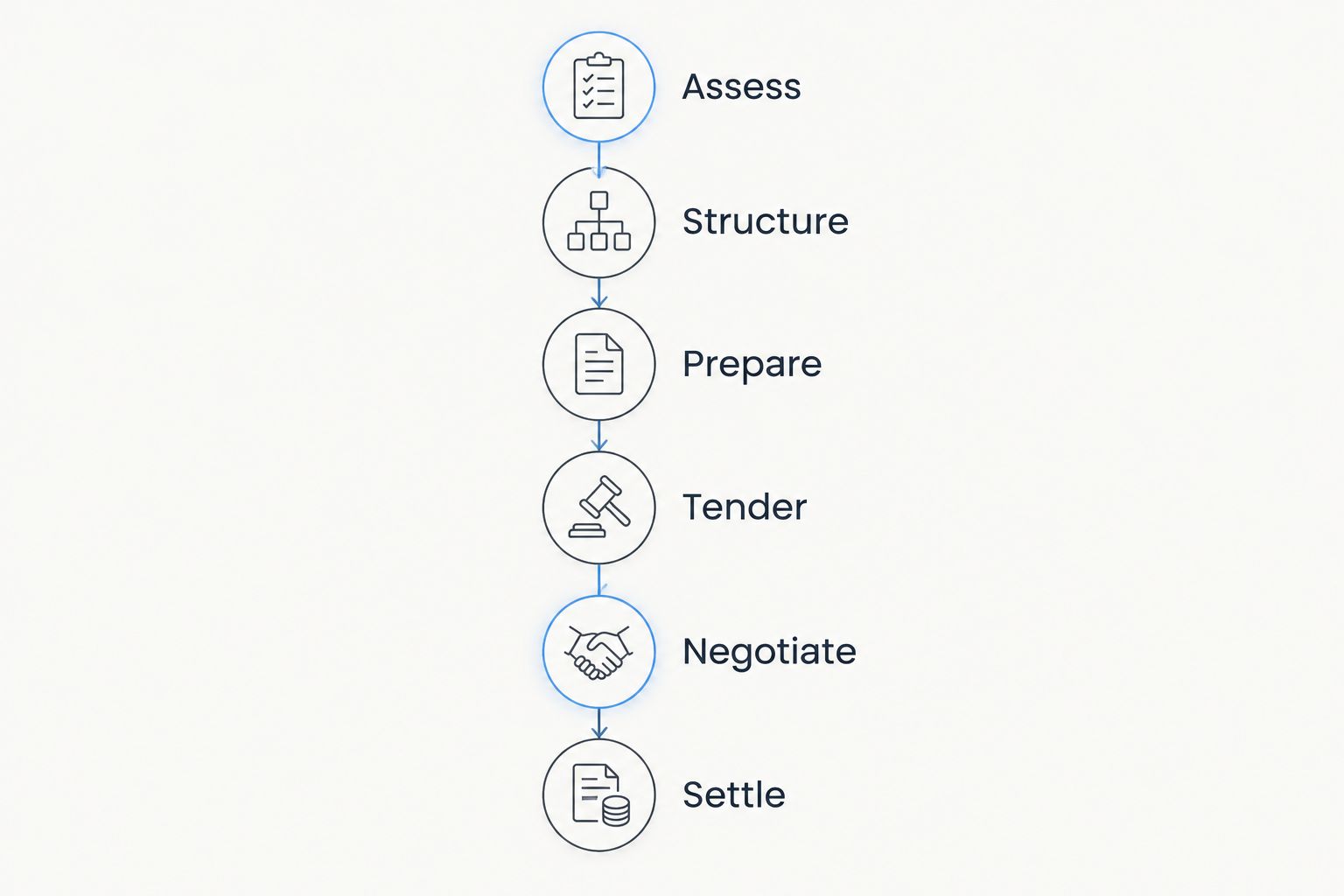
A useful tender asks lenders to assess the same project on the same assumptions. Follow these 6 steps before comparing offers.
Assess
Set out the current debt, property ownership, approval status and funding purpose. State whether you are financing an acquisition, refinancing existing debt or funding civil works. Separate established facts from matters still awaiting confirmation.
Structure
Map the required facilities to the project stages. Identify equity contributions, security, guarantees and the proposed repayment source. Keep project funding separate from unrelated business working capital unless the proposed structure expressly addresses both.
Prepare
Assemble the works budget, approvals, consultant information and existing loan documents. Explain the sales or refinance exit. Reconcile the requested funding with the expenditure it is intended to cover.
Tender
Give suitable lenders a consistent brief. Ask each to identify exclusions, conditions and assumptions rather than supplying only an indicative borrowing limit.
Negotiate
Compare the terms that affect execution: drawdowns, reporting, security, lot releases and extensions. Resolve differences before selecting a proposal, not after instructing settlement.
Settle
Track outstanding conditions and responsibility for satisfying them. Confirm which costs must be funded before the initial advance and how existing security will be discharged or retained.
Review existing banking before replacing it
For a 2026 refinance, first establish what the existing lender will support. Compare that position with alternative proposals against the same project brief. Replacing a lender is a decision, not the objective of the review.
Ask for a written explanation of existing security, guarantees, discharge requirements and any conditions affecting the subdivision. Check whether lot settlements require lender consent and how sale proceeds must reduce debt.
A lot sale is not the same as unrestricted cash. The facility documents determine the lender's release requirements and the treatment of proceeds.
Keep brokerage and debt advisory engagements distinct. Lender-paid brokerage differs from debt advisory work using a retainer and success-fee structure. Confirm the engagement type, remuneration and scope before work begins; do not assume one arrangement applies to every assignment.
Review your subdivision funding structure
Discuss existing debt, civil works funding and the lender requirements your project needs to meet.
How these structures are ranked
The ranking prioritises project-stage fit, funding coverage, drawdown conditions, security and repayment alignment. It compares structures rather than claiming one lender approves more applications or delivers better outcomes.
Glenclair's focus is established Australian business owners seeking business-purpose finance greater than A$2 million, including reviews of existing borrowing. That is a service focus, not a universal eligibility threshold. Suitability remains case by case.
Which subdivision finance should you choose?
Start with senior development debt if the project is approval-ready. Use that proposal as the baseline for testing non-bank alternatives, not as an automatic instruction to borrow.
Choose staged finance when acquisition and works genuinely need separate funding phases. Reserve bridging finance for a documented timing gap. If the exit or funding transition is unresolved, resolve it before committing to the structure.
FAQ
What's the best property development finance for small lot subdivisions?
Senior development debt is the starting point for an approval-ready subdivision with a documented budget and repayment exit. Compare non-bank and staged alternatives against the same project requirements before choosing.
Can I refinance a land loan to fund subdivision works?
Refinancing a land loan can form part of a subdivision funding structure, subject to lender assessment. The replacement facility must expressly cover the required works and satisfy its drawdown conditions.
Is non-bank subdivision finance better than bank finance?
Non-bank subdivision finance is not automatically better than bank finance. Compare the actual funding conditions, security, repayment terms and project coverage rather than the lender category.
Do I need pre-sales for small lot subdivision finance?
Pre-sale requirements depend on the lender and project assessment. Ask whether sales are required before approval, before a drawdown or as part of the repayment strategy.
Does a land loan approval include civil works funding?
A land loan approval does not establish that civil works are funded. Confirm the approved purpose, eligible expenditure and conditions for any later development facility.
What should I check before accepting bridging finance?
Check the repayment event, facility term and consequences of an exit delay. Confirm any extension rights in the documents rather than assuming an extension will be available.
Is A$2 million a minimum eligibility rule for every project?
A$2 million is not a universal subdivision finance eligibility rule. Suitability depends on the project, borrower, lender requirements and the scope of the finance engagement.
One last thing
Before signing, ask the lender to explain how a single lot settlement affects the remaining facility. Confirm the required debt reduction, the remaining available funding and the conditions for releasing that lot. This tests whether the repayment mechanics support the rest of the subdivision, not just the first sale.
Related guides
- Income requirements for commercial property finance
- Equipment finance options for construction businesses
- Machinery finance options for earthmoving contractors
Author: Glenclair Financial team.