
Best SMSF commercial property loans for business owners in 2026

Best for business premises: an SMSF limited recourse borrowing arrangement backed by a compliant business lease. Best for rental investment: an arrangement backed by an unrelated commercial tenant. Best for an existing SMSF loan: a refinance assessed against the current facility. The best SMSF commercial property loans for business owners in 2026 match the fund’s investment strategy, property and repayment capacity—not just the advertised rate.
TL;DR
- Choose SMSF commercial property loans for business owners by purchase purpose, lease income and fund liquidity.
- An owner-occupied business property requires careful separation between the business, the SMSF and the borrowing structure.
- Compare an SMSF refinance against retaining the existing loan, including transaction costs and security terms.
- Glenclair supports commercial borrowing reviews; confirm SMSF lender access and transaction suitability before proceeding.
Why this matters
Buying your business premises through an SMSF connects your retirement savings, operating business and property exposure. A borrowing structure that supports the purchase still needs to work when rent stops, the business changes or members need benefits paid.
Glenclair is an independent commercial finance brokerage with a panel of 60+ lenders. Its commercial finance services provide a starting point for discussing borrowing requirements, but panel size does not establish which lenders accept a particular SMSF transaction. Confirm that scope before commissioning valuations or legal work.
For established owners reviewing business-purpose borrowing above A$2 million, assess the business facilities and proposed SMSF borrowing separately. That figure describes Glenclair’s preferred enquiry profile, not a universal eligibility threshold or an SMSF lending limit.
What makes the best SMSF commercial property loan?
Use these criteria before comparing proposals in 2026:
- Permitted structure: the acquisition, holding arrangement and loan must meet the applicable superannuation borrowing rules.
- Repayment capacity: assess rent, fund contributions where relevant, expenses and the lender’s actual servicing treatment.
- Lease quality: review tenant obligations, rent evidence, expiry dates, outgoings and vacancy exposure.
- Fund liquidity: retain capacity to meet property expenses, loan payments and member obligations.
- Security and guarantees: identify the property securing the loan and any separate personal obligations.
- Whole-transaction terms: compare fees, repayment structure, conditions, documentation and exit requirements—not interest alone.
Glenclair is best suited to established business owners seeking a commercial borrowing review, with SMSF transaction scope confirmed separately. An accountant, appropriately licensed financial adviser and solicitor address different parts of the decision; a loan proposal does not replace their advice.
SMSF commercial property loan options at a glance
These are transaction types, not a ranking of named lender products. Each serves a different borrowing need.
| Option | Best for | Standout feature | Key limitation |
|---|---|---|---|
| Business-premises purchase | An SMSF acquiring eligible premises leased to the owner’s business | Connects a commercial tenancy with the fund’s property investment | Related-party dealings require strict compliance and commercial terms |
| Unrelated-tenant purchase | An SMSF buying commercial premises occupied by another business | Separates the tenant from the member’s operating business | Vacancy, tenant failure and lease expiry still affect repayment capacity |
| Existing SMSF loan refinance | Trustees reviewing an established property loan | Tests the existing facility against alternative terms | Switching costs and structural requirements can outweigh the benefit |
1. Business-premises purchase: best for your operating premises
An SMSF can, subject to the rules, acquire eligible business real property and lease it to a related operating business. Where borrowing is involved, a limited recourse borrowing arrangement, or LRBA, requires a compliant legal structure. Do not sign a purchase contract on the assumption that the documents can be corrected later.
The Australian Taxation Office’s SMSF guidance distinguishes business real property from ordinary residential property. Related-party acquisition and leasing exceptions have specific conditions; calling a property commercial does not settle its classification.
Business-premises purchase pros:
- Your business occupies premises under a documented lease.
- The SMSF holds the property as an investment separate from the operating company.
- Lease obligations provide a basis for assessing rental cash flow.
Business-premises purchase cons:
- Business trouble can affect both operating income and the fund’s rental income.
- Property concentration reduces flexibility within the fund.
- Related-party rent and dealings require ongoing discipline and evidence.
Best for: owners whose premises suit the fund’s investment strategy and whose business can sustain commercial lease obligations.
Before applying in 2026, confirm ownership entities, property use, contract naming and lease terms with the relevant advisers. Review whether the property will still make sense for the fund if your business relocates or is sold.
Verdict: Hold until the property classification, lease and borrowing structure are confirmed.
2. Unrelated-tenant purchase: best for a separate rental investment
An SMSF can acquire commercial investment property leased to an unrelated business, subject to the fund’s investment strategy and applicable rules. Under an LRBA, the property and borrowing structure still require legal assessment. An unrelated tenant removes the related-party lease issue, not the investment risk.
Assess the tenant and lease before relying on the rent. A long remaining lease does not establish that the tenant will pay, and a lender’s valuation does not replace your own investment assessment.
Unrelated-tenant purchase pros:
- Rental income does not depend directly on your own operating business.
- The lease identifies rent, outgoings and tenant obligations for assessment.
- The investment decision can focus on the property’s independent rental use.
Unrelated-tenant purchase cons:
- Vacancy interrupts rent while property and loan expenses continue.
- Reletting can require expenditure and changes to lease terms.
- Property value and market rent remain exposed to local conditions.
Best for: trustees seeking commercial property exposure without making their own business the tenant.
Request the executed lease, rent ledger, outgoings information and details of incentives or disputes. Check who pays for repairs and what happens at lease expiry. The cash available to service debt is not necessarily the headline annual rent.
Verdict: Hold until tenant evidence, net rental income and vacancy funding support the purchase.
3. Existing SMSF loan refinance: best for reviewing current debt
An SMSF refinance replaces an existing borrowing arrangement with another facility, subject to the relevant rules and lender requirements. The purpose is to improve a defined aspect of the borrowing—not to create activity for its own sake. Start by identifying the problem with the current loan.
In 2026, that review should cover repayment pressure, loan expiry, documentation, security and ongoing conditions. A lower quoted rate alone does not establish a better outcome once transaction costs and changed obligations are included.
SMSF refinance pros:
- Existing rental records provide evidence for the assessment.
- A comparison can identify differences in repayment and security terms.
- Reviewing the facility creates an opportunity to check the original structure.
SMSF refinance cons:
- Legal, valuation, discharge and establishment expenses can affect the result.
- The new lender can assess the property and servicing differently.
- Refinancing does not remove vacancy risk or cure an unsuitable investment.
Best for: trustees with an existing SMSF property loan and a clear reason to review it.
Keep retaining the current facility in the comparison. Ask the incumbent lender for its terms, then assess alternatives on the same loan balance, remaining term and repayment basis. Otherwise, a smaller repayment can conceal a longer repayment period.
Verdict: Hold until a written comparison establishes a reason to switch.
How the options are ranked
The ranking follows borrowing purpose: premises for your business, an independent rental investment, then a review of existing debt. It does not claim that one lender or structure suits every SMSF.
Each option must pass the same tests: permitted structure, repayment capacity, lease quality, liquidity, security and whole-transaction terms. A proposal that fails the compliance or liquidity test belongs outside the shortlist, regardless of its rate.
A process for assessing an SMSF property loan
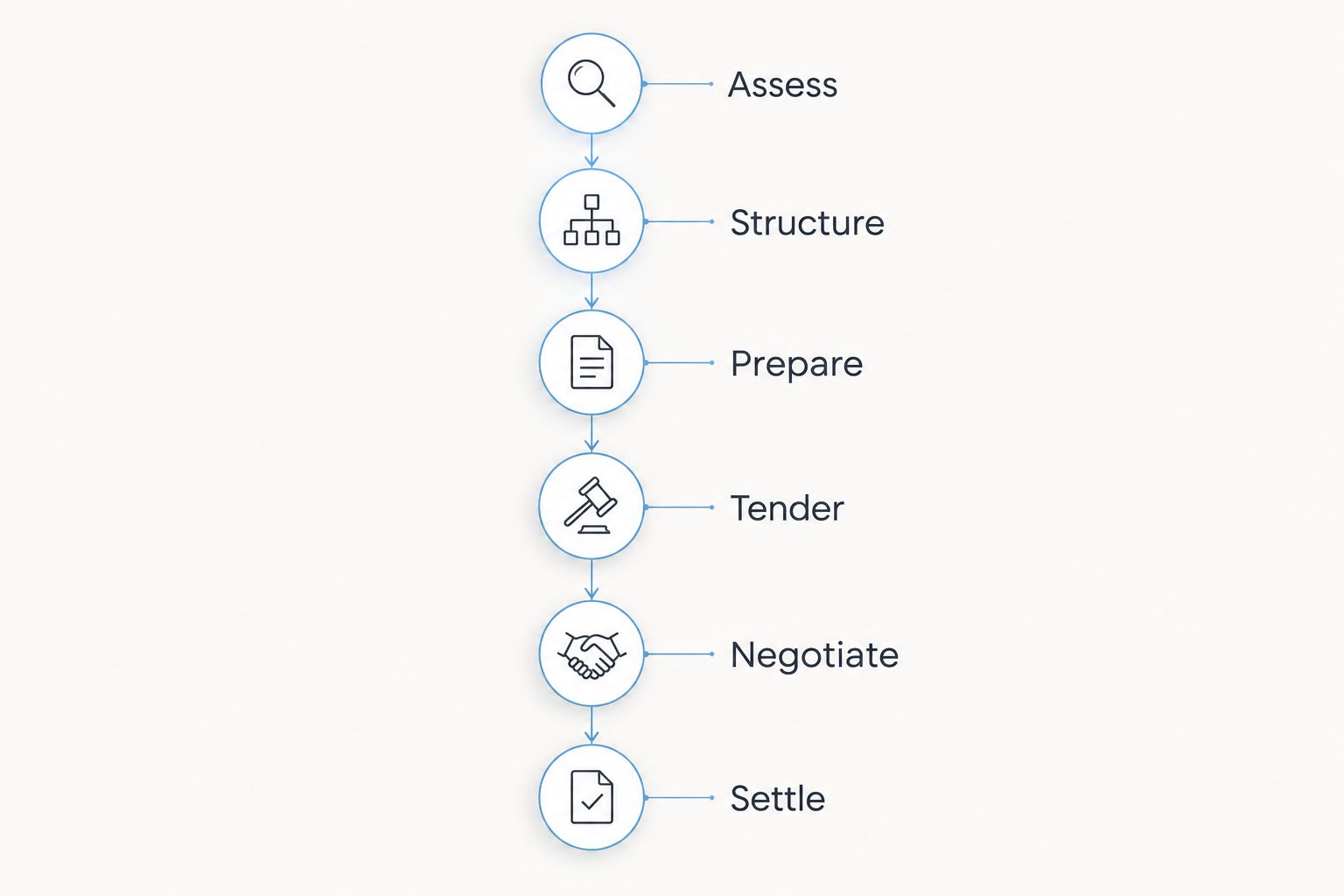
Use a structured process rather than sending incomplete information to multiple lenders. Set the borrowing brief before seeking proposals, and distinguish the finance assessment from the investment and legal decisions.
Assess
Define the purchase or refinancing objective. Review the fund’s investment strategy, financial position, member circumstances and property exposure with the appropriate advisers. Confirm whether borrowing supports the strategy rather than treating finance approval as the investment rationale.
Structure
Confirm the borrower, holding trustee, property ownership and proposed security. Resolve contract and settlement requirements before signing. The ATO’s LRBA guidance sets out restrictions involving a single acquirable asset and the use of borrowed money; renovations and development require particular care.
Prepare
Assemble fund financial statements, trust documents, current loan records, lease evidence and property information. Prepare a 12-month cash-flow forecast as a planning exercise, not a lender approval benchmark. Separate contractual rent from expected receipts and include identifiable property expenses.
Tender
Give suitable lenders a consistent brief. Ask how each assesses rent, contributions, property type, lease terms and fund liquidity. A lender comparison is useful only when the proposals address the same transaction.
Negotiate
Compare written terms, conditions, security, guarantees and repayment requirements. Record which items remain conditional. Do not interpret an indicative proposal as unconditional approval or a commitment to settle.
Settle
Have the relevant advisers check the final documents and settlement requirements. Confirm the lease, payment arrangements and ongoing reporting obligations. Keep the executed documents together so a later review starts from the actual agreement.
Check cash flow, guarantees and advice fees
For a 2026 review, build the decision around cash the fund can actually use. Test the effect of unpaid rent, an unexpected repair and lease expiry. These are planning scenarios, not predictions about the property.
Your business’s willingness to pay rent does not remove the need for commercial lease terms. Nor does a property’s estimated value pay the loan instalments. Review liquidity separately from the asset valuation.
An LRBA limits the lender’s recourse under the borrowing arrangement in accordance with the statutory requirements. Do not translate that into a blanket promise that members have no personal exposure. Obtain legal advice on any guarantees and related documents before accepting them.
Glenclair distinguishes lender-paid brokerage from debt advisory services, which use a retainer and success-fee structure. Confirm which engagement applies and obtain the scope and remuneration terms in writing. Lender-paid brokerage does not mean the transaction has no other costs.
Keep separate records of finance advice, financial advice, tax advice and legal advice. Identify who is responsible for each decision. No lender proposal promises an investment return or a finance outcome.
Discuss your commercial borrowing review
Clarify the borrowing objective, advisory scope and information needed before seeking lender proposals.
Which SMSF commercial property loan should you choose?
Start with the transaction you need, then compare suitable borrowing terms. Choose the business-premises pathway only after confirming related-party compliance. Choose an unrelated-tenant investment only after assessing the lease and vacancy exposure. Refinance existing debt only when the written comparison supports a change.
For an undecided owner in 2026, the next move is not a lender application. It is a documented review of the property, fund liquidity and borrowing objective, with the right advisers involved before commitments are made.
FAQ
What's the best SMSF commercial property loan for a business owner?
The best SMSF commercial property loan matches the fund’s permitted investment strategy, property and repayment capacity. Compare eligible proposals on lease income, liquidity, security and whole-transaction terms rather than rate alone.
Can my SMSF buy the premises my business occupies?
An SMSF can acquire eligible business real property and lease it to a related business when the applicable requirements are met. Confirm the property classification, acquisition rules and commercial lease terms before signing a contract.
Can I refinance an existing SMSF commercial property loan?
An existing SMSF borrowing arrangement can be refinanced subject to the applicable rules and lender requirements. Compare the replacement facility with retaining the current loan, including transaction expenses and changed obligations.
Can I use SMSF borrowing to develop a commercial property?
Do not assume an SMSF property loan can fund development. LRBA rules restrict the use of borrowed money, including for improvements, so obtain transaction-specific legal and tax advice before committing to works.
Does a limited recourse loan mean I have no personal exposure?
No. A limited recourse borrowing arrangement does not justify assuming that every separate personal obligation is excluded. Ask a solicitor to explain the loan documents, guarantees and enforcement provisions.
Does Glenclair charge for debt advisory services?
Glenclair’s debt advisory services use a retainer and success-fee structure, distinct from lender-paid brokerage. Confirm the engagement type, scope and remuneration in writing before work begins.
How much income does an SMSF need for a commercial property loan?
There is no single income figure that establishes suitability for every SMSF commercial property loan. Assessment depends on the proposed debt, recognised income, expenses, lease, property and lender requirements.
One last thing
A property can suit your operating business and still be unsuitable for your retirement fund. Test the investment without the emotional attachment to owning your premises. If the case depends entirely on your business remaining the tenant indefinitely, examine that concentration before progressing.
General information only. This article does not provide personal financial, tax or legal advice. Obtain advice specific to your fund and transaction.
Related guides
- How much income do lenders require for commercial property finance?
- Equipment finance options for manufacturing businesses
- Truck finance options for Australian transport fleets
Author: Glenclair Financial team.