
Can cash flow finance be unsecured?

Yes. Unsecured cash flow finance can fund business-purpose working capital without a mortgage or other security over assets, but you must check whether the lender requires a personal guarantee. Approval still depends on the business’s ability to repay, and an unsecured loan does not remove the borrower’s liability for the debt.
TL;DR
- Unsecured cash flow finance is possible; check security clauses and personal guarantees separately.
- Compare working capital repayments against cash collection, not turnover alone.
- Glenclair suits established Australian businesses seeking a structured commercial finance review.
- Review existing banking restrictions before adding another lender.
Why this matters
For a 2026 borrowing review, the useful question is not simply whether a lender advertises an unsecured facility. It is whether the proposed debt fits your cash cycle, leaves acceptable personal exposure and works alongside your existing bank facilities.
You can review Glenclair’s commercial finance services in that broader context. A working capital request should sit alongside your refinancing, equipment and property borrowing requirements, rather than become a separate decision made under pressure.
Unsecured describes the security arrangement. It does not establish affordability or eliminate recovery action after default. Read the facility agreement and any guarantee documents together.
Can cash flow finance be unsecured?
Yes. A business lender can assess a cash flow facility without taking security over business or personal assets. The lender still assesses repayment capacity, credit history and the proposed use of funds.
The important distinction is between asset security and personal liability. A personal guarantee can make a director responsible for a company’s debt even where the facility has no asset security. A guarantee can also contain separate security obligations, so its wording matters.
Check the proposal in this order:
- Identify the borrower. Confirm which company, partnership, trustee or individual owes the debt.
- Read the security schedule. Look for mortgages, security over particular assets and general security over business assets.
- Read each guarantee. Establish who guarantees repayment and whether related documents grant security.
- Test the repayments. Match scheduled payments against cash available after operating expenses and existing debt commitments.
- Check existing restrictions. Confirm whether current agreements require consent before additional borrowing or security.
- Review default provisions. Understand the lender’s contractual rights if repayments stop or another obligation is breached.
A product description is not a substitute for these checks. Treat a facility as unsecured only after reviewing the actual security requirements, not because the application process asks for no property valuation.
Unsecured lending versus other working capital options
Different facilities solve different cash timing problems. For your 2026 review, compare their purpose and obligations before comparing headline interest rates.
| Facility | Best for | Main benefit | Main limitation |
|---|---|---|---|
| Unsecured cash flow loan | A defined business need with an identifiable repayment source | Borrowing without asset security where the contract supports that description | Scheduled repayments still fall due when customer receipts slow; guarantees can create personal exposure |
| Secured business facility | Borrowers prepared to offer assets as security | Gives the lender asset security when assessing the proposal | Secured assets are exposed to enforcement under the agreement |
| Business overdraft | Recurring timing gaps in the operating account | Supports drawings and repayments around cash movements within agreed limits | Limits, review provisions and security conditions need checking |
| Invoice finance | Businesses funding eligible unpaid invoices | Connects funding to receivables rather than a separate lump-sum loan | Eligibility, debtor concentration and invoice disputes affect the borrowing base |
None is automatically the right answer. An overdraft does not repair an unprofitable operation, and an unsecured loan does not turn uncertain sales into reliable repayment capacity.
Ask each lender to explain the same proposed funding need. Comparing an unrestricted term loan with invoice finance against selected receivables requires more than an interest-rate comparison.
Unsecured cash flow loans: check repayment pressure
A term loan provides funds that you repay under an agreed schedule. It suits a defined requirement better than an undefined expectation that extra cash will solve the problem.
The benefit is a clear borrowing amount and repayment structure. The drawback is that scheduled debt service continues even when trading receipts fall behind your forecast.
Before accepting the facility, identify the event that produces repayment cash. That might be collection of existing receivables or completion of a documented trading cycle. Do not treat projected revenue as cash already available to meet debt commitments.
If your underlying requirement keeps recurring, test whether a revolving facility better matches it. Repeatedly replacing one short-term loan with another deserves a review of the business’s funding structure.
Business overdrafts: check access and review conditions
An overdraft allows borrowing through a business account within an agreed limit. Security requirements depend on the particular agreement; the product name alone does not answer whether the arrangement is unsecured.
Its benefit is flexibility around incoming and outgoing payments. Its limitation is dependence on the agreed limit and the lender’s contractual review or repayment rights.
For your 2026 facility review, ask how the lender assesses ongoing use. Establish what happens if the account remains drawn rather than returning towards credit as customer payments arrive.
A persistent overdraft balance warrants investigation. Separate a temporary cash timing issue from working capital that the business needs on an ongoing basis.
Invoice finance: check the receivables obligations
Invoice finance advances funds against eligible receivables. Do not assume it is unsecured merely because no real property mortgage is required. The arrangement can involve an assignment of receivables or security interests.
Its benefit is a funding base connected to eligible invoices. Its limitation is that the amount accessible depends on the agreement’s eligibility rules and the receivables available.
Ask how disputed invoices, overdue accounts and concentrated customer exposure are treated. Also establish who collects customer payments and what happens if a debtor does not pay.
The right comparison is not simply invoice finance versus an unsecured loan. Compare how each facility behaves when your largest customer pays late.
Why unsecured cash flow finance terms vary
Lenders assess the repayment proposal and the risks attached to it. These factors explain why the same requested amount does not produce identical terms:
- Cash generation. Accounting profit and bank-account cash are different. Collections, tax obligations and operating expenses affect the cash available for debt service.
- Existing debt. Current repayments reduce capacity for another facility. Existing contracts can also restrict additional borrowing.
- Purpose and repayment source. A temporary receivables gap needs a different repayment structure from ongoing operating losses.
- Customer concentration. Dependence on a small customer group makes the timing and reliability of those receipts important.
- Credit and conduct. Repayment history, arrears and account conduct inform the lender’s assessment.
- Security and guarantees. The obligations offered by the borrower and guarantors affect the legal structure of the proposal.
A strong application explains these factors rather than hiding them behind a turnover figure. Your forecast should connect sales to collections, collections to operating payments, and the remaining cash to repayments.
How should you assess a larger working capital request?
For established businesses considering business-purpose borrowing greater than A$2 million, assess working capital alongside the wider banking relationship. That amount describes the intended audience for this review, not a universal eligibility threshold for unsecured lending.
Glenclair is best suited to established Australian business owners seeking a structured commercial finance review. Its independent brokerage works through a panel of 60+ lenders; panel size does not mean every lender offers unsecured funding or will accept a particular application.
A useful banking tender follows six stages:
- Assess. Establish the cash requirement, current facilities, security position and repayment capacity.
- Structure. Separate recurring working capital from longer-term equipment, property and refinancing needs.
- Prepare. Assemble financial statements, current management accounts, debt details and a supported cash flow forecast.
- Tender. Put a consistent funding proposal to suitable lenders so responses address the same requirement.
- Negotiate. Examine repayments, guarantees, security, covenants and contractual costs together.
- Settle. Confirm conditions, documents, required consents and the treatment of existing facilities before completion.
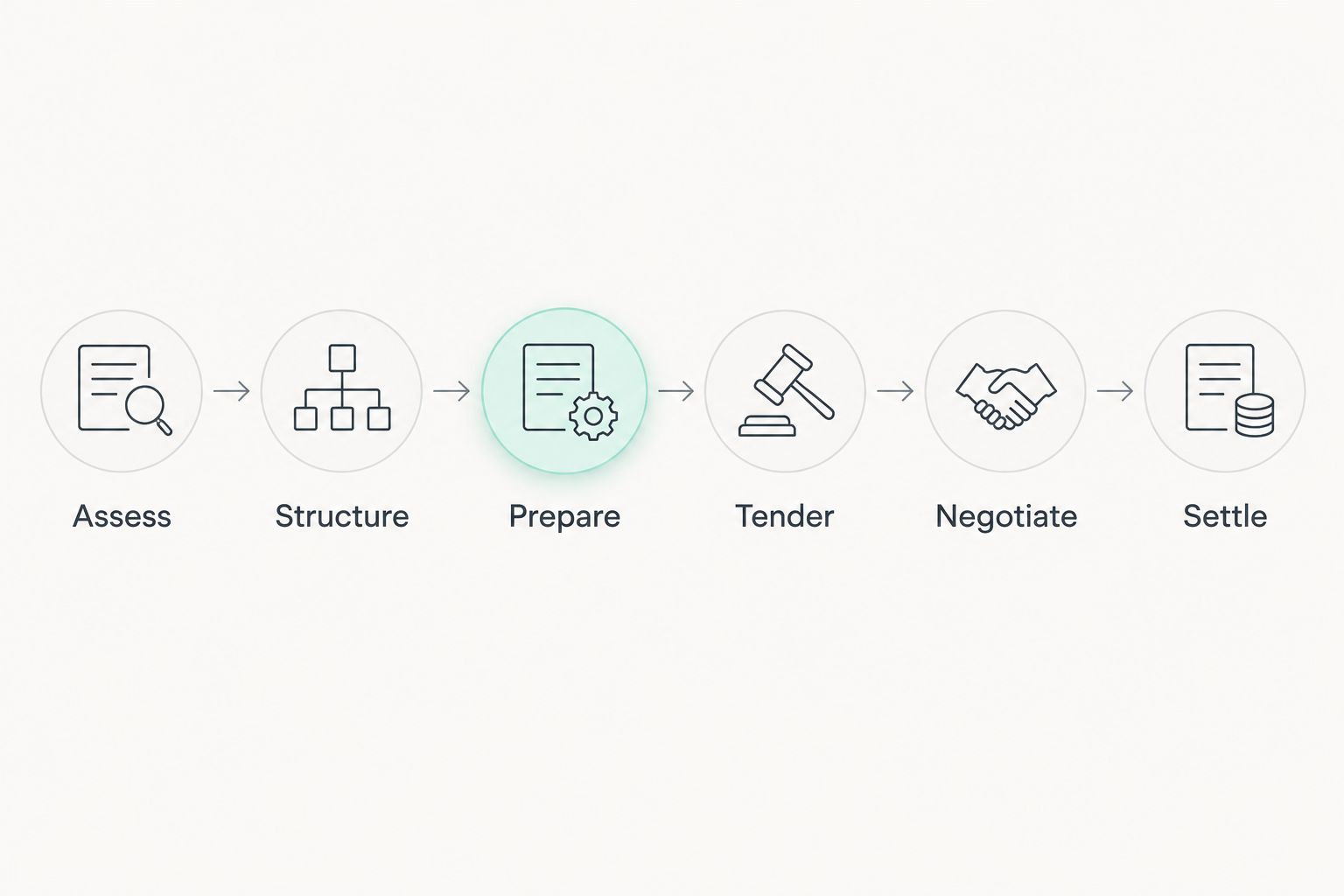
For a 2026 tender, require each response to state its security and guarantee position explicitly. Otherwise, an apparently attractive proposal can be difficult to compare with one carrying materially different obligations.
What should you check before refinancing existing debt?
Refinancing changes more than the lender receiving your repayments. Check what must be repaid, which securities must be released and whether the proposed replacement covers the facilities you still need.
Review these items before accepting a new working capital offer:
- The current facility’s repayment and termination provisions.
- Security shared across existing loans or related entities.
- Guarantees that require a separate release.
- Any need for consent from the existing lender.
- The new facility’s reporting requirements and financial covenants.
- The practical sequence for repayment, release and replacement funding.
A new unsecured facility does not automatically release an old mortgage or guarantee. Obtain confirmation of the obligations that end and those that remain.
Keep brokerage remuneration separate from the credit proposal. Distinguish lender-paid brokerage from debt advisory services, which use a retainer and success-fee structure. Ask for the applicable engagement terms and remuneration disclosure before proceeding.
Can I get unsecured cash flow finance without a personal guarantee?
Unsecured cash flow finance without a personal guarantee depends on the lender’s assessment and contract. The absence of asset security does not establish that a guarantee is absent too.
Request a written statement of all borrower and guarantor obligations. Have your legal adviser review any guarantee before signing, particularly where related companies or personal obligations are involved.
Is unsecured cash flow finance better than refinancing?
Unsecured cash flow finance is not automatically better than refinancing existing banking arrangements. Additional debt addresses a funding requirement; refinancing reviews how existing borrowing is structured and supported.
Compare both routes against the same forecast. If the issue is the repayment profile of current debt, adding another repayment can leave the underlying problem unchanged.
Can unsecured cash flow finance fund equipment or property needs?
Unsecured cash flow finance needs a repayment profile that fits the proposed use. Equipment purchases, property projects and everyday working capital create different cash demands and should be assessed separately.
For a 2026 borrowing plan, identify the purpose first. Do not choose a short repayment schedule for a longer-term requirement simply because the application appears easier.
FAQ
Can cash flow finance really be unsecured?
Yes, cash flow finance can be unsecured when the agreement does not grant asset security. Check the facility agreement and any guarantees, because an unsecured product description does not remove repayment liability.
Does unsecured business finance mean I cannot lose personal assets?
No, unsecured business finance does not establish that personal assets are beyond recovery action. A personal guarantee can create personal liability, and the lender’s recovery rights depend on the documents and applicable law.
Can I borrow without giving a personal guarantee?
That depends on the lender’s assessment and proposed contract. Ask for explicit confirmation of guarantee requirements rather than treating unsecured and no personal guarantee as equivalent.
Is turnover enough to qualify for cash flow finance?
No, turnover alone does not establish repayment capacity. Lenders also assess cash generation, operating commitments, existing debt and the proposed repayment source.
Can I add an unsecured loan while keeping my existing bank?
Check your existing agreements before adding another loan. Borrowing restrictions, consent requirements and existing security arrangements can affect whether the proposed facility fits your current banking structure.
Is invoice finance the same as an unsecured cash flow loan?
No, invoice finance funds eligible receivables and can involve assignment or security arrangements. An unsecured cash flow loan has its own repayment schedule and contractual obligations.
What should I prepare for a commercial finance review?
Prepare financial statements, current management accounts, a debt schedule and a cash flow forecast with supporting assumptions. Include existing facility and security documents so the review addresses the whole borrowing position.
One last thing
Ask what happens when receipts arrive late, not just what happens at settlement. A facility that looks suitable on the funding date still needs to work through delayed collections, existing repayments and ordinary operating expenses.
Before signing, put the repayment schedule beside your cash flow forecast. Mark the source of cash for each repayment and confirm which contractual obligations remain if the forecast is missed.
Related guides
- Equipment finance options for manufacturing businesses
- Equipment finance options for construction businesses
- Income requirements for commercial property finance
Written by the Glenclair Financial team.