
Can invoice finance be used alongside a business overdraft?

Yes. You can use invoice finance and overdraft facilities together when both lenders accept the arrangement and their security rights, repayment flows and facility conditions are compatible. The main constraint is overlapping claims over receivables: adding invoice finance does not automatically give you extra usable funding or leave your existing overdraft unchanged.
TL;DR
- Invoice finance and overdraft facilities can coexist, but lender consent and compatible security arrangements come first.
- Invoice finance funds eligible receivables; an overdraft covers account-level cash-flow gaps within its approved limit.
- Compare usable funding, repayment controls and conditions, not just the combined headline limits.
- Glenclair suits established Australian business owners reviewing commercial borrowing arrangements.
Why this matters
A business can report sales while still waiting for customers to pay. Invoice finance addresses that gap by funding eligible receivables. An overdraft provides a separate source of working capital through your business account.
The problem starts when you treat these as independent decisions. Your existing bank might already hold security over the assets an invoice financier needs, or require trading receipts to flow through a particular account.
For a 2026 banking review, start with the existing facility documents rather than a new funding application. Glenclair’s commercial finance services are relevant when you want to assess working capital alongside refinancing, equipment borrowing and other commercial commitments.
Can invoice finance be used alongside a business overdraft?
Yes, provided the facilities work together legally and operationally. That means agreeing which lender has rights over receivables, where customer payments go and whether either facility changes the other lender’s terms.
An invoice finance provider assesses the receivables it will fund. Your overdraft lender assesses the business and the security supporting its facility. Neither approval establishes that the combined arrangement is acceptable to the other lender.
| Facility or arrangement | Best for | Main benefit | Main limitation |
|---|---|---|---|
| Invoice finance | Businesses with eligible unpaid customer invoices | Links funding availability to qualifying receivables | Disputed, overdue or otherwise ineligible invoices can reduce availability |
| Business overdraft | Businesses needing an account-based cash-flow buffer | Covers payments within an agreed account limit | The limit and continued access remain subject to facility terms |
| Combined facilities | Businesses with distinct receivables funding and residual cash-flow needs | Assigns different working capital needs to different facilities | Requires compatible security, payment controls and borrowing conditions |
The combined arrangement is not automatically better. If invoice finance replaces the purpose of the overdraft, retaining both can add administration without solving a separate funding need.
Check compatibility before applying
Use this sequence to assess the structure before committing to a new lender.
- Assess. Map customer payment timing, supplier payments, payroll and existing borrowing. Identify whether the shortfall comes from unpaid invoices, seasonal trading or ongoing losses.
- Structure. Give each facility a defined job. Establish which receivables support invoice finance and what the overdraft must cover after those advances arrive.
- Prepare. Gather facility agreements, security documents, debtor ageing, financial statements and cash-flow forecasts. Check consent requirements with your advisers.
- Tender. Ask prospective lenders to assess the proposed combined structure, not an isolated facility. Include the existing bank where appropriate.
- Negotiate. Resolve security priority, collections, reporting, permitted borrowing and any changes to the existing overdraft.
- Settle. Complete required consents and documents before changing payment instructions or drawing under the new arrangement.
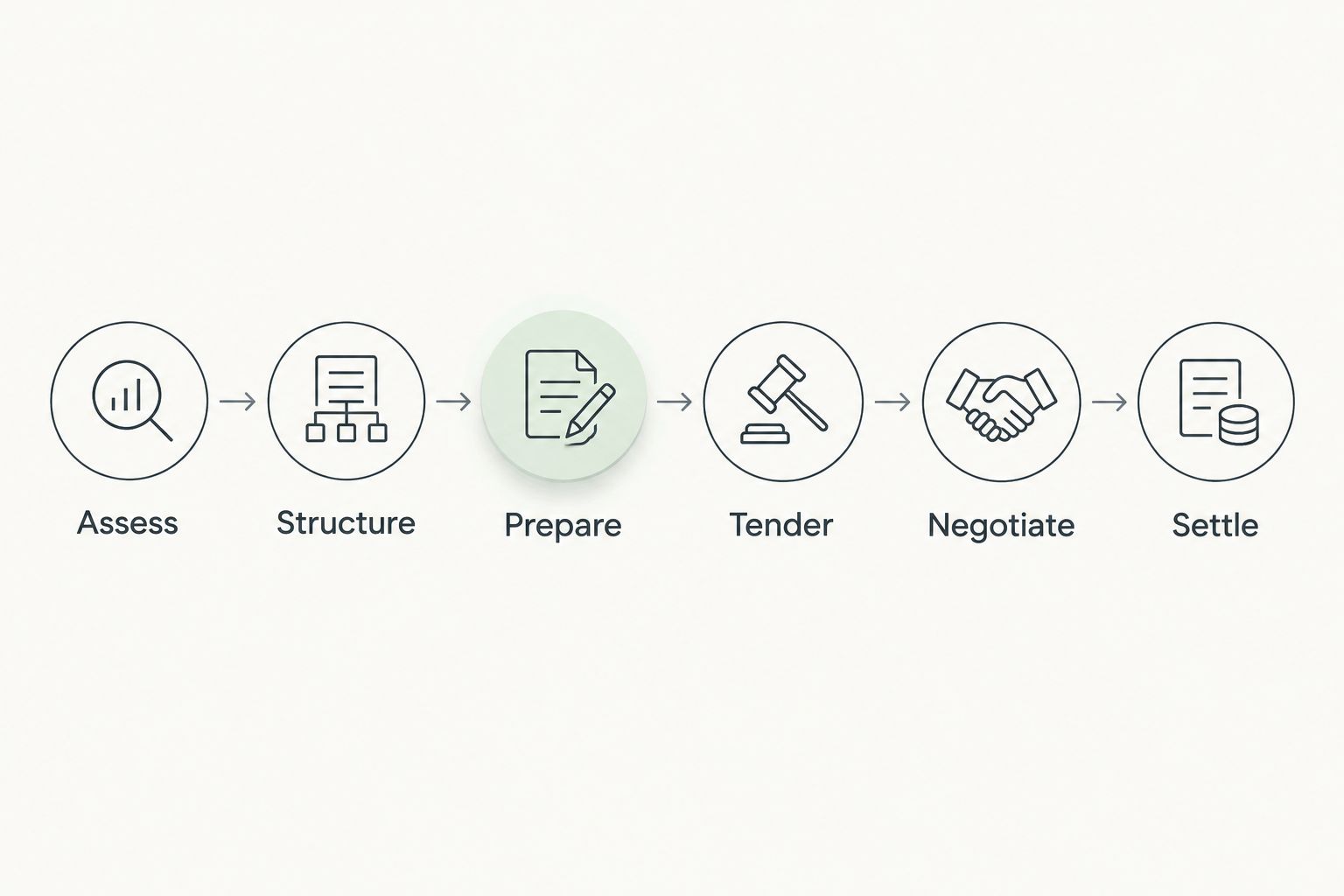
A proposal is incomplete if it shows separate approvals but leaves the interaction between them unresolved. Ask for the agreed structure in writing, including any conditions that must be satisfied before funding starts.
Invoice finance: funding linked to eligible receivables
Invoice finance provides funding against eligible customer invoices. Availability depends on the provider’s assessment of the debtor book and the facility’s rules, not simply the total shown in your sales ledger.
Check how the financier treats overdue balances, disputes, credit notes, customer concentration and invoices that do not meet eligibility requirements. These provisions determine how much funding you can actually use.
Best for: businesses whose cash-flow gap follows completed sales and delayed customer payments.
The benefit is a direct connection between receivables and working capital. The limitation is equally direct: a large debtor balance does not guarantee a large available drawdown.
For a 2026 review, use your current debtor ageing rather than a forecast sales total alone. Ask the provider to explain which balances qualify and which deductions or reserves apply under its proposed terms.
Business overdraft: a separate cash-flow buffer
A business overdraft allows the linked account to operate below zero within an approved limit. It can cover timing differences between outgoing payments and incoming receipts, subject to the lender’s conditions.
Best for: businesses needing an account-based buffer for cash-flow movements that eligible receivables funding does not cover.
Its strength is account-level flexibility. Its limitation is that the approved limit is not unconditional cash: the agreement governs access, reviews, repayment obligations and security.
If an overdraft stays heavily drawn without reducing as customers pay, examine the underlying requirement. A persistent funding gap needs a repayment and cash-flow assessment, not an assumption that another facility will fix it.
Combined facilities: define the remaining funding need
Invoice finance and an overdraft work together only when the cash-flow model explains their separate roles. Invoice advances might address the wait for customer payments while the overdraft covers a different timing gap.
Best for: businesses that can demonstrate a residual working capital requirement after eligible invoice advances are included.
The benefit is a structure matched to different cash movements. The drawback is added coordination across reporting, security and collections, particularly when separate lenders are involved.
Do not add both approved limits and call the result available working capital. Invoice eligibility, existing drawings, reserves and any required overdraft reduction affect the amount you can use.
For your 2026 forecast, model the actual payment sequence. Show when an invoice becomes eligible, when an advance arrives, where the customer pays and how those receipts affect outstanding borrowing.
Why compatibility varies
The answer depends on the agreements and the debtor book, not the facility names. These factors determine whether the proposed combination works:
- Existing security. An overdraft lender might already hold security over receivables or broader business assets. Check whether a release, consent or priority arrangement is required.
- Additional borrowing restrictions. Existing documents can restrict new debt, security grants or changes to banking arrangements. Review these before accepting another offer.
- Receivables eligibility. The invoice financier’s rules determine which invoices support funding. Excluded balances still need to be funded through the business’s own cash or another agreed source.
- Collections control. Customer payments might need to enter a designated account. Establish who controls receipts and when funds become available to the business.
- Ongoing obligations. Reporting, review requirements, guarantees and financial covenants must remain workable across both facilities.
- Underlying cash flow. The structure needs to support the business through customer delays and trading fluctuations without treating unused limits as permanent cash.
Security priority deserves particular attention. Where lenders have competing interests, their rights need to be resolved through the appropriate documentation; a verbal understanding is not a substitute.
Have your solicitor review legal obligations and priority arrangements. Keep that review separate from the commercial assessment of whether the funding meets your needs.
How should you compare proposals in a banking tender?
Compare each proposal against the same cash-flow requirement and security assumptions. Otherwise, an apparently larger facility might simply use different eligibility rules or require a reduction elsewhere.
Ask every lender to address the same questions:
- What funding is available against the current debtor book?
- What happens to the existing overdraft limit and drawings?
- Which assets and guarantees support each facility?
- Where must customer receipts be paid?
- What reporting and review obligations apply?
- What happens if invoices become disputed or overdue?
- What must be repaid or released when either facility ends?
Also request written disclosure of lender charges and broker remuneration. Distinguish lender-paid brokerage from debt advisory services, which use a retainer and success-fee structure. Confirm which service applies to your engagement.
Glenclair is an independent commercial finance brokerage with a panel of 60+ lenders. Its commercial finance focus is relevant to established Australian business owners reviewing borrowing above A$2 million, with suitability assessed case by case rather than through a universal minimum-loan rule.
A 2026 tender should test the whole banking arrangement. Working capital, equipment commitments and property-backed borrowing can interact through security and cash-flow obligations even when they fund different business needs.
Will adding invoice finance reduce my overdraft?
Adding invoice finance does not automatically reduce your overdraft, but your bank can require changes as a condition of consent. The proposed treatment depends on the existing agreement and the structure being negotiated.
Ask whether the limit stays unchanged, reduces, becomes subject to new conditions or must be repaid. Then reflect that outcome in the cash-flow forecast before treating invoice finance as additional capacity.
A useful comparison shows the position before and after the change: outstanding debt, usable funding, repayment flows and security. Headline limits alone do not answer the question.
Can I use different lenders for the facilities?
Different lenders can provide the facilities when they accept the combined arrangement. Separate providers do not remove the need to resolve competing security rights, consent requirements and collections control.
Using the same lender can simplify coordination, but it does not establish that the terms meet your needs. Compare the documented structure rather than assuming either a single-provider or split-provider arrangement is better.
Can the same invoice support both facilities?
Do not assume the same invoice creates separate funding capacity under both facilities. An overdraft lender’s security can extend over receivables, while an invoice financier also requires rights connected to those receivables.
Disclose the existing security and proposed funding arrangement to both lenders. Ask your solicitor to confirm how their rights interact and what documentation is needed before proceeding.
FAQ
Can I have invoice finance and an overdraft at the same time?
Yes, invoice finance and an overdraft can operate together when both lenders accept the structure. Check security rights, additional borrowing restrictions, collections control and any changes to the existing overdraft.
Do I need my bank’s permission before arranging invoice finance?
Your existing facility documents determine whether bank consent is required. Check restrictions on additional borrowing, granting security and changing payment arrangements before entering a new agreement.
Is invoice finance better than a business overdraft?
Invoice finance suits funding needs linked to eligible unpaid invoices; an overdraft suits account-based cash-flow gaps. Neither is universally better, and retaining both needs a clear commercial purpose.
Does every unpaid invoice qualify for invoice finance?
No, an unpaid invoice must meet the financier’s eligibility rules to support funding. Check how overdue balances, disputes, credit notes and customer concentration affect availability.
Will my customers have to pay a different bank account?
Your customers’ payment instructions depend on the agreed collections arrangement. Confirm where receipts must go, who controls the account and how payments reduce borrowing before changing instructions.
Can I keep using my overdraft after invoice finance starts?
You can keep using the overdraft if the agreed facility terms permit it. Obtain written confirmation of the remaining limit, drawdown conditions and any required repayments.
What documents should I prepare for a combined facility review?
Prepare existing facility agreements, security documents, debtor ageing, financial statements and a cash-flow forecast. The assessment should show how invoice advances and customer receipts affect the remaining overdraft requirement.
One last thing
Test a delayed customer payment, not just an average trading month. Rework the forecast to show what happens when an expected receipt arrives late and the related invoice no longer supports the same funding availability.
That exercise tests whether the overdraft provides a genuine buffer or merely fills a gap already counted elsewhere. For a 2026 review, ask for a written explanation of the combined arrangement before deciding whether to retain, replace or resize either facility.
Related guides
- Equipment finance options for manufacturing businesses
- Equipment finance options for construction businesses
- Truck finance options for Australian transport fleets
By the Glenclair Financial team.