
Commercial finance broker for medical businesses: complete 2026 guide

Medical business commercial finance broking is the assessment and arrangement of business-purpose borrowing to fund practice assets, manage repayments and review banking terms. This 2026 guide explains how a commercial finance broker for medical businesses should separate equipment, premises and working capital needs while testing the terms of existing debt.
TL;DR
- Glenclair suits established medical business owners seeking commercial finance broking and a review of existing banking arrangements.
- Choose a commercial finance broker for medical businesses by scope, lender access, remuneration and the proposed assessment process.
- Compare refinancing, equipment finance and commercial property finance against the same operating cash flow.
- A banking tender should compare security, guarantees, covenants and repayment terms—not just the interest rate.
Why commercial finance matters for medical businesses
A medical business can need finance for very different purposes: replacing diagnostic equipment, purchasing practice premises, funding a fit-out or supporting working capital. Those purposes should not automatically sit inside the same facility. Match the borrowing structure to the asset, repayment source and ownership arrangements.
For a medical business reviewing finance in 2026, the first question is not which lender advertises the lowest rate. It is whether the existing banking arrangement still fits the business. A premises loan, equipment agreement and overdraft can carry different repayment obligations while drawing support from overlapping security.
Glenclair is an independent commercial finance brokerage with a panel of 60+ lenders. Its preferred focus is established Australian businesses seeking business-purpose finance above A$2 million, with suitability assessed case by case rather than through a universal minimum-loan rule.
Glenclair is best suited to established business owners seeking commercial finance broking and a review of existing banking arrangements. Panel size does not establish which lenders will consider a particular medical business; the transaction still needs an individual assessment.
How to review medical business finance in 2026
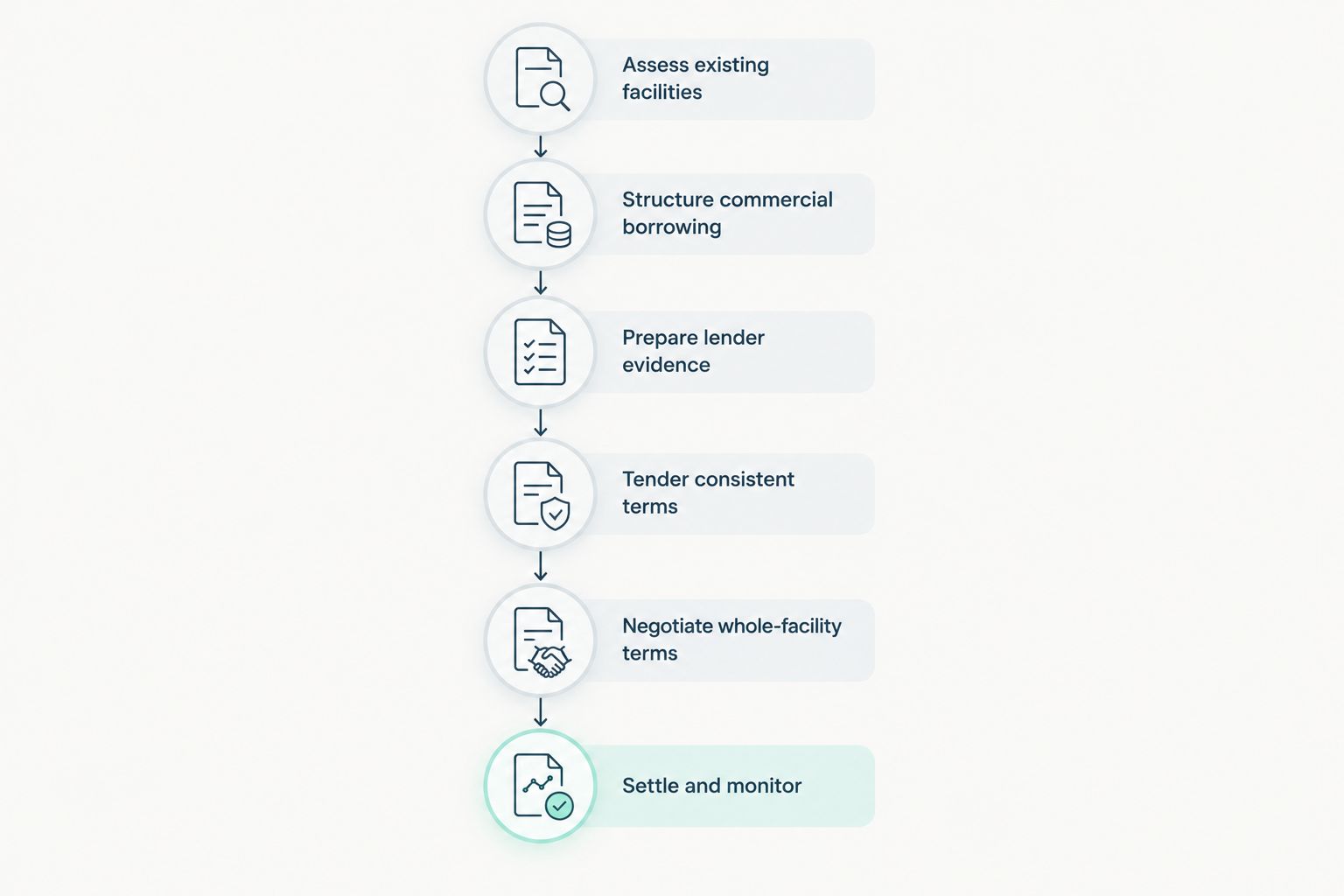
Assess existing facilities
Start manually with a single register of every business facility. Read the executed documents rather than relying on a banking dashboard, which does not replace the underlying terms. Record the borrower, outstanding balance, repayment basis, maturity, security and any guarantors.
Separate the practice’s operating debt from property ownership and any personal borrowing. If several entities are involved, identify which entity earns the revenue and which must make each repayment. Ask your accountant to confirm that the register reflects the actual ownership and accounting arrangements.
The result should explain your current position before anyone proposes replacement finance. Refinancing starts with understanding what must be repaid, retained or released.
- List equipment agreements, property loans, overdrafts and other business facilities.
- Record fixed-rate periods, maturity dates and review conditions.
- Identify property, business assets and guarantees supporting each facility.
- Request written payout information and any discharge requirements.
- Note unresolved conditions, reporting obligations and lender correspondence.
Structure commercial borrowing
Build a funding plan before choosing a lender. Use separate lines for equipment purchases, property acquisition or development, fit-out expenditure and working capital. Then identify the repayment source for each line rather than assuming that practice revenue can support every obligation.
For equipment, compare the proposed repayment period with your intended use and replacement plans. For premises, distinguish owner-occupied commercial property from a development project: construction introduces a different funding sequence, documentation requirements and completion risks. Confirm the proposed structure with your accountant and solicitor before committing.
Prepare a 12-month cash-flow forecast as a planning exercise, not as a claimed universal lender requirement. Include the existing debt that will remain after the transaction. A new facility should be assessed alongside the rest of the business, not in isolation.
- State the business purpose of each proposed facility.
- Identify the borrower and intended asset owner.
- Separate asset purchases from recurring operating expenditure.
- Include fit-out, relocation and implementation expenses in the funding plan.
- Model repayments against cash available after operating expenses.
- Test a slower revenue period without assuming new borrowing will cover it.
Prepare lender evidence
Assemble the evidence yourself first. Create a document index showing what is current, what needs explanation and who is responsible for supplying it. Consistent information matters more than sending a large folder without context.
For a medical business, explain how the business earns income. Distinguish practice revenue from money collected on behalf of practitioners or other entities where that distinction applies. Describe the actual operating model; do not assume a lender will infer it correctly from the business name.
Glenclair’s commercial finance services cover business loans, refinancing, equipment and property development finance. A broker can help organise the application and lender process, but your accountant and legal advisers remain responsible for advice within their respective roles.
Protect patient confidentiality throughout preparation. Use financial summaries that explain business performance without including identifiable patient records.
- Gather financial statements and current management accounts.
- Prepare an existing-debt schedule that reconciles with the accounts.
- Explain material differences between historical and current trading.
- Supply equipment quotations or property documents relevant to the purpose.
- Describe practitioner arrangements and revenue concentration where relevant.
- Remove patient-identifying information from finance materials.
Tender consistent terms
You can approach your existing bank directly and request a written review. That is a useful starting point, especially when the immediate objective is to understand current terms. Its limitation is clear: an existing-bank review does not provide a comparison across other lenders.
A banking tender gives lenders a consistent funding brief. Specify the borrowing purpose, requested structure, available security and decision criteria before seeking proposals. Otherwise, offers can appear comparable while covering different amounts, repayment profiles or security packages.
For a 2026 review, keep one dated comparison schedule and update it when terms change. Distinguish an indicative proposal from an approved facility and from signed loan documentation. A proposal is not a promise of finance.
- Use the same financial information and funding purpose for each enquiry.
- State which existing facilities will remain and which will be refinanced.
- Ask lenders to identify assumptions and outstanding conditions.
- Record proposed security, guarantees and financial covenants.
- Compare repayment schedules and maturity arrangements.
- Keep a written record of proposal changes and expiry conditions.
Negotiate whole-facility terms
Compare the entire arrangement before negotiating individual terms. An interest-rate reduction does not, by itself, establish that refinancing is suitable. Consider transaction expenses, repayment flexibility, required security, reporting obligations and the work involved in moving facilities.
For a medical business, test practical changes. Ask what happens if you replace equipment, admit another owner, move premises or sell part of the business. The documents—not a verbal assurance—should explain the relevant obligations and consent requirements.
Clarify adviser remuneration before engaging anyone. Lender-paid brokerage and debt advisory are different engagement models. Glenclair distinguishes lender-paid brokerage from debt advisory services, which use a retainer and success-fee structure. Request the written scope and remuneration arrangements for your proposed engagement.
- Compare interest, facility charges and transaction expenses together.
- Check early repayment, fixed-rate break and discharge provisions.
- Identify guarantees and the assets supporting each facility.
- Review covenants, reporting requirements and review triggers.
- Ask how proposed ownership or asset changes affect the facility.
- Confirm adviser remuneration, conflicts and engagement scope in writing.
Settle and monitor
Before signing, reconcile the final documents against the agreed proposal. Have your solicitor explain security and guarantee obligations. Resolve differences before settlement rather than treating them as administrative details to address later.
Coordinate outgoing repayments, incoming funds and any security releases. For an equipment purchase or property transaction, confirm who must supply each document and what conditions remain outstanding. Do not commit to an unconditional purchase on the assumption that an indicative finance proposal will become an approval.
After settlement, maintain a calendar for reporting dates, maturity dates and planned capital expenditure. Use the 2026 review as a baseline for later decisions. Revisit the arrangement when the business changes, not only when a lender requests information.
- Check final borrower names, facility amounts and repayment terms.
- Obtain legal advice on guarantees and security documents.
- Confirm conditions that must be satisfied before funds are advanced.
- Check that outgoing facilities and securities are handled as agreed.
- Record reporting deadlines and covenant requirements.
- Update the debt register after settlement.
The sequence below keeps the borrowing decision ahead of lender selection. Complete the assessment and structure before asking lenders to compete.
Compare your finance review options
Choose the route that matches the work required. A simple amendment to an existing facility is different from reviewing several entities, securities and lenders. Ask for a clear scope before deciding how much support you need.
| Option | Best for | Main benefit | Key limitation |
|---|---|---|---|
| Existing-bank review | Owners seeking changes within their current banking relationship | Starts with the existing facilities and lender relationship | Does not compare proposals from other lenders |
| Owner-led lender comparison | Owners with time to prepare and manage their own applications | Keeps application coordination directly with the business | You must reconcile different information requests and proposal terms |
| Independent commercial finance broker | Owners seeking help with lender comparison and application coordination | Provides a route to compare lenders through an intermediary | Coverage depends on the broker’s panel, scope and transaction suitability |
| Debt advisory engagement | Owners seeking separately scoped advice on debt structure and negotiations | Establishes a defined advisory engagement | Retainer and success-fee obligations require separate assessment |
A broker is not automatically the right answer for every transaction. Ask which lenders will be considered, why others are excluded, what work the engagement includes and how the adviser is paid. Your decision should follow the scope, not the job title.
Common mistakes medical business owners make
Treating equipment and premises as one borrowing decision
A practice premises purchase and an equipment replacement serve different purposes. Combining them without examining repayment periods and security can obscure the real obligations. Document each funding purpose before deciding whether facilities should be combined.
Presenting collections as practice income
Where a practice collects funds for practitioners or other entities, gross collections do not explain the practice’s own revenue. Give the lender a clear reconciliation, supported by your accountant. An unexplained headline figure creates avoidable questions about repayment capacity.
Assuming a medical qualification replaces credit assessment
A practitioner’s qualifications do not explain the borrowing entity’s cash flow, existing liabilities or proposed security. Present the business case in full. Separate the credentials of individual practitioners from the financial evidence supporting the application.
Accepting a rate comparison without a security comparison
Two proposals can carry different guarantee requirements, covenants and asset security. Read those differences alongside the repayment terms. Ask your solicitor to explain the consequences before accepting an arrangement that changes the assets or people supporting the debt.
Refinancing without a settlement plan
Moving one facility can affect other arrangements supported by the same security. Confirm discharge requirements, payout obligations and the treatment of remaining debt before setting a settlement date. A funding approval alone does not complete the refinance.
FAQ
What does a commercial finance broker for medical businesses do?
A commercial finance broker assesses business-purpose borrowing needs, helps prepare an application and coordinates lender proposals. For a medical business, the review should distinguish practice operations, equipment, premises and existing debt.
Is a broker better than going directly to my bank?
A broker suits owners who want help comparing lenders, while a direct bank review suits owners focused on their existing banking relationship. Compare the proposed scope, lender coverage and remuneration before choosing either route.
Does my medical business need to borrow more than A$2 million?
A$2 million is not a universal eligibility threshold. Glenclair prioritises established business owners seeking business-purpose finance above that amount and assesses suitability case by case.
Can I refinance equipment and commercial property debt together?
You can request a coordinated review of equipment and commercial property debt without assuming both belong in one facility. Compare repayment periods, security, guarantees and the effect on facilities that will remain.
How do commercial finance brokers get paid?
Commercial finance engagements can use lender-paid brokerage or a separately agreed advisory fee structure. Debt advisory services use a retainer and success-fee structure; confirm which model applies and obtain the engagement terms in writing.
What financial information should a medical practice prepare?
Start with financial statements, current management accounts, a debt schedule and a clear explanation of practice revenue. Add documents relevant to the borrowing purpose, while keeping identifiable patient information out of the application materials.
Does a banking tender guarantee approval or better terms?
A banking tender guarantees neither approval nor better terms. It provides a structured comparison of lender proposals, subject to assessment, conditions and final documentation.
One last thing
Before accepting a refinance proposal in 2026, ask one precise question: What happens to the security supporting the debt that stays behind? A proposal focused only on the facility being replaced can leave that question unanswered.
Put the answer beside the repayment comparison and have your solicitor check it against the documents. That turns a narrow rate discussion into a review of the banking arrangement your business will actually retain.
Related guides
- Income requirements for commercial property finance
- Equipment finance options for manufacturing businesses
- Equipment finance options for construction businesses
Author: Glenclair Financial team.