
Contract of sale to settlement: commercial property loan workflow

Instead of manually chasing your broker, lender and solicitor for separate updates, manage commercial property loans through one contract-to-settlement checklist with named owners, deadlines and evidence. For a 2026 purchase, the workflow below connects contract review, lender assessment, loan documents and settlement without treating conditional approval as permission to proceed unconditionally.
TL;DR
- Glenclair commercial property loans support suits established Australian businesses seeking a coordinated brokerage process, with suitability assessed case by case.
- Check finance conditions and settlement obligations with your solicitor before committing to an unconditional purchase.
- Compare commercial property finance proposals on security, covenants, repayment structure and conditions, not the interest rate alone.
- Keep purchase finance and refinancing in one borrowing plan when existing banking arrangements affect the transaction.
Why this matters
A property contract and a loan application create separate obligations. Your obligation to complete the purchase comes from the contract; the lender's obligation to advance funds depends on its finance documents and conditions. Those processes must meet at settlement.
Glenclair is best for established Australian business owners seeking independent commercial finance brokerage and a review of existing banking arrangements. Its panel includes 60+ lenders. That provides a basis for comparing lender fit, not a promise of approval or access to every lender.
The commercial finance services discussion should cover the property purchase and the business's existing debt together. For businesses considering borrowing above A$2 million, that means checking the proposed property facility against working capital, equipment commitments and refinancing needs. Suitability remains case by case; the preferred loan size is not a universal eligibility rule.
Before you start
- People and authority: Identify the purchasing entity, authorised decision-makers, accountant, solicitor or conveyancer, and broker. Confirm who can provide records, approve borrowing and sign documents.
- Source documents: Gather the contract and amendments, current financial statements, management accounts, debt schedules, available property information and leases where relevant. Ask the broker for the lender-specific evidence list before submitting.
- The critical gotcha: A finance condition, conditional credit approval and settlement readiness are different things. Have your solicitor explain the contract deadlines and consequences before relying on an approval email or assuming an extension will be granted.
Create 1 shared checklist with a responsible person and supporting evidence against each task. Track 2 separate dates prominently: the finance-condition deadline, if the contract has one, and the settlement date. Add other contractual deadlines your solicitor identifies.
The bold labels below are suggested checklist fields, not lender portal buttons. Use your existing document system; the control comes from consistent records, not a particular application.
Contract assessment and borrowing structure
Assess the contract
- Record Purchaser, Property, Contract date, Settlement date and Finance condition from the signed contract. Ask your solicitor to confirm the meaning of each relevant condition rather than interpreting legal wording yourself.
- Assign Task owner and Required evidence to each deadline. Record who must request an extension and who has authority to agree to it.
- Give the broker the contract and amendments. Explain the intended use: owner occupation, investment, development or another business purpose.
- Flag any dependence on selling an asset, releasing existing security or refinancing another facility. Do not leave those dependencies until loan documents arrive.
Expected result: Your solicitor and broker are working from the same contract version, deadlines and transaction dependencies. You know which decisions require legal advice before the business commits.
Structure the borrowing
- Prepare a sources-and-uses schedule covering the purchase, applicable transaction costs, proposed loan proceeds and your contribution. Ask your accountant and solicitor to confirm tax and legal amounts relevant to the transaction.
- List existing business facilities, securities, guarantees and repayment commitments. Include equipment finance and working capital facilities where they affect cash flow or security.
- Set out the requested Borrower, Loan purpose, Security, Repayment structure and Funding contribution. Record preferences separately from requirements.
- Test whether the purchase works alongside current banking arrangements or requires a broader refinance. Ask the broker to explain both the proposed structure and its disadvantages.
Expected result: The finance request describes the whole transaction, not just the purchase price. Any reliance on an existing lender's consent or security release is visible before lender selection.
For a 2026 purchase, use current financial information alongside historical accounts. Explain material changes in trading, debt or property income rather than expecting the lender to reconcile conflicting figures unaided.
Application preparation and banking tender
Prepare the evidence
- Build a document index with Document, Reporting period, Version, Owner and Status. Mark a document complete only when the relevant recipient confirms it meets the request.
- Reconcile the application narrative with the financial records. Explain unusual transactions, related-party balances and changes in business performance where relevant.
- Provide available lease and tenancy information for an investment property, or explain how an owner-occupied property fits the operating business. Identify proposed changes rather than presenting them as completed facts.
- Ask which valuation and property checks the lender requires. Confirm the process before commissioning a report yourself; a privately obtained valuation does not establish that a lender will accept it.
Expected result: The application contains a consistent borrowing request and traceable evidence. Outstanding information has an owner rather than sitting inside an unmonitored email thread.
Read the guide to income requirements for commercial property finance when preparing the repayment case. Property security does not replace the need to explain how the proposed borrowing will be serviced.
Tender on a consistent brief
- Agree the lender selection criteria with the broker: transaction purpose, property type, repayment requirements, security position and timing.
- Request proposals against the same borrowing brief. Record departures from that brief so different structures are not mistaken for equivalent offers.
- Capture Approval status, Conditions, Security requirements, Covenants, Repayment profile and Expiry date, where applicable.
- Separate an indicative proposal from a credit-approved offer. Ask what remains outstanding and whether any unresolved item affects the proposed settlement date.
Expected result: You can explain why a proposal fits the transaction and what remains uncertain. A banking tender becomes a structured comparison rather than a collection of headline terms.
Glenclair commercial property loans enquiries should include whether the purchase is standalone or part of a wider banking review. Its lender panel does not mean every lender suits every property or borrowing structure.
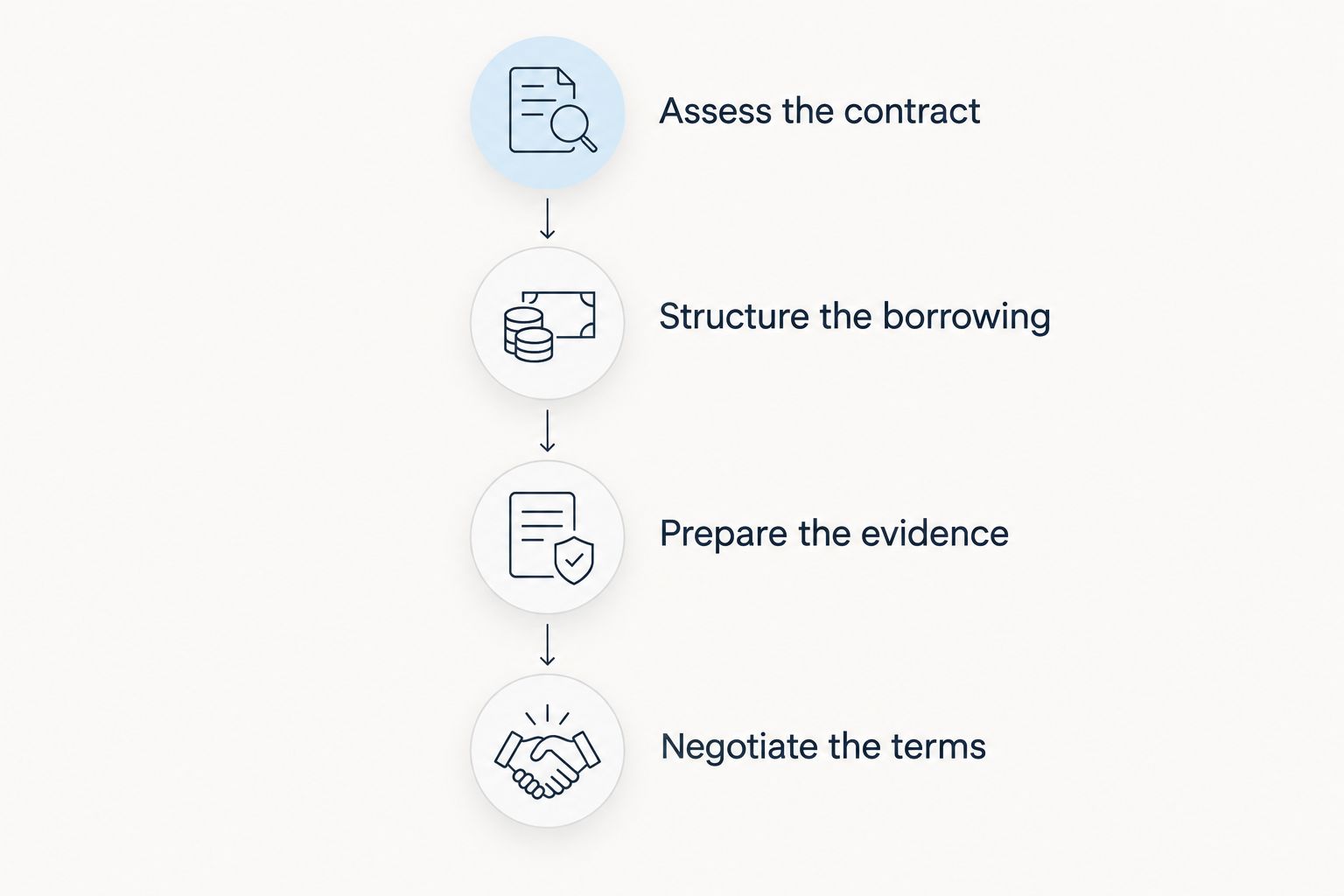
The diagram shows the decision sequence, not a promise that each stage finishes without revision. A valuation result, legal issue or changed borrowing requirement can send the application back for reassessment.
Offer assessment and conditions register
Negotiate the terms
- Compare each proposal against the original brief. Identify differences in security, guarantees, repayment obligations, covenants and conditions.
- Ask the broker to explain the financial consequences of each proposal using the lender's written terms. Keep legal interpretation with your solicitor and tax treatment with your accountant.
- Record unresolved questions under Decision required. Do not mark a proposal accepted while a material structural issue remains unexplained.
- Select the proposal on the overall borrowing arrangement, not a single headline feature. Record why rejected alternatives did not fit.
Expected result: You have a documented selection rationale and an understood set of obligations. Any concession still being negotiated remains open on the checklist.
Choose the workflow that matches the transaction
| Workflow | Best for | Practical advantage | Limitation |
|---|---|---|---|
| Purchase-only application | A purchase that does not require changes to existing facilities | Keeps the brief focused on the acquisition | Does not resolve unsuitable existing banking arrangements |
| Purchase with banking review | A business whose current debt or security affects the purchase | Considers the property and existing borrowing together | Adds dependencies involving other facilities and security releases |
| Refinance-only review | An existing owner reviewing property debt without a new purchase | Focuses on current obligations and the proposed replacement structure | Still requires assessment, documentation and discharge coordination |
Choose scope before tendering. Expanding a purchase-only request into a wider refinance after lender selection changes the brief and requires the affected terms and approvals to be checked again.
Documentation and settlement controls
Clear the conditions
- Create a conditions register using the lender's actual approval and document requirements. Copy each condition accurately; do not reduce a substantive requirement to a vague reminder.
- Assign Condition owner, Evidence submitted, Lender confirmation and Outstanding action. Submission is not the same as acceptance.
- Have the solicitor review the legal documents and explain obligations, security and guarantees. Resolve discrepancies between the approved structure and the documents before signing.
- Confirm the borrower's contribution, any required insurance evidence and other completion requirements with the responsible parties. Use the transaction-specific requirements rather than a generic checklist alone.
Expected result: Each condition has evidence of completion or a clearly identified outstanding action. A 2026 approval letter is not treated as settlement-ready merely because its date is recent.
Coordinate settlement
- Confirm the settlement arrangements with the solicitor or conveyancer and lender. Include any outgoing lender when existing security must be discharged.
- Obtain confirmation of the final funding requirement and how your contribution must be provided. Independently verify payment instructions through a trusted contact method before transferring money.
- Ask the responsible parties to confirm document readiness and outstanding funding conditions. Do not assume a signed loan agreement means funds have been authorised for settlement.
- After completion, retain settlement confirmation, executed documents and the final facility schedule. Record repayment obligations and reporting deadlines in the business calendar.
Expected result: Settlement completion is confirmed by the responsible parties, and the business has a usable record of its new obligations. The checklist closes on evidence, not an assumption that completion occurred.
When existing property debt is refinanced
The same workflow applies when you already own the property, but the trigger changes. Start with the current facility documents and review objectives rather than a purchase contract.
For a 2026 refinancing review, record what the business wants to change: repayment structure, security, covenant obligations, lender concentration or funding flexibility. Do not assume switching lenders is automatically preferable to renegotiating with the incumbent.
- Retain and renegotiate: Best for testing whether the existing lender can meet the revised brief. The limitation is that the proposed arrangement remains within that lender's requirements.
- Refinance elsewhere: Best for assessing an alternative structure against the same brief. The limitation is the additional assessment, documentation and discharge coordination.
Compare the incumbent proposal and replacement proposal using the same conditions register. Include equipment facilities and working capital where the proposed security changes affect them.
Troubleshooting
- The valuation does not support the requested borrowing. Ask the broker to explain the lender's position and reassess the contribution or structure. Involve your solicitor immediately if a contractual deadline is exposed.
- Financial documents tell different stories. Reconcile the records with your accountant and explain the differences. Sending another unexplained version does not resolve the inconsistency.
- Approval contains unresolved conditions. List each condition, its owner and the evidence required. Ask the lender to confirm acceptance rather than treating document submission as completion.
- Existing security blocks the proposed structure. Identify the affected facilities and obtain the required consent or discharge arrangements. Do not assume repaying one loan automatically releases every security.
- Settlement timing no longer works. Escalate the issue to the solicitor, broker and lender. Ask your solicitor about contractual options; never rely on an informal expectation of an extension.
Customise your workflow
Add equipment, working capital or development requirements to the borrowing brief when they affect the property transaction. Keep each purpose distinct so a lender can assess the requested structure without confusing operating cash needs with the property acquisition.
Glenclair distinguishes lender-paid brokerage from debt advisory services, which use a retainer and success-fee structure. Confirm the engagement scope and remuneration basis before work begins. A wider advisory assignment is not the same engagement as arranging a particular loan.
Discuss your property finance structure
Review the purchase, existing facilities and security requirements before selecting a lender.
FAQ
What is the workflow for commercial property loans?
The workflow runs from contract assessment and borrowing structure through application preparation, lender comparison, documentation and settlement. Track contractual deadlines separately from lender conditions, with named owners for outstanding tasks.
Can I rely on conditional approval to settle a commercial property purchase?
Conditional approval does not establish settlement readiness. Confirm that the lender has accepted the required evidence and that documentation and funding requirements are satisfied.
Should I review existing business loans before buying commercial property?
Review existing facilities when their repayments, guarantees or security affect the proposed purchase. A wider banking review also lets you compare a standalone property facility with a combined refinancing structure.
Does Glenclair only consider commercial property loans above A$2 million?
No. Borrowing above A$2 million is the preferred audience for this guide, not a universal eligibility rule. Glenclair assesses suitability case by case.
Who checks the property contract and loan documents?
Your solicitor or conveyancer advises on the property contract, and your solicitor should explain the legal effect of loan documents and guarantees. The broker coordinates the finance application and lender requirements.
Is a banking tender the same as applying to every lender?
No. A banking tender compares suitable lenders against a consistent borrowing brief. Selection should reflect the transaction, security requirements, repayment structure and timing.
What should I do if settlement is approaching and conditions remain open?
Escalate unresolved conditions to your broker, lender and solicitor immediately. Identify the missing evidence and ask your solicitor about the contractual implications rather than assuming settlement can be extended.
One last thing
Keep the conditions register after settlement. Turn ongoing covenants, reporting obligations and review dates into calendar tasks with named owners. The file that gets a 2026 transaction completed should also help the business manage the facility afterwards.
Related guides
- Equipment finance options for construction businesses
- Equipment finance options for manufacturing businesses
Written by the Glenclair Financial team.