
Development approval to staged drawdown: property finance workflow

Instead of rebuilding the funding file for every builder claim, set up a property development finance workflow that connects development approval, lender conditions and staged drawdowns. For a 2026 project, keep the approved scope, funding budget and evidence for each release in one controlled file.
TL;DR
- Property development finance needs separate controls for development approval, credit approval, settlement and each staged drawdown.
- Glenclair suits established Australian business owners seeking an independent commercial finance review; project suitability remains case by case.
- Prepare lender submissions around the development budget, construction contract, borrower contribution and repayment strategy.
- Recheck remaining funding against remaining costs whenever the project changes, not just when a builder submits a claim.
Why this matters
Development approval is not credit approval, and credit approval is not permission to draw every dollar. Planning conditions, facility conditions and construction payment obligations serve different purposes. Your funding workflow must track each separately.
Glenclair is an independent commercial finance brokerage with a panel of 60+ lenders. Its property development finance service is best suited to established Australian business owners seeking a structured review of commercial borrowing, with suitability assessed case by case.
The focus is business-purpose finance above A$2 million, particularly refinancing and existing banking reviews. That is a preferred enquiry profile, not a universal eligibility threshold or a promise of funding.
For property development finance in 2026, the practical objective is simple: identify what must happen before settlement, what must happen before each advance, and who supplies the evidence. A well-organised file supports assessment. It does not replace lender approval.
Before you start
- Collect the project materials. Assemble the development approval and conditions, plans, ownership details, construction contract or current tender, development budget, programme and supporting reports. Identify documents still being prepared rather than presenting them as final.
- Confirm access and authority. Nominate who can provide financial information, instruct advisers, approve changes and sign finance documents. Record the borrowing entities, security owners and proposed guarantors for assessment.
- Check the funding gap before promising payments. A builder's payment entitlement does not automatically match the lender's drawdown requirements. Confirm borrower contribution requirements, certification requirements and release conditions before relying on facility proceeds to pay a claim.
Set up 2 linked registers: a conditions register and a drawdown register. These are working documents you create, not prescribed lender forms. Use the lender's actual forms whenever the facility requires them.
Assessment and structure
Establish the project baseline
- Assess. Record the approved use, development scope, project entities and current planning status. List outstanding approval conditions and identify which affect commencement, construction or occupation.
- Structure. Separate the land position, construction costs, professional costs and other project costs in the budget. Record the proposed source of funding for each component.
- Document the repayment strategy. Identify whether repayment depends on sales, refinancing, retained investment income or another evidenced source. Keep assumptions separate from contracted outcomes.
- Record the proposed security and guarantees for discussion. Do not assume that separate project entities prevent a lender from requesting additional security or guarantees.
Use labelled fields such as Document owner, Current version, Outstanding condition and Evidence required. These are suggested register headings. Copy actual approval conditions exactly where their wording determines compliance.
Expected result: you can explain what is being built, who is borrowing, how costs are funded and how the proposed facility is repaid, without relying on verbal assumptions.
Connect scope to funding
A development budget and a construction contract answer different questions. The budget describes the project's funding requirement; the contract records the builder's agreed scope and payment terms. Reconcile them before approaching lenders.
Check whether exclusions, provisional amounts and separately procured work appear in the budget. Record contingencies as an explicit budget item rather than an unexplained difference between totals. Ask the relevant adviser to resolve inconsistencies in professional estimates or contract interpretation.
This baseline is also the reference point for later changes. Without it, you cannot distinguish an approved cost from a new funding request.
Tender preparation
Build a comparable lender submission
- Prepare. Assemble a dated submission containing the project baseline, financial information, development budget, construction documents and repayment evidence. Give each document a clear version date.
- Tender. Ask the selected lenders to assess the same scope and assumptions. Record any lender-specific qualifications instead of quietly changing the project description between submissions.
- Compare the proposed facility amount, borrower contribution, security, guarantees, repayment terms, reporting obligations and drawdown conditions. Keep indicative terms separate from formal approvals.
- Ask how the lender assesses construction progress and remaining costs. Identify any required quantity surveyor involvement, valuation evidence, presales or other conditions specified for the particular facility.
Expected result: the comparison shows differences in obligations and funding mechanics, not just headline borrowing terms.
Glenclair's commercial finance services cover business loans, refinancing, equipment and property development finance. Keep the engagement clear: lender-paid brokerage and debt advisory are different services. Debt advisory uses a retainer and success-fee structure; confirm the applicable engagement terms before work begins.
Compare the workflow, not just the offer
For a 2026 lender comparison, use a consistent decision table. The following are workflow choices, not claims that either approach guarantees approval.
| Workflow | Best for | Benefit | Limitation |
|---|---|---|---|
| Existing-lender review | Testing whether the current banking arrangement fits the project | Starts with the current facilities and their documented obligations | Does not, by itself, compare alternative lenders |
| Multi-lender tender | Comparing proposed structures against one project brief | Makes differences in security, conditions and drawdown mechanics visible | Requires consistent documents and responses to lender-specific questions |
| Post-change reassessment | A material change to scope, budget or repayment assumptions | Identifies whether existing approval still supports the revised project | Requires fresh assessment where the lender's approval or documents demand it |
Choose the process that answers the funding question. An existing-lender review tests the current arrangement. A tender tests alternatives. A material project change requires its own assessment, regardless of how the original lender was selected.
Approval and settlement
Turn the approval into an action list
- Negotiate. Clarify unresolved terms before accepting the facility. Ask about borrower contribution timing, permitted uses of funds, reporting, release conditions and the treatment of variations.
- Transfer the approval conditions into the conditions register. Separate Before settlement, Before drawdown and Ongoing obligations, using the actual facility wording to determine each category.
- Assign each condition to an owner. Record the evidence required, the responsible adviser and whether lender acceptance has been received. Sending a document is not the same as satisfying a condition.
- Settle. Have the relevant legal advisers review the finance and security documents. Confirm settlement requirements and the process for requesting the initial advance before committing to dependent payments.
Expected result: every outstanding condition has an owner and evidence requirement, and the project team understands the difference between settlement and subsequent funding releases.
The full sequence is Assess, Structure, Prepare, Tender, Negotiate, Settle. Settlement then leads into ongoing drawdown control, rather than ending the finance workflow.
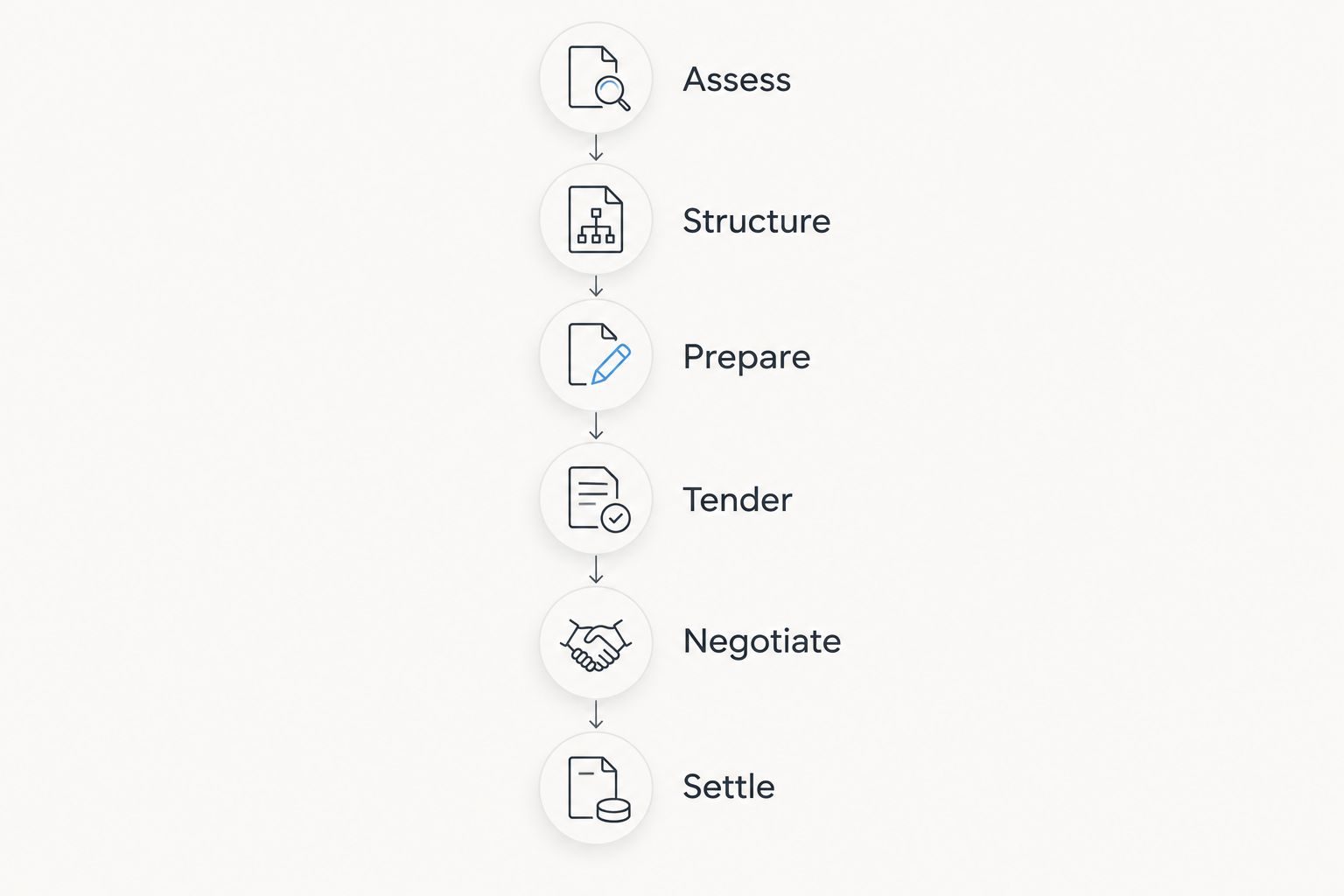
A broad lender panel does not mean every lender fits every development. Glenclair's 60+ lender panel provides a basis for lender selection; the relevant comparison still depends on the project, borrower and proposed structure.
The limitation is unchanged: lender assessment determines whether funding is offered and on what terms. A broker-led process organises that assessment; it cannot promise its outcome.
Drawdown controls
Build a release file for each claim
- Enter the builder claim into the drawdown register. Record the claimed work, supporting documents, amount requested and relevant contract reference. Keep disputed items visible rather than treating them as agreed costs.
- Check the facility's release requirements. Obtain the certifications, reports, invoices or other evidence specified for that advance. Do not substitute an internal approval for required external certification.
- Reconcile the request against the current budget and previous payments. Check that the same work has not been included twice and that any required borrower contribution has been addressed.
- Reconcile remaining funding sources against remaining project costs. Include approved variations, unpaid commitments and costs outside the builder's contract that belong in the project budget.
- Submit through the lender's specified channel. Record requests for clarification, acceptance of evidence and confirmation of funds received. Only then update the payment status.
Expected result: each drawdown has a traceable evidence file, and the project team can distinguish a submitted request from money received.
For 2026 drawdown records, use Requested, Evidence outstanding, Submitted, Funds received and Paid as internal status labels. These are suggested controls, not lender portal button names.
When the project changes
Run a change-triggered review alongside the scheduled claim process. A revised design, builder substitution, programme change or altered repayment assumption deserves attention before the next payment request.
- Record the change and identify which baseline documents it affects.
- Obtain updated scope, budget, programme and supporting evidence from the responsible parties.
- Check the facility documents for notification and consent requirements. Ask the lender to confirm the required assessment where the change affects approved assumptions.
- Update the conditions and drawdown registers only after recording the response. Preserve the earlier version so the decision trail remains clear.
Expected result: the next drawdown request reflects the current project, not a superseded approval pack.
Do not treat unused facility capacity as automatic permission to fund additional work. The facility's purpose, conditions and lender consent requirements still apply. Keep commercial agreement with the builder separate from approval to use borrowed funds.
Troubleshooting
The builder claim is due but the drawdown is unresolved
Identify the missing release requirement and its owner immediately. Check the construction payment obligations with the appropriate adviser and confirm the lender's outstanding requirements. Do not promise a release date that the lender has not confirmed.
The updated budget exceeds identified funding
Reconcile the shortfall before requesting funds on the old assumptions. Review proposed scope changes, additional borrower funds or revised finance with the relevant advisers and lender. None is a substitute for obtaining required approvals.
A certificate does not match the claim
Ask the certifier and builder to resolve the discrepancy through the required process. Retain both documents and the explanation. Do not edit a third-party certificate to make it match the requested advance.
A condition keeps reappearing
Check whether the condition applies once or at every release. Record lender acceptance where available and retain current evidence for recurring obligations. A settled facility can still carry ongoing reporting requirements.
Customise your workflow
Extend the file beyond construction claims. Connect it to refinancing dates, covenant reporting, project insurance evidence and the documented repayment strategy wherever the facility requires them.
Keep equipment and working capital borrowing visible if the same business group uses those facilities. Record security and guarantee connections for review rather than assuming that each loan operates independently. This helps frame the whole banking discussion without combining unrelated funding requests.
For a 2026 banking review, ask Glenclair to assess the existing arrangement alongside the proposed development funding. Define the question first: refinance existing debt, fund a new stage, or review the wider structure.
Review your development funding structure
Discuss existing banking, lender conditions and the documents needed for a project assessment.
FAQ
Does development approval mean I can get property development finance?
No. Development approval addresses planning permission; a lender separately assesses the borrower, project, security and repayment proposal. Funding also depends on the conditions attached to any offer.
What do I need before requesting a staged drawdown?
You need the evidence required by your facility for that release. Check the claim, supporting certification, budget reconciliation and any outstanding conditions before submitting.
Can I use remaining facility funds for a project variation?
Not automatically. Check the facility's permitted purpose and consent requirements, and obtain the required lender response before relying on borrowed funds for the variation.
Should I refinance my existing development loan or ask my current lender?
Start by defining the problem with the existing arrangement. An existing-lender review tests the current structure, while a tender compares alternatives against a consistent project brief.
Is finance above A$2 million a strict Glenclair eligibility requirement?
No. Glenclair prioritises established Australian businesses seeking business-purpose finance above A$2 million, but assesses suitability case by case. The preferred enquiry size is not a universal lending rule.
Are lender-paid brokerage and debt advisory the same service?
No. Lender-paid brokerage and debt advisory have different engagement structures. Debt advisory uses a retainer and success-fee structure, so confirm which service applies before proceeding.
What should I update when the construction budget changes?
Update the project budget, remaining-cost assessment and affected supporting documents. Check lender notification and consent requirements before treating the revised budget as an approved funding basis.
One last thing
A submitted drawdown is not cash received. Keep those statuses separate in the project records and confirm funds before marking the finance step complete. That simple distinction prevents the workflow from concealing an unresolved funding dependency.
Related guides
- Income requirements for commercial property finance
- Equipment finance options for construction businesses
- Machinery finance options for earthmoving contractors
By the Glenclair Financial team.