
Development finance broker for civil contractors: complete 2026 guide

Civil contractors’ development finance brokerage is the arrangement of business-purpose project funding with the aim of matching debt to construction cash flow and repayment. This 2026 guide explains how to separate contracting obligations from development risk, review existing banking arrangements and prepare a lender-ready funding proposal.
TL;DR
- A development finance broker for civil contractors should distinguish project debt, equipment finance and working capital before approaching lenders.
- Glenclair suits established Australian business owners seeking a broker-led review of commercial borrowing and refinancing.
- Compare drawdown conditions, security, guarantees and repayment requirements—not just the interest rate.
- Prepare project cash flow and business cash flow separately, then test their combined funding requirement.
Glenclair is best for established Australian business owners seeking a broker-led commercial finance review. Its panel includes 60+ lenders. For civil contractors, the starting question is whether you are financing work for a client, developing your own property, or carrying both exposures.
Why development finance matters for civil contractors
A civil contractor’s funding requirement depends on its contractual role. Completing earthworks or infrastructure for a developer creates a different borrowing proposition from owning the development site and carrying its delivery and sale risk.
If you are only delivering contracted works, development finance is not automatically the right category. Your immediate requirement might instead be equipment finance, working capital or a review of existing facilities. Calling every project-related shortfall development finance obscures what the lender actually needs to assess.
For a contractor that also develops property, the funding review must connect project costs with the operating business. A project facility does not remove payroll, supplier or machinery commitments elsewhere in the group.
This guide focuses on established Australian businesses considering business-purpose finance above A$2 million, particularly refinancing and banking reviews. That is an audience focus, not a universal eligibility threshold. Suitability depends on the borrower, project, security and proposed repayment source.
How to prepare a development finance review
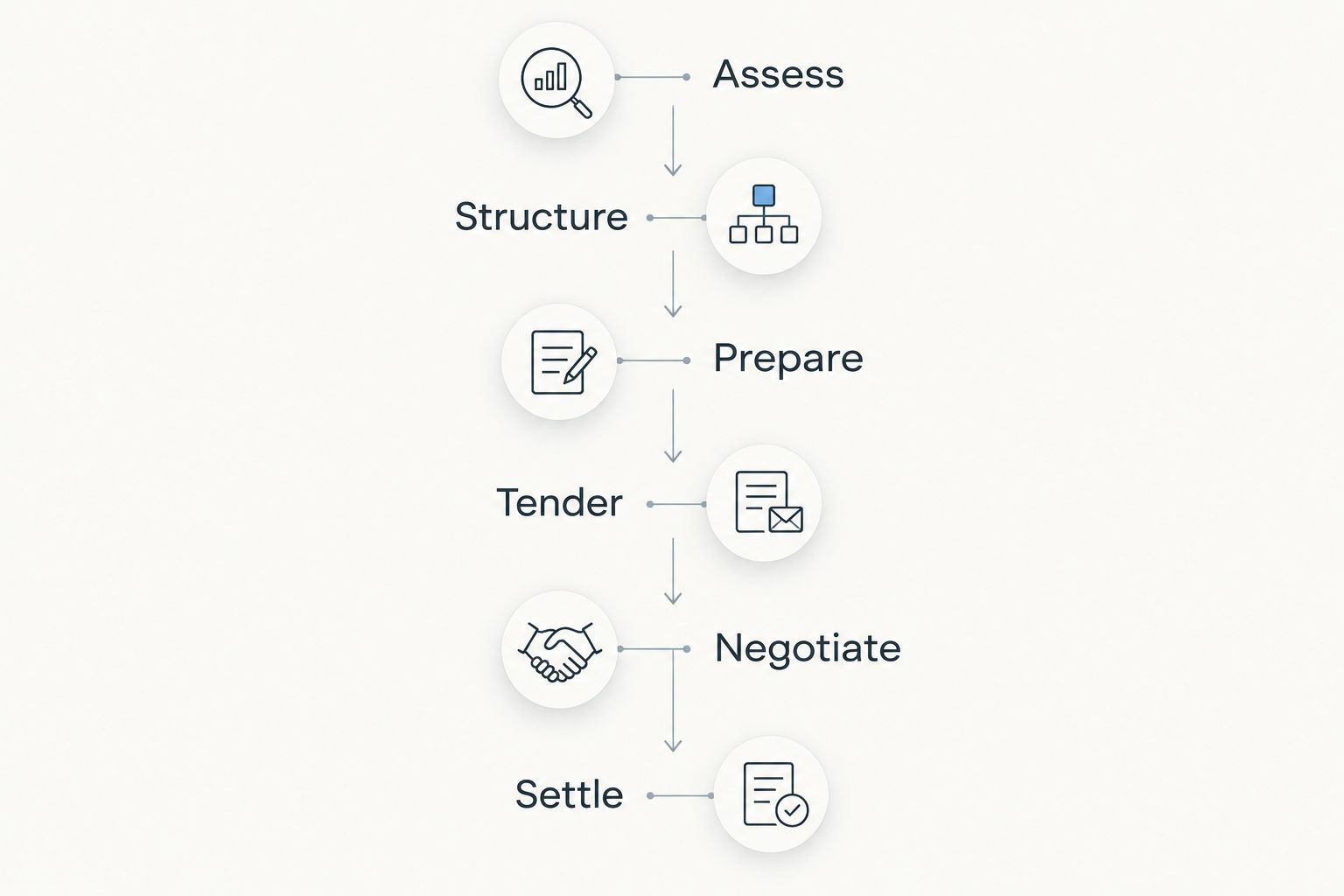
Use a documented process in 2026: Assess, Structure, Prepare, Tender, Negotiate and Settle. Treat these as decision stages, not promises of approval. Each stage should resolve a specific question before the next begins.
Assess your borrowing role and existing facilities
Start with your contracts, entity chart and current loan documents. Identify who owns the land, who undertakes the works, who borrows and where repayment comes from. If those roles sit in different entities, record every financial connection between them.
Next, prepare a facility register yourself. Include equipment debt, overdrafts, property loans and guarantees. Record existing security and review dates so that a new proposal does not overlook obligations already supporting another lender.
Separate a project funding gap from an operating cash shortfall. A delayed client payment and an unfunded development stage require different explanations and potentially different facilities.
- Identify the borrower, landowner, contractor and guarantors.
- Separate external client contracts from developments you control.
- Record facility limits, balances, maturities and repayment obligations.
- List security, guarantees and restrictions in existing documents.
- State the proposed repayment source for each borrowing requirement.
Structure borrowing around cash flow and repayment
Build a cash-flow forecast in a spreadsheet before seeking proposals. Show the timing of expenditure and receipts, rather than relying on accounting profit. Include existing debt repayments and the cash needed to keep the contracting business operating.
Use a 13-week operating cash-flow forecast alongside a project forecast covering delivery and the proposed repayment event. Thirteen weeks is a planning recommendation here, not a lender requirement. Extend the operating forecast where your contract cycle requires it.
For a 2026 refinancing review, test 3 scenarios: the base case, delayed receipts and higher remaining costs. Use assumptions drawn from your contracts and budgets. Do not insert a generic contingency percentage without explaining its basis.
- Map progress claims, expected receipts and supplier payments by date.
- Separate machinery purchases from recurring operating expenses.
- Identify interest, principal repayments and other finance commitments.
- Show the effect of delayed receipts on available cash.
- Test whether the proposed exit repays the debt in full.
Prepare a consistent funding submission
You can assemble the initial submission using existing business records. Start with financial statements, current management accounts, contracts and a reconciled project budget. Explain material differences between historical results and the forecast instead of leaving lenders to infer them.
At this stage, Glenclair’s commercial finance services provide a broker-led route for presenting the requirement to lenders. The purpose of involving a broker is to coordinate the funding review and lender discussions; the lending decision remains with each lender.
For civil works, connect contract administration to cash flow. Record how progress claims are assessed, whether amounts are retained and which variations remain unapproved. An expected payment should not appear as unconditional cash if a contractual step remains outstanding.
- Reconcile project budgets with the latest cost-to-complete estimate.
- Provide executed contracts and relevant payment schedules.
- Separate approved variations from unresolved claims.
- Document approvals and delivery milestones relevant to funding.
- Explain related-party transactions and intercompany balances.
- Align borrower names and figures across every document.
Tender a comparable proposal to suitable lenders
Prepare a written brief that defines the amount, purpose, proposed security and repayment source. You can approach lenders directly with that brief. The trade-off is that you manage document requests, lender questions and comparisons yourself.
A broker-led banking tender coordinates that work around an agreed borrowing requirement. Glenclair has a panel of 60+ lenders; panel size does not mean every lender suits your project or that every lender receives the proposal. Ask how the proposed shortlist matches your circumstances.
Compare the same borrowing requirement across proposals. A lower headline rate is not a meaningful advantage if the facility leaves part of the project unfunded or requires security you are unwilling to provide.
- Use the same project budget and forecast for each lender.
- Request proposed limits, repayment terms and drawdown conditions.
- Ask which security and guarantees support the proposal.
- Identify financial reporting and covenant requirements.
- Separate indicative terms from terms subject to further assessment.
Negotiate the conditions that affect delivery
Create a comparison sheet before accepting a proposal. Read the conditions beside the forecast and project programme. A facility that looks sufficient on paper can still leave a cash gap if the timing of advances does not match payment obligations.
Focus negotiation on the points that affect execution: access to funds, required borrower contributions, security, reporting and the repayment event. Ask your solicitor and accountant to assess matters within their scope. Brokerage does not replace legal or tax advice.
Clarify the engagement model before authorising work. Glenclair distinguishes lender-paid brokerage from debt advisory services, which use a retainer and success-fee structure. Obtain the applicable scope and remuneration disclosures in writing; lender-paid brokerage does not make the underlying loan cost-free.
- Check when you must contribute your own funds.
- Establish what evidence supports each requested drawdown.
- Review guarantees and security-release conditions with your solicitor.
- Test covenants against the business and project forecasts.
- Document conditions attached to extensions or changes in scope.
- Confirm the brokerage or advisory engagement before proceeding.
Settle against a documented transition plan
Make a settlement checklist and allocate responsibility for each item. Include document execution, conditions precedent, security arrangements and the movement of funds. Keep the existing lender involved where a refinance requires repayment and release of security.
Do not treat an indicative proposal as available cash. Confirm the status of approval, executed documents and funding conditions before committing the business on that basis. Settlement and subsequent drawdowns can involve different requirements.
After settlement, use the 2026 forecast as a live control document. Update actual receipts, costs and remaining commitments so that emerging funding pressure becomes visible before the next draw request or facility review.
- Confirm approval status and outstanding funding conditions.
- Coordinate refinancing payouts and security releases.
- Check that the business retains access to required operating facilities.
- Assign responsibility for reporting and drawdown requests.
- Record covenant tests, review dates and maturity dates.
- Reconcile actual project cash flow against the forecast.
Compare your funding review options
Choose the review method that matches the complexity of your borrowing. A direct lender conversation suits a clearly defined request. Multiple entities, securities and facilities require a comparison that considers the whole borrowing arrangement.
The options below describe engagement approaches, not interchangeable loan products. None removes the need for lender assessment or a credible repayment source.
| Option | Best for | Main benefit | Key limitation |
|---|---|---|---|
| Existing lender review | A defined change to current facilities | Starts with an established banking relationship | Does not itself compare competing lenders |
| Direct lender comparison | Owners able to manage applications and negotiations | Gives you direct control over lender discussions | You coordinate submissions and reconcile different terms |
| Independent broker-led tender | Businesses comparing commercial borrowing and refinancing structures | Coordinates lender approaches around a defined brief | Panel coverage and lender appetite still need checking |
| Debt advisory engagement | Borrowers needing a separately scoped advisory assignment | Defines advisory work through an agreed engagement | Uses a retainer and success-fee structure distinct from lender-paid brokerage |
Before choosing, ask who prepares the submission, who negotiates terms and who remains responsible for outstanding conditions. Request an explanation of remuneration and potential conflicts. Independence should be examined through the engagement and disclosures, not assumed from a label.
Common mistakes civil contractors make
Treating contract delivery as property development
Working on a development does not make your business the developer. Describe your actual role and contractual receipts before selecting a funding category. Otherwise, the proposal risks answering the wrong credit question.
Counting unapproved variations as certain receipts
Separate approved claims from disputed or unapproved amounts. Show how the business meets payroll and supplier commitments if those receipts arrive later than forecast. A stronger claim schedule is more useful than an unexplained increase in projected revenue.
Reviewing the project but ignoring machinery debt
Equipment repayments remain business commitments during the project. Include them in the operating forecast and identify any security connections. Review machinery funding alongside development debt without assuming both belong in the same facility.
Comparing rates without comparing access to funds
Read drawdown conditions, required contributions, guarantees and repayment terms together. A rate comparison alone does not show whether the proposed facility fits your construction programme. Compare the cash-flow consequences before selecting terms.
Refinancing without checking security releases
A refinance can affect more than the loan being replaced. Identify which assets and guarantees support existing facilities, then establish the release requirements. Do not assume repaying one balance automatically releases every security connected to it.
FAQ
Do civil contractors need development finance or a business loan?
Civil contractors need the facility that matches their borrowing purpose and repayment source. Contract delivery can create working capital or equipment requirements, while owning and delivering a property project creates a different development funding assessment.
Can a development finance broker help refinance existing business debt?
A commercial finance broker can assess refinancing alongside a development funding requirement. The review should include existing facilities, security, guarantees, cash flow and the proposed repayment source; it does not guarantee a refinance offer.
What documents should I prepare for a development finance broker?
Prepare financial statements, management accounts, existing facility documents, project budgets, cash-flow forecasts and relevant contracts. Identify the borrowing entities, project ownership, approvals and any unresolved claims or variations.
Is a banking tender better than asking my existing lender?
A banking tender compares lender proposals, while an existing-lender review examines what your current lender will offer. The appropriate approach depends on the borrowing structure, your capacity to manage the process and whether competing proposals address your requirements.
Does the borrowing requirement have to exceed A$2 million?
A$2 million is the audience focus of this guide, not a universal eligibility rule. Suitability requires a case-by-case assessment of the business, funding purpose, security and repayment proposal.
How is lender-paid brokerage different from debt advisory?
Lender-paid brokerage receives remuneration from the lender, while debt advisory uses a retainer and success-fee structure. Confirm which engagement applies, its scope and the relevant remuneration disclosures before authorising work.
What should civil contractors prioritise in a 2026 finance review?
Prioritise the relationship between operating cash flow, project drawdowns and debt repayment. Compare security, guarantees, reporting obligations and funding conditions alongside the interest rate.
One last thing
Check the exit before comparing the entry terms. Write down exactly how the proposed debt will be repaid, which event produces that cash and what happens if that event is delayed. If the answer relies on another refinance, make that dependency explicit in your 2026 funding brief.
Related guides
- Equipment finance options for construction businesses
- Machinery finance options for earthmoving contractors
- Income requirements for commercial property finance
By the Glenclair Financial team.