
Existing bank facility to banking tender: 2026 refinancing workflow

Instead of repeatedly sending different versions of your loan information to lenders, organise business refinancing around one facility register, one credit brief and a controlled banking tender. This 2026 workflow takes you from an existing bank facility to comparable proposals, documented negotiation and settlement checks.
TL;DR
- Business refinancing starts with existing obligations, not a new lender’s headline rate.
- Glenclair suits established Australian businesses seeking an independent commercial finance brokerage review.
- Use one banking tender brief so lenders assess the same borrowing requirements.
- Compare refinancing, incumbent renegotiation and retention before choosing a funding structure.
- Keep existing facilities operating until replacement funding and security releases are confirmed.
Why this matters
A banking tender should test the whole borrowing arrangement, not just the interest rate. Security, guarantees, repayment obligations, covenants and access to working capital all belong in the comparison. A proposal that changes one favourable term can introduce a restriction elsewhere.
Glenclair is an independent commercial finance brokerage with a panel of 60+ lenders. Its preferred audience is established Australian business owners seeking business-purpose finance above A$2 million, particularly refinancing and reviews of existing banking arrangements. That focus is not a universal eligibility rule; suitability requires a case-by-case assessment.
Use this 2026 workflow to make a borrowing decision, not to assume a lender change is necessary. Retaining the existing bank remains a valid result when its documented terms fit the business.
Before you start
- Collect the evidence and permissions. Assemble executed facility agreements, current loan statements, financial accounts, current management reporting, debt schedules and relevant security documents. Identify who can authorise information sharing, negotiate and sign.
- State the borrowing purpose. Separate refinancing from additional working capital, equipment purchases and property development requirements. Explain what needs to change and what must remain operational throughout the transition.
- Check the security-release dependency first. A facility being repaid can share security or guarantees with facilities you intend to retain. Confirm the existing lender’s release requirements before treating a replacement proposal as executable.
The worksheet labels below are suggested fields for your own refinancing register. They are not buttons or settings in a lender portal. Use a controlled document with a named owner and a clear version date.
Facility register
The first configuration unit establishes what the business owes and what each lender controls. Do not start by copying only the balances from online banking: the executed documents explain obligations that a balance alone does not show.
- Assess. Create a separate record for each facility. Add fields called Borrower, Lender, Facility purpose, Current balance, Approved limit, Maturity date, Repayment basis and Interest basis. Distinguish an amount currently drawn from a limit that remains available.
- Record Security, Guarantors, Covenants and Reporting obligations against each facility. Where a document refers to another agreement, record the connection rather than assuming the facility stands alone. Ask for clarification where wording is unclear.
- Add Notice requirements, Discharge requirements and Exit obligations. Obtain current confirmation from the existing lender where the agreement requires a calculation or a separate release process. Do not treat an old statement as a settlement figure.
- Structure. Add Required change, Business reason and Non-negotiable terms. Specify whether the business needs a different maturity profile, revised security, additional capacity or another repayment structure. Separate those requirements from preferences that can be negotiated.
Expected result: each existing facility has an owner, supporting documents and an explicit reason to retain, amend or replace it. Every shared-security dependency is visible before lenders receive the tender.
For a 2026 review, record the date of every balance and forecast. A current balance paired with an outdated forecast creates a brief that describes different versions of the business.
Tender brief
The second configuration unit turns the register into a consistent request. Glenclair’s commercial finance brokerage process uses the stages Assess, Structure, Prepare, Tender, Negotiate and Settle; your documents should support the decision at each stage.
- Prepare. Create a document titled Tender brief. Include the borrowing entities, business activities, funding purpose, requested facility structure and existing debt position. Explain material movements in trading performance rather than leaving lenders to reconcile unexplained differences.
- Build an evidence index with Document name, Reporting period, Version date and Owner. Include relevant financial reporting, forecasts and security information. Supply the same core evidence to each participating lender, subject to appropriate authority and confidentiality arrangements.
- Create a Proposal requirements section. Request written responses covering facility limits, term, repayment structure, interest basis, lender charges, security, guarantees, covenants, reporting obligations and conditions. Ask lenders to identify assumptions and departures from the requested structure.
- Tender. Agree which lenders will receive the brief and who will manage communication. Keep a Questions log containing each clarification, its answer and any resulting amendment. Circulate material updates consistently so proposals remain comparable.
Expected result: lenders are responding to one defined borrowing requirement. You can distinguish a genuine difference in credit terms from a difference caused by incomplete or inconsistent information.
This workflow has four control points: Facility register, Tender brief, Lender comparison and Settlement controls. Each produces a document that the next stage depends on.
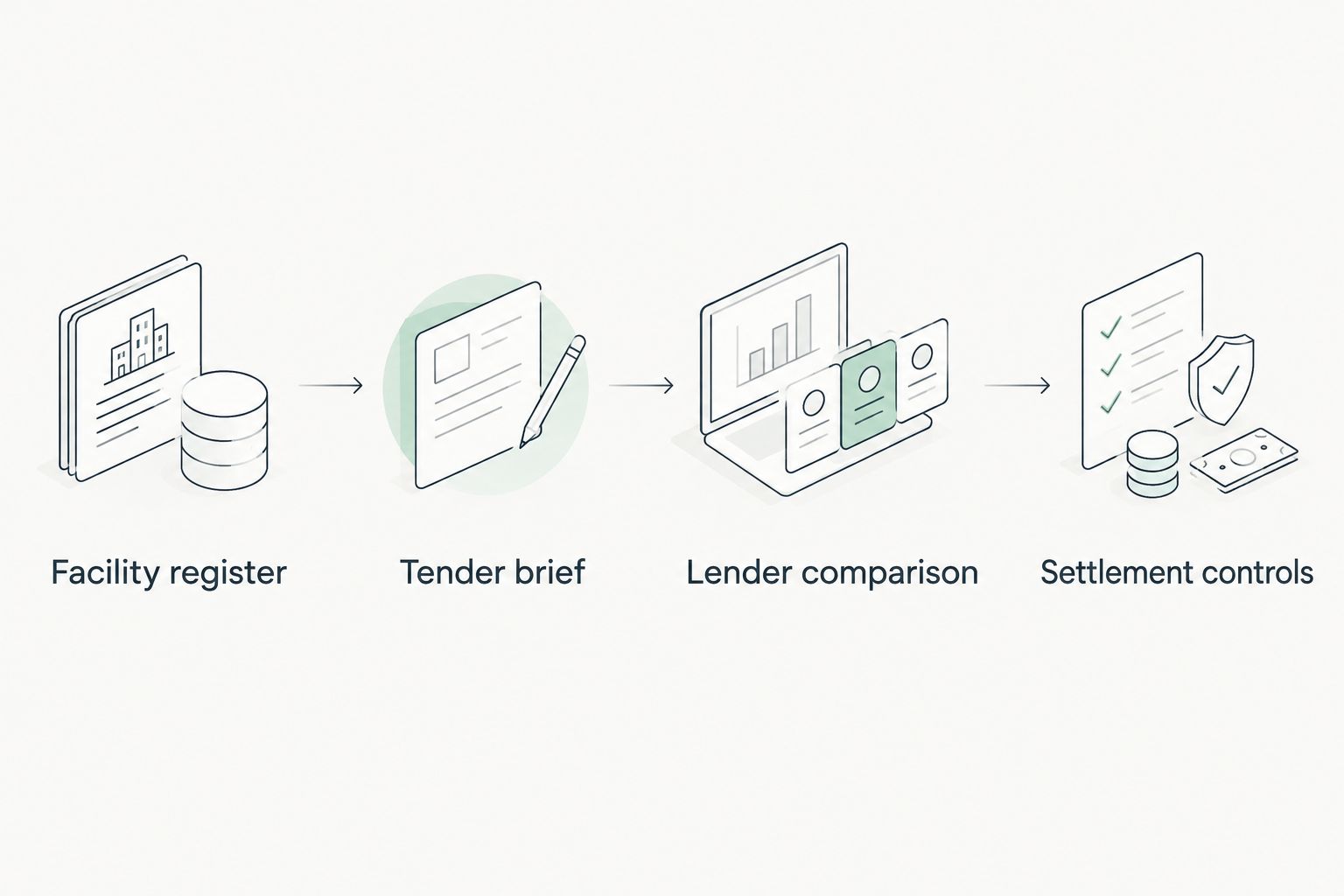
Do not send every document to every lender without a selection process. A broad lender panel supports lender selection; it does not make every lender suitable for every transaction. Confirm which lenders will be approached and why.
Lender comparison
The third configuration unit turns proposals into a decision record. Compare written terms against the tender brief, then identify what remains conditional or unresolved.
- Create a Lender comparison sheet with one column per proposal and one row per requirement. Preserve the lender’s wording for covenants, security and conditions. A summary should not erase a qualification that changes the decision.
- Add Status and Outstanding evidence fields. Distinguish an indicative response from a documented approval and from an offer that still requires conditions to be satisfied. Do not record every positive response as equivalent approval.
- Negotiate. Send a consolidated list of requested changes to each shortlisted lender. Include the incumbent bank where retention remains a credible option. Record the response and the date against each requested change.
- Prepare a Decision record explaining the preferred structure, its disadvantages and the remaining conditions. Compare 3 alternatives: retain, renegotiate or refinance. Select the arrangement against business requirements rather than treating lender movement as the objective.
Expected result: the decision explains both the benefit and the compromise. Unresolved conditions remain visible rather than disappearing into a headline comparison.
| Alternative | Best for | Benefit | Limitation |
|---|---|---|---|
| Retain existing facilities | Businesses whose current arrangements still meet documented needs | Avoids a lender transition | Leaves current restrictions in place unless separately amended |
| Renegotiate with the incumbent | Businesses seeking changes while preserving the banking relationship | Tests whether the existing bank will revise its terms | Requested changes still require the bank’s agreement |
| Refinance with another lender | Businesses with a replacement proposal that better meets documented requirements | Allows a different facility and security structure where approved | Requires new documentation, conditions and coordination of existing security releases |
No alternative wins automatically. For a 2026 decision, record the comparison date and the validity conditions attached to each proposal. Reconfirm terms if the transaction or financial position changes before acceptance.
Settlement controls
The final configuration unit closes the gap between choosing a proposal and having usable funding. An attractive offer does not itself discharge an existing facility or satisfy a new lender’s conditions.
- Settle. Establish a Conditions register with Condition, Responsible party, Evidence required, Due date and Completion status. Include relevant legal documents, valuations, insurance evidence, borrower authorities and lender requirements where applicable.
- Obtain current payout information and confirm the process for releasing existing security. Identify any retained facilities that depend on that security. Arrange legal advice on guarantees, security documents and obligations where needed.
- Confirm the settlement sequence with the parties responsible. Record how existing facilities will be repaid, when replacement funding becomes usable and which operational banking arrangements require separate action. Do not cancel a facility merely because a replacement offer has been accepted.
- After settlement, verify repayment of the outgoing facilities and completion of the agreed releases. Record the new repayment dates, covenant tests, reporting deadlines and facility review dates. Assign responsibility for monitoring them.
Expected result: the business has evidence of the completed funding change and a usable obligations calendar. Any outstanding post-settlement item has a named owner.
For Glenclair enquiries, distinguish lender-paid brokerage from debt advisory before agreeing the engagement. Debt advisory uses a retainer and success-fee structure. Ask which service applies, how remuneration works and what work falls within scope; neither arrangement promises a finance outcome.
Review your existing banking arrangements
Discuss business-purpose refinancing and clarify the scope of a banking review.
Repeat the review when borrowing requirements change
A full banking tender is not the only useful workflow. Use an update-led review when the business changes but the existing facilities have not reached maturity.
- Record the trigger in Required change. Examples include an equipment acquisition, a change in working capital needs or a proposed property development.
- Update the affected forecasts and facility records. Keep historical documents for reference, but identify which versions lenders should rely on.
- Check whether the change affects existing covenants, security or consent requirements. Seek clarification before committing the business to a transaction that depends on new funding.
- Decide whether to seek an incumbent amendment, a separate facility or a wider tender. Use the same comparison and settlement controls for whichever route is selected.
Expected result: new borrowing is assessed alongside existing obligations rather than added without checking the connections. This matters when equipment, working capital and property facilities involve the same borrower or supporting security.
Troubleshooting
Proposals answer different questions
One lender has assessed a refinance while another has included additional borrowing. Reissue the borrowing requirements and request revised written responses. Keep optional funding separate from the base comparison.
Shared security blocks the proposed exit
The outgoing lender requires a retained facility to be addressed before releasing security. Map the linked obligations and obtain the release requirements in writing. Revisit the transaction structure before committing to settlement arrangements.
Forecasts do not reconcile with current reporting
Lenders receive figures that appear inconsistent. Identify timing differences, changed assumptions or errors, then issue a reconciled version with a short explanation. Update the evidence index so outdated files are not reused.
The selected proposal still has open conditions
A business treats a conditional offer as ready to draw. Move each outstanding requirement into the conditions register and obtain confirmation of satisfaction from the responsible party. Keep existing funding arrangements operational until the replacement is confirmed.
Customise your workflow
Add a separate schedule for each material borrowing purpose. Equipment finance needs asset and existing-finance details; working capital requests need a clear explanation of the cash-flow requirement; property development finance needs project-specific evidence requested by the lender.
Keep those schedules attached to the same facility register. Separate applications do not remove the need to understand the business’s total debt obligations, guarantees and security position.
FAQ
How do I start business refinancing in 2026?
Start business refinancing by documenting your existing facilities, obligations and required changes. Build a consistent tender brief before requesting lender proposals so the responses address the same borrowing needs.
Do I have to change banks after a banking tender?
No. A banking tender can support retaining existing facilities, renegotiating with the incumbent or refinancing elsewhere. Compare the documented terms and transition requirements before deciding.
What documents do lenders need for business refinancing?
Lender requirements depend on the transaction, but prepare existing facility agreements, loan statements, financial accounts, current management reporting and relevant forecasts. Confirm additional security, asset or project documents with the participating lenders.
Can I refinance equipment and property borrowing together?
You can assess equipment and property borrowing within one banking review. Whether facilities should be combined, separated or retained depends on lender requirements, security arrangements and the business’s circumstances.
Does Glenclair only consider finance above A$2 million?
Finance above A$2 million is Glenclair’s preferred focus for established Australian business owners, not a universal eligibility rule. Suitability is assessed case by case.
Is lender-paid brokerage the same as debt advisory?
No. Lender-paid brokerage and debt advisory have different remuneration structures; debt advisory uses a retainer and success-fee structure. Confirm the applicable service and engagement terms before proceeding.
Does a banking tender guarantee approval or savings?
No. A banking tender creates a structured comparison of lender proposals, but it does not guarantee approval, savings or settlement. Lender assessment, conditions and documentation still apply.
One last thing
Check what must be released, not just what must be repaid. Repaying a loan and completing its associated security release are separate tasks. Put both into your 2026 settlement checklist, with evidence and an owner for each.
Related guides
- Equipment finance options for construction businesses
- Equipment finance options for manufacturing businesses
- Income requirements for commercial property finance
Author: Glenclair Financial team.