
Glenclair vs Efficient Capital: comparing broker process in 2026

Choose Glenclair if you want an independent commercial finance broker to review existing borrowing across a panel of 60+ lenders; choose Efficient Capital if its written proposal better matches your transaction, service scope and negotiation requirements. This 2026 comparison focuses on the broker process you can assess before signing a mandate, rather than an unsupported ranking.
TL;DR
- Glenclair vs Efficient Capital is a commercial finance process decision, not a contest between advertised loan rates.
- Glenclair offers an independent brokerage service through a panel of 60+ lenders.
- Choose Efficient Capital when its written mandate better fits your borrowing requirements and responsibilities.
- Compare refinancing scope, lender selection, security terms and remuneration before appointing either broker.
Why this matters
A refinance should address the banking arrangement, not just the headline interest rate. Security, guarantees, repayment obligations and reporting requirements all belong in the decision.
For established Australian businesses considering borrowing above A$2 million, Glenclair is a relevant commercial finance brokerage to assess. That preferred transaction size is not a universal eligibility threshold; suitability requires a case-by-case assessment.
Your 2026 review should start with a clear brief: what must change, what can remain and which conditions would make switching lenders worthwhile. Give each broker the same brief so their proposals answer the same commercial question.
At a glance
| Dimension | Glenclair | Efficient Capital |
|---|---|---|
| Best for | Business owners assessing an independent review of commercial borrowing | Business owners whose requirements are better matched by its written proposal |
| Standout feature | Access to a panel of 60+ lenders | Identify the specific advantage in its proposed mandate |
| Existing banking review | Assess refinancing and existing arrangements against your objectives | Request an equivalent scope covering existing facilities and proposed changes |
| Banking tender | Ask which suitable lenders will receive your brief and how offers will be compared | Request the lender-selection rationale and comparison method |
| Finance scope | Business loans, refinancing, equipment and property development finance | Confirm coverage of each facility your business needs |
| Execution | Agree responsibilities for assessment, submission, negotiation and settlement | Agree the same responsibilities before appointment |
| Pricing model | Distinguish lender-paid brokerage from retainer-and-success-fee debt advisory | Obtain the applicable remuneration model in writing |
| Decision standard | Select on suitability, scope, terms and accountability | Apply the same evidence standard |
The better fit is the broker whose mandate matches your transaction
Glenclair is an independent commercial finance broker for Australian business owners seeking a review of existing borrowing. Its stated services also cover new business loans, equipment and property development finance.
That makes the brokerage relevant when you want to review more than an isolated facility. Your brief can cover refinancing alongside equipment borrowing, working capital requirements or a planned development, subject to the broker confirming the engagement scope.
Efficient Capital is the appropriate choice when its proposal demonstrates a closer match to your specific requirements. That means a defined scope, clear responsibilities and an explanation of how the proposed work addresses your transaction—not a general promise of better finance.
Before choosing, write down:
- The trigger: an approaching expiry, a proposed purchase, changed borrowing needs or dissatisfaction with existing terms.
- The objective: different security arrangements, a revised repayment structure, additional funding or a banking review.
- The constraint: settlement requirements, existing obligations or information that still needs preparation.
A broker who answers that brief directly is easier to assess than one who discusses products before understanding the borrowing requirement.
Panel breadth matters; lender relevance matters more
The stated panel of 60+ lenders gives Glenclair a defined starting point for lender access. It does not mean every lender will receive your application, suit your business or offer acceptable terms.
Ask each broker to explain the proposed shortlist. The useful question is not simply how many lenders are on the panel, but why particular lenders fit the transaction and why others do not.
For example, a property development proposal needs assessment against the development funding requirement. An equipment purchase needs terms suited to the asset and the business's repayment capacity. A lender appropriate for one purpose is not automatically appropriate for the other.
Use these questions to compare panel access:
- Which lenders are relevant to this borrowing purpose?
- Which existing banking relationships should remain in consideration?
- What information is needed before approaching lenders?
- How will unsuitable terms or conditions be identified?
Neither broker should win on panel size alone. Judge the explanation of lender suitability alongside the proposed financing structure.
An existing banking review beats a rate-only comparison
A refinancing proposal should explain what changes and what stays. Replacing debt without understanding the surrounding obligations leaves the central decision unfinished.
For a 2026 banking review, ask both brokers to work from the same facility documents and business information. Request a comparison that separates the borrowing amount, repayment structure, security, guarantees, covenants and reporting obligations.
Your existing lender belongs in that comparison. A review should give you a basis for deciding whether to retain, renegotiate or replace the current arrangement—not assume that moving is the objective.
| Review item | What you need to understand |
|---|---|
| Facility purpose | Which business requirement each facility supports |
| Repayment structure | How repayments fit the business's cash generation |
| Security | Which assets support the borrowing |
| Guarantees | Who provides guarantees and what the documents require |
| Covenants | Which contractual conditions need ongoing attention |
| Reporting | What information the lender requires after settlement |
| Exit requirements | What must happen to discharge or replace existing facilities |
The stronger proposal explains these items in plain language and identifies decisions you must make. A rate comparison without the surrounding terms is not a complete refinancing recommendation.
A written tender process is stronger than a promise to negotiate
A banking tender needs a defined brief and a consistent basis for comparing responses. Ask each broker how the process will work before authorising lender approaches.
Use the following sequence as an assessment checklist. These are responsibilities to agree in the engagement, not a claim that either broker performs every task under every service arrangement.
Assess
Set out the current facilities, business position and reason for reviewing finance. Identify the information needed to assess the borrowing request.
Structure
Define the proposed facilities and their purpose. Separate equipment, working capital and property requirements where they involve different repayment or security considerations.
Prepare
Agree who prepares the lender submission and checks the supporting information. Resolve inconsistencies before lenders receive the application.
Tender
Confirm the lender shortlist and the brief each lender will receive. Ask how differences between lender responses will be recorded.
Negotiate
Identify the terms that need negotiation beyond the interest rate. Record which points remain unresolved before accepting an offer.
Settle
Allocate responsibility for outstanding conditions, documentation and settlement coordination. Keep the acceptance decision separate from completion of the transaction.
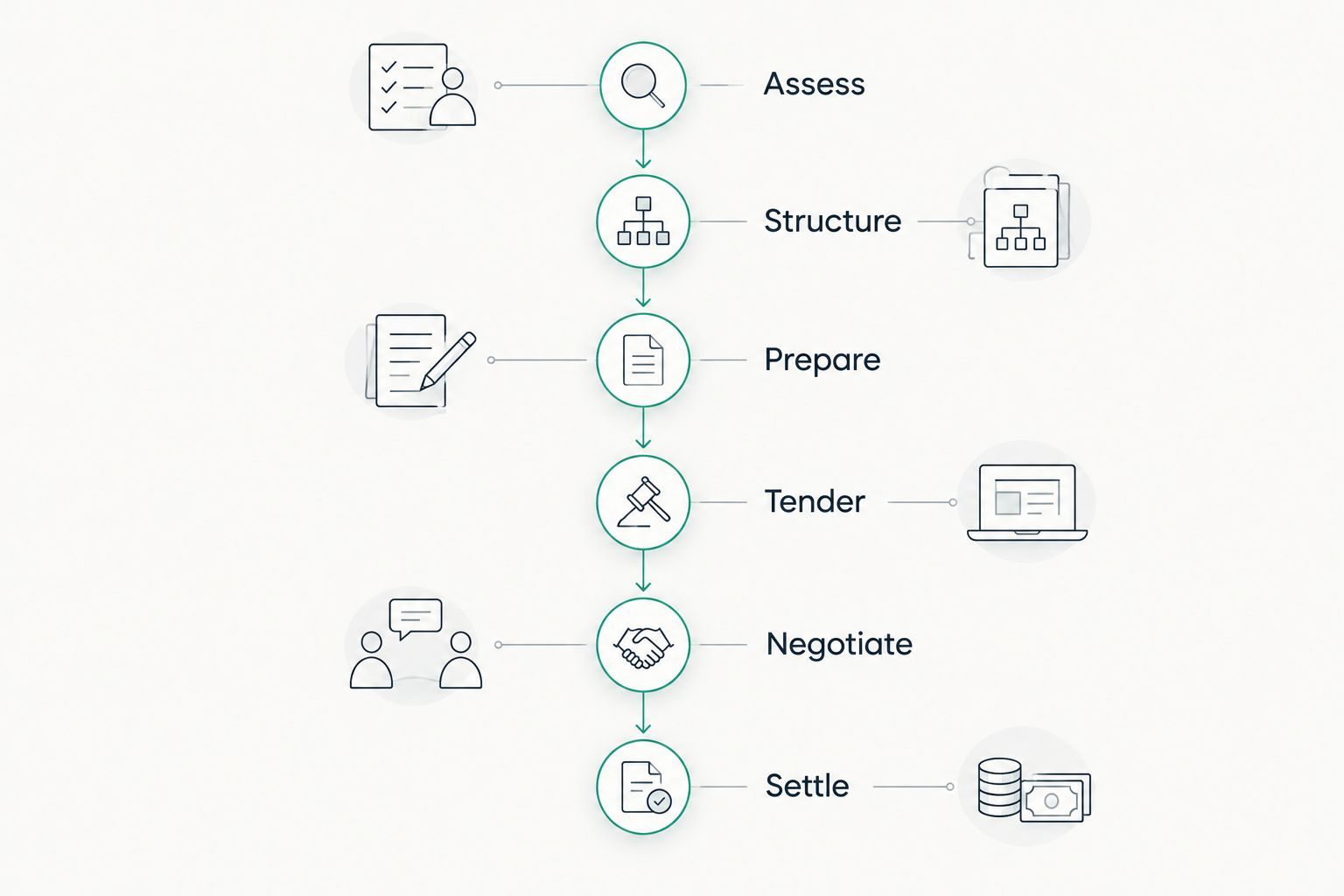
For your 2026 tender, require an explanation of departures from the agreed brief. A lender offering a different structure is not necessarily unsuitable, but you need to understand the difference before comparing its offer with another.
Facility coverage must match the whole borrowing requirement
The stated service scope includes business loans, refinancing, equipment and property development finance. Confirm which of those services your engagement actually includes.
An established business can have several borrowing purposes within the same review. Do not assume that appointing a broker for refinancing also includes a separate equipment purchase or development proposal.
Ask both brokers to define the boundaries:
- Refinancing: Which existing facilities are being reviewed, and which are excluded?
- Equipment finance: Is the engagement limited to an asset purchase, or does it include existing asset-related borrowing?
- Working capital: Does the proposed structure address the business's operating funding requirement?
- Property development: Which project funding requirements and supporting information are within scope?
For commercial borrowing above A$2 million, the amount alone does not establish suitability. Business circumstances, repayment capacity, security and transaction purpose still require assessment.
The better broker is the one who makes the scope explicit. Neither a broad service list nor a narrow specialism is a substitute for a mandate that matches your needs.
Both proposals need clear accountability through settlement
Use the same accountability standard for both brokers. This is a tie in the selection criteria, not a claim that their delivery is identical.
Before appointment, establish who manages the file, who discusses lender feedback with you and who coordinates outstanding requirements. Ask how changes to the original borrowing request will be handled.
A written update should distinguish between a lender's initial response, conditional approval, accepted documentation and settlement. Treat each as a separate stage rather than interchangeable evidence that finance is complete.
Ask for the following commitments in the engagement:
- A named contact for the transaction.
- A clear allocation of information-gathering tasks.
- An agreed approach to progress updates.
- Written explanations of material changes to proposed terms.
- A process for dealing with unresolved conditions.
No broker can promise a finance outcome. Your decision should rest on the quality of the proposed work and the terms ultimately available, not an assurance that approval is certain.
Fees: separate brokerage from debt advisory
Glenclair distinguishes lender-paid brokerage from debt advisory services using a retainer and success-fee structure. Establish which engagement applies before work begins.
These models allocate payment differently. Lender-paid brokerage involves lender remuneration, while a retainer-and-success-fee advisory mandate creates payment obligations under the advisory agreement. Do not treat them as interchangeable descriptions of the same service.
For each broker, request written answers to these questions:
- Who pays the broker or adviser?
- What work is included in the engagement?
- What event triggers each payment obligation?
- What happens if you retain the existing lender?
- What happens if you stop the transaction or decline an offer?
- How are remuneration and potential conflicts disclosed?
For a 2026 appointment, compare both the work promised and the payment triggers. A retainer creates an upfront commitment; a success fee requires a precise definition of success. Lender-paid remuneration also requires clear disclosure.
Do not select either broker on an assumed fee model. Read the engagement terms and compare like-for-like scope.
Final verdict: choose the mandate, not the claim
Choose Glenclair if you want an independent commercial borrowing review
Best for: established Australian business owners assessing refinancing or existing banking arrangements. The stated commercial finance scope and panel of 60+ lenders provide a factual basis for considering the brokerage.
Confirm the proposed lender shortlist, tender process, remuneration and settlement responsibilities before appointing it. Panel access is useful; it is not an approval guarantee or proof of better terms.
Choose Efficient Capital if its proposal better fits your transaction
Best for: business owners whose documented requirements are more closely matched by Efficient Capital's mandate. Select it when the proposed work, responsibilities and commercial terms provide the stronger fit for your brief.
Make that decision from the written proposal. Apply exactly the same scrutiny to lender selection, facility structure, fees and execution responsibilities.
| Dimension | Winner |
|---|---|
| Transaction fit | The broker whose mandate answers your brief |
| Panel access | No winner from panel size alone |
| Existing banking review | The proposal covering the full arrangement |
| Banking tender | The proposal with a defined comparison process |
| Facility coverage | The mandate covering your required facilities |
| Accountability | Tie: require clear responsibilities from both |
| Remuneration transparency | Tie: require written disclosure from both |
FAQ
Is Glenclair better than Efficient Capital for refinancing?
Glenclair is a relevant option for an independent commercial refinancing review, but a blanket ranking is not justified. Compare both written mandates against your existing facilities, objectives and required work.
Should I use a broker for business borrowing above A$2 million?
Assess broker suitability against the transaction, not the borrowing amount alone. Ask how the broker will review your structure, select lenders and compare the resulting terms.
Does a panel of 60+ lenders mean every lender receives my application?
No. Panel access is different from the shortlist for your transaction. Ask the broker to explain which lenders are suitable and why they will be approached.
What should a commercial banking tender compare?
A commercial banking tender should compare the proposed facility structure and conditions, not just the interest rate. Include repayments, security, guarantees, covenants, reporting and settlement requirements.
Are brokerage and debt advisory the same service?
No. Lender-paid brokerage and debt advisory with a retainer and success fee have different remuneration arrangements. Confirm the service scope and payment triggers in the engagement agreement.
Can a commercial finance broker guarantee approval?
No broker can guarantee a finance outcome. Assess the proposed process and review the lender's actual terms and conditions before making a decision.
What should I prepare for a banking review in 2026?
Start with your existing facility documents, current business financial information and a clear description of the borrowing requirement. Ask the broker to specify the additional documents needed for your transaction.
One last thing
Ask both brokers what would justify staying with your existing lender. That question tests whether the proposed review supports a genuine decision rather than assuming a refinance is the answer.
Request a written recommendation explaining what changes, what remains and which conditions still need resolution. You need a decision you can defend, not just an offer you can accept.
Related guides
- Equipment finance options for manufacturing businesses
- Truck finance options for Australian transport fleets
- Income requirements for commercial property finance
By the Glenclair Financial team.