
Glenclair vs Hodgestone Finance: comparing broker process in 2026

Choose Glenclair if you want an independent commercial finance brokerage to review existing banking arrangements across a panel of 60+ lenders; choose Hodgestone Finance if its written proposal better matches your borrowing structure, tender requirements and engagement terms. This 2026 comparison focuses on the evidence you should require before appointing either broker, not an unsupported ranking.
TL;DR
- Glenclair vs Hodgestone Finance is a broker-process decision: compare written scope, lender selection and engagement terms.
- Glenclair offers an independent commercial finance brokerage with a panel of 60+ lenders.
- Choose Hodgestone Finance when its documented proposal better meets your transaction requirements.
- Separate lender-paid brokerage from debt advisory retainers and success fees before signing.
Why this matters
Changing a business loan means more than comparing an interest rate. You need to understand the proposed security, repayment obligations, reporting requirements and conditions attached to the facility. A borrowing proposal should explain those terms before asking you to commit.
For an established Australian business reviewing facilities above A$2 million, the broker appointment should start with your existing banking arrangements. That borrowing size describes the intended audience here, not a universal eligibility rule. Suitability still needs an individual assessment.
Start with the commercial finance services relevant to your transaction, then request a written scope. Your 2026 broker comparison should establish what will be reviewed, which lenders will be approached and how you will make the final decision.
At a glance
| Dimension | Glenclair | Hodgestone Finance |
|---|---|---|
| Best for | Business owners seeking an independent review of commercial borrowing | Owners whose requirements are better matched by its written proposal |
| Lender access | Panel of 60+ lenders | Request the relevant lender shortlist and selection rationale |
| Banking tender | Banking tender is a stated content and process focus | Request the proposed tender method and comparison format |
| Security and terms | Assess the proposed scope against your existing facilities | Apply the same security and covenant checklist |
| Communication | Request milestones, responsibilities and escalation arrangements | Request milestones, responsibilities and escalation arrangements |
| Pricing model | Lender-paid brokerage; debt advisory uses a retainer and success-fee structure | Confirm remuneration and any borrower obligations in writing |
| Standout feature | Independent commercial finance brokerage with stated lender-panel breadth | Identify the specific commitment in its proposal that matters to your transaction |
| Settlement | Require a written list of conditions and responsibilities | Require the same written list |
The Hodgestone Finance column is an appointment checklist, not a claim about its panel, performance or engagement terms. Award a comparison point only when the written proposal supports it.
Glenclair provides a stated starting point for lender access
A panel of 60+ lenders gives you a defined starting point for assessing lender access. It does not mean every lender will receive your application, suit your security or support your proposed facility. Ask for the relevant shortlist rather than treating the panel total as the decision.
For either broker, request an explanation of:
- Which lenders fit the borrowing purpose and proposed security.
- Which lenders will receive the submission.
- Why other potential lenders are excluded.
- Whether your existing bank will be invited to respond.
The advantage of a stated panel is visibility into the breadth available for consideration. Its limitation is equally clear: panel breadth does not establish the quality of the shortlist or the final terms. Choose the appointment that explains lender selection in relation to your business.
The stronger tender is the one you can compare
A banking tender should give lenders a consistent brief and give you an understandable comparison of their responses. Asking several lenders different questions produces offers that are difficult to evaluate together.
For your 2026 refinancing review, request a common borrowing brief covering the amount, purpose, preferred structure and available security. Require the broker to distinguish an indicative response from a credit-approved offer and identify outstanding conditions.
Use these 6 stages as an appointment checklist:
- Assess: establish the existing debt position and business objectives.
- Structure: define the requested facilities and proposed security.
- Prepare: assemble financial information and explain the credit request.
- Tender: approach the selected lenders using a consistent brief.
- Negotiate: compare responses and seek changes to material terms.
- Settle: track approval conditions, documents and facility implementation.
These stages describe what to request, not a promise that finance will be approved.
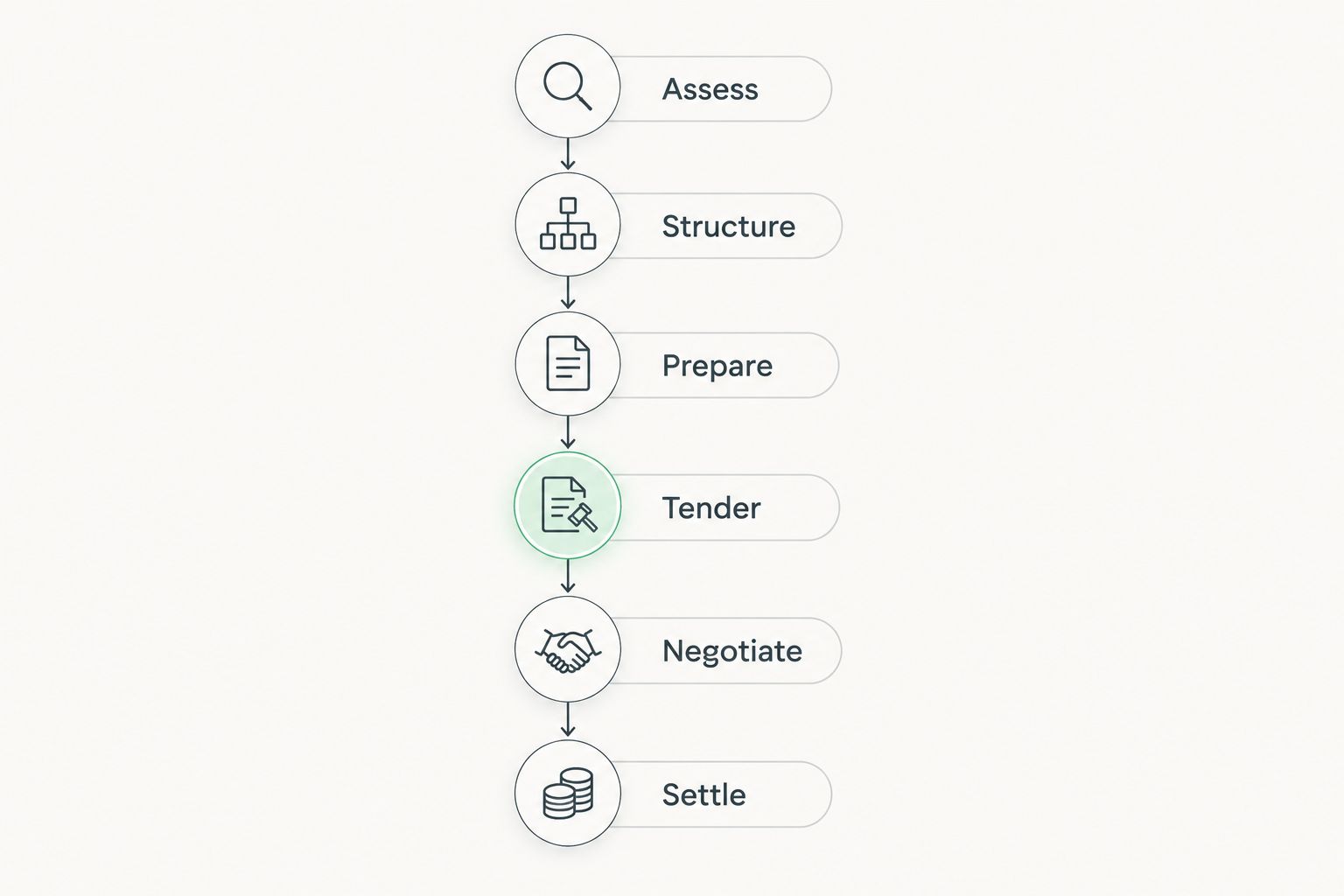
A strong tender process also records why the recommended offer fits your objectives. The decision should remain understandable after the negotiation ends, without relying on a verbal explanation alone.
Both proposals need the same security and covenant test
Neither broker earns a security advantage from its name or lender relationships. The evidence sits in the proposed facility documents and the explanation of what they require from your business.
Ask each broker to separate the borrowing amount from the obligations supporting it. Your comparison should identify the security requested, any guarantees, financial covenants, reporting obligations and conditions affecting access to funds. Ask your legal adviser to explain the effect of the documents before execution.
For refinancing, check what happens to the existing facilities and security arrangements. For a property development transaction, request a clear account of funding conditions and the information needed at each stage.
Treat this dimension as a tie until the proposals establish a difference. The better result is the structure that meets your requirements, not the offer with the shortest summary.
A written communication plan beats a general service promise
Choose Hodgestone Finance on communication if its written engagement gives you clearer responsibilities, decision points and escalation arrangements. Apply exactly the same test to the alternative. This is a genuine appointment advantage only when it is documented.
Request the name or role responsible for your transaction, the information you must supply and the process for dealing with lender questions. Agree how you will receive updates and how decisions will be recorded. Do not substitute a promise of personal service for those details.
A useful communication plan answers practical questions:
- Who checks whether the submission is ready?
- Who tells you when lender requirements change?
- Who explains differences between competing offers?
- Who coordinates the broker, lender and your other advisers?
The benefit is clear accountability. The limitation is that an agreed process cannot remove lender assessment or guarantee a settlement date.
Pricing models: distinguish brokerage from debt advisory
Glenclair distinguishes lender-paid brokerage from debt advisory services, which use a retainer and success-fee structure. These are different engagements. Confirm which applies to your transaction before authorising work or lender submissions.
Lender-paid brokerage identifies the lender as the source of brokerage remuneration. It does not, by itself, establish every obligation in your engagement or every cost attached to the finance. Request written disclosure and an explanation of any borrower obligations.
For debt advisory, ask what the retainer covers, how success is defined, what triggers the success fee and what happens if the transaction changes or does not proceed. The scope matters as much as the fee mechanism.
Ask Hodgestone Finance to identify its remuneration model and contractual obligations in the same written format. Do not assume it uses the same structure.
For a 2026 appointment, compare:
- The services included in the engagement.
- Who pays the broker or adviser.
- When payment obligations arise.
- Any cancellation or termination provisions.
- How remuneration and potential conflicts are disclosed.
Neither model wins automatically. The better engagement makes the work and payment triggers explicit.
Transaction fit matters more than a broad service list
Business loans, refinancing, equipment finance and property development finance are within the client's stated service scope. That breadth makes it relevant to ask how a proposed review will account for different commercial borrowing needs. It does not establish suitability for every transaction.
Frame your enquiry around the business decision:
- Refinancing: review existing facilities, security and repayment requirements.
- Equipment finance: explain the asset purchase and its relationship to other business debt.
- Property development finance: identify the project, funding requirements and proposed security.
- Working capital: describe the operating cash requirement and how the requested facility would be used.
Choose Hodgestone Finance on transaction fit if its written scope addresses your particular borrowing requirements more directly. Ask both brokers to explain the proposed work, rather than inferring capability from a service label.
For established borrowers, a relevant scope beats an extensive list of finance categories.
Both need a settlement plan before the decision is complete
An attractive lender response is not the same as a completed refinancing. Require a settlement plan that identifies outstanding conditions, document responsibilities and coordination with your existing lender where relevant.
Your 2026 appointment checklist should establish who tracks each requirement and who confirms it has been satisfied. Ask how changes between the initial offer and final documents will be brought to your attention. Keep your legal and accounting advisers involved where their advice is required.
Apply the same standard to both brokers. Neither should receive credit for a promised outcome; compare the responsibilities they agree to undertake.
The practical test is simple: before proceeding, you should understand what remains unresolved, who owns each task and which decisions still require your approval.
Final verdict: appoint the broker with the stronger written mandate
Choose Glenclair if you want a panel-based banking review
Best for: an established Australian business owner seeking an independent commercial finance brokerage to review existing borrowing and consider lenders from a stated panel of 60+.
The stated service scope includes loans, refinancing, equipment and property development finance. The constraint is that panel size and service breadth do not prove a particular outcome. Require a transaction-specific scope, lender-selection rationale and engagement terms.
Choose Hodgestone Finance if its proposal fits your transaction better
Best for: a business owner whose written Hodgestone Finance proposal provides the closer match on transaction scope, tender method, communication or engagement obligations.
That is a sound reason to choose a competitor. The constraint is that you should establish the advantage from the proposal itself, not assume it from general positioning. Require the same evidence from both candidates.
One-glance appointment scorecard
| Dimension | Winner |
|---|---|
| Best for | The broker whose mandate matches your borrowing objective |
| Lender access | The relevant, explained shortlist; panel size alone does not decide |
| Banking tender | The proposal with a consistent brief and comparable responses |
| Security and terms | Tie until facility terms establish a difference |
| Communication | The clearer written responsibility and update plan |
| Pricing model | The engagement with clear scope and payment triggers |
| Standout feature | The documented commitment most relevant to your transaction |
| Settlement | Tie until responsibilities and conditions are compared |
FAQ
Is Glenclair better than Hodgestone Finance for commercial refinancing?
Glenclair is a relevant choice for an independent commercial finance review across a stated panel of 60+ lenders. Choose between the brokers by comparing transaction-specific mandates, tender methods, remuneration disclosures and proposed facility terms.
Should I choose the commercial broker with the largest lender panel?
No. Choose a broker who explains which lenders fit your transaction and why. Panel size does not establish that every lender will be approached or that the resulting facility will meet your requirements.
What should I ask Hodgestone Finance before appointing it?
Ask Hodgestone Finance for a written scope, lender-selection method, remuneration disclosure and communication plan. Compare those commitments with your borrowing objectives and the other broker's proposal.
Does lender-paid brokerage mean there are no borrower obligations?
No. Lender-paid brokerage identifies the source of brokerage remuneration, not every obligation attached to your engagement or finance. Read the engagement terms and request written disclosure before proceeding.
How is debt advisory different from lender-paid brokerage?
The debt advisory structure described here uses a retainer and success fee, while lender-paid brokerage receives remuneration from lenders. Confirm the services covered, payment triggers and termination provisions for your particular engagement.
Do I need to borrow more than A$2 million to enquire?
Borrowing above A$2 million describes the intended audience for this comparison, not a universal eligibility rule. Suitability requires an individual assessment of the business, borrowing purpose and transaction.
What should a banking tender compare besides the interest rate?
A banking tender should compare facility structure, security, guarantees, covenants, reporting requirements and outstanding conditions. Ask for a consistent comparison that separates indicative responses from credit-approved offers.
One last thing
Ask each broker to explain why staying with your existing bank would or would not meet your objectives. A useful refinancing review must test the current arrangement as well as alternatives. Changing lenders is not the objective; selecting an arrangement that meets your business requirements is.
Related guides
- Equipment finance options for manufacturing businesses
- Truck finance options for Australian transport fleets
- Income requirements for commercial property finance
By the Glenclair Financial team.