
Glenclair vs Loanworx: comparing broker process in 2026

Choose Glenclair if you want an independent commercial finance broker to review established business borrowing through a banking tender; choose Loanworx if its written proposal better meets your requirements for lender access, execution and ongoing support. This 2026 comparison focuses on how to make that decision, rather than assigning a winner from headline claims.
TL;DR
- Glenclair vs Loanworx should turn on the written refinancing scope, lender selection, remuneration and responsibility for settlement.
- Glenclair suits established businesses seeking a banking review, with business-purpose borrowing above A$2 million assessed case by case.
- Choose Loanworx when its documented proposal better satisfies your requirements; do not assume either broker wins every dimension.
- Compare lender-paid brokerage separately from debt advisory work involving a retainer and success fee.
Why this matters
A commercial refinancing decision changes more than your interest expense. It can change repayment obligations, security, guarantees, reporting requirements and the flexibility to fund your next investment. A broker comparison should address those terms before you authorise applications.
For a 2026 banking review, start with the problem you need solved. Replacing an equipment facility is different from restructuring business debt, funding property development or reviewing your entire banking relationship. Give both brokers the same brief so their proposals answer the same question.
Glenclair is best suited to established business owners seeking an independent commercial finance review and a structured banking tender. Its preferred focus is business-purpose finance above A$2 million, with suitability assessed case by case rather than through a universal minimum-loan rule.
At a glance
The table distinguishes the stated service proposition from the evidence you should require in a competing proposal. A conditional advantage is not a claim that Loanworx has a particular panel, fee arrangement or service standard.
| Dimension | Glenclair | Loanworx |
|---|---|---|
| Best for | Established businesses reviewing commercial borrowing and refinancing | Borrowers whose written proposal better meets their specific brief |
| Finance scope | Business loans, refinancing, equipment and property development finance | Match the proposed scope to each facility you need reviewed |
| Lender access | Panel of 60+ lenders | Request the relevant lender shortlist and selection rationale |
| Tender process | Assess, Structure, Prepare, Tender, Negotiate, Settle | Compare the proposed stages, deliverables and responsibilities |
| Relationship continuity | Assess the benefit of a new banking review | Stronger fit if an existing relationship provides continuity you value |
| Security and covenants | Include these in the review brief | Require the same written comparison of obligations |
| Pricing model | Distinguish lender-paid brokerage from retainer-and-success-fee debt advisory | Confirm the engagement and remuneration model before appointment |
| Standout feature | Independent brokerage with a banking tender process | The specific advantage demonstrated in its written proposal |
The stated service scope fits a broad commercial banking review
For an established business, the strongest reason to consider an independent commercial finance broker is a problem spanning several facilities. Refinancing, equipment purchases and property development should be considered alongside existing borrowing commitments, not as disconnected applications.
The commercial finance services brief covers business loans, refinancing, equipment and property development finance. That makes the service scope relevant when you want to examine the overall borrowing structure rather than source one isolated facility.
The advantage is scope, not a promised outcome. A broad service offering does not establish that a particular lender will approve your application or that refinancing will improve your position.
Your brief should identify:
- Which facilities need replacing, retaining or restructuring.
- Which assets support existing borrowing.
- What additional equipment, property or working capital funding you need.
- Which repayment, reporting or security obligations you want changed.
Ask Loanworx to respond to the same scope. If its proposal addresses your complete borrowing position more clearly, that is a valid reason to select it.
Loanworx wins on continuity if it already knows your business
An established Loanworx relationship is a genuine advantage when continuity matters more than starting a new review. This applies if you already work with the broker, it understands your facilities, and its proposed work addresses the changes you need.
That is a borrower-specific advantage, not a claim about Loanworx's service to every client. Existing knowledge matters only when it is current and useful to the engagement.
Before retaining an incumbent broker, ask for a fresh written brief. It should identify the facilities under review, the objectives, the proposed lender approach and the information still required. Familiarity should reduce repeated explanation, not replace a clear process.
The tradeoff is equally important. A new adviser requires an information handover, but gives you an opportunity to question assumptions behind the current banking arrangement. Decide whether you need continuity or a new review; neither is automatically better.
A panel of 60+ lenders is useful only with a relevant shortlist
A panel of 60+ lenders gives the commercial finance review a broad starting point. The practical question is which lenders fit your business, facility purpose, security position and repayment capacity.
Panel size is not a count of lenders that will receive your application. Ask how the broker narrows the panel and why the shortlisted lenders suit your circumstances. A relevant shortlist is more useful than a long list without an explanation.
For your 2026 review, require both proposals to explain:
- Which lender types suit the funding purpose.
- What makes the proposed facility structure appropriate.
- Which material constraints limit the lender shortlist.
- Whether the existing lender will be included in the comparison.
Do not declare Loanworx better or worse on lender access from a brand name. Give the advantage to the broker that explains its selection and connects it to your actual borrowing requirements.
A staged banking tender makes the work easier to assess
The banking tender process has 6 stages: Assess, Structure, Prepare, Tender, Negotiate and Settle. Use those stages to ask what you will receive, what you must provide and who handles each decision.
- Assess: Establish the existing borrowing position and the business objective.
- Structure: Set out the proposed facilities, repayment approach and security requirements.
- Prepare: Assemble the financial information and supporting material for lender consideration.
- Tender: Present the borrowing requirement to suitable lenders for comparison.
- Negotiate: Address proposed terms, obligations and conditions.
- Settle: Coordinate the requirements for completing the agreed transaction.
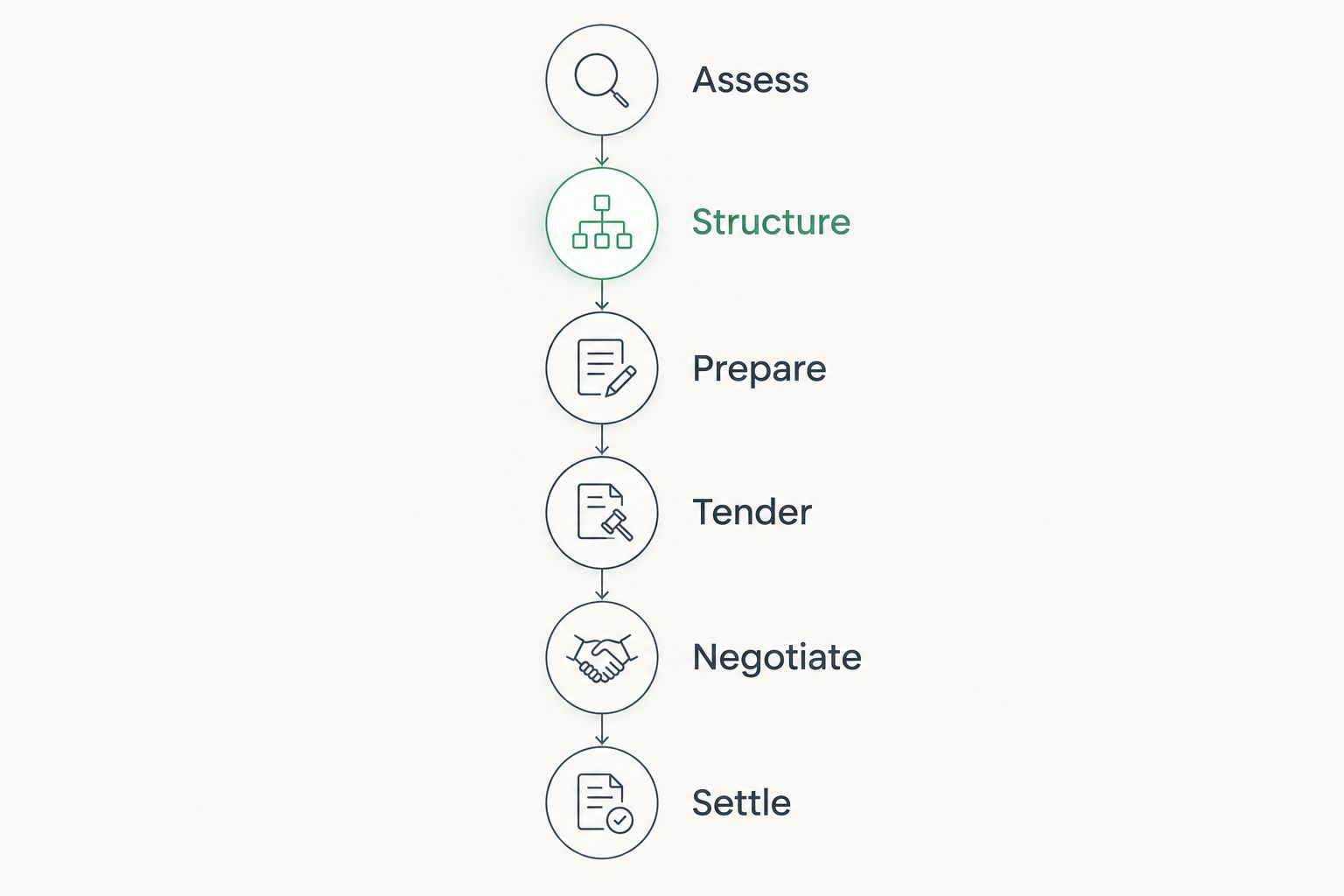
The sequence creates a practical comparison framework. Ask Loanworx to describe its own process against the same work, without assuming its terminology or delivery model matches.
The stronger process is the one tied to written responsibilities. A sequence of stage names alone does not tell you who answers lender questions, compares offers or resolves settlement conditions. Require those responsibilities in the engagement scope.
Loanworx wins when its proposal better fits a defined transaction
Not every business needs a full banking tender. If you have a clearly defined equipment purchase or a specific refinancing requirement, select the broker whose written scope fits that transaction without adding work you do not need.
Choose Loanworx for that transaction if its proposal offers the better documented fit. The evidence should be specific: relevant lender selection, a clear information request, ownership of lender communication and defined settlement responsibilities.
This is different from assuming a smaller assignment requires less care. Equipment finance still needs to sit alongside your existing commitments. Property development funding needs a brief reflecting the project rather than a generic business loan request.
The tradeoff is scope. A focused engagement should not be mistaken for a review of every facility, guarantee or security arrangement. If you want the whole banking relationship examined, say so before accepting a transaction-specific proposal.
Neither broker wins on security without a terms comparison
Security, guarantees and covenants require a facility-level comparison. Neither broker earns an automatic win because of its panel size, independence or relationship with you.
For a 2026 refinancing decision, request a written comparison covering:
- Assets proposed as security and the treatment of existing security.
- Guarantees required under the proposed facilities.
- Repayment structure and any final repayment obligation.
- Financial reporting requirements and covenants.
- Conditions that must be met before settlement.
- How the facilities interact with other borrowing.
Treat this dimension as a tie until the proposed terms establish a difference. A recommendation should explain the obligations you are accepting, not just the finance being arranged.
Ask your legal and accounting advisers to assess matters within their expertise before you sign. Broker selection does not replace that review, and a lender's willingness to provide finance does not settle whether the obligations suit your business.
Compare remuneration models, not a generic brokerage claim
The relevant distinction is between lender-paid commercial finance brokerage and debt advisory services using a retainer and success-fee structure. Confirm which engagement applies to your work and what the agreement requires of you.
Lender-paid brokerage and debt advisory are different service and remuneration arrangements. Do not compare them as though the scope is identical. A proposal covering a broader advisory assignment needs to identify that work separately from arranging a facility.
Ask both brokers:
- Who pays for the proposed service?
- What work is included and excluded?
- When does an obligation to pay arise?
- What event triggers any success fee?
- What happens if you stop or change the assignment?
- How are remuneration arrangements disclosed?
Neither broker wins on remuneration until you compare equivalent scopes. For predictability, require clear deliverables and payment triggers. For flexibility, establish how changes to the assignment are approved. Do not assume either payment model automatically provides better advice.
Final verdict: choose the brief before the broker
Choose Glenclair for an established-business banking review
You are an established Australian business owner reviewing existing banking arrangements, refinancing or coordinating commercial borrowing across several purposes. Business-purpose finance above A$2 million matches the preferred focus, subject to case-by-case suitability.
Choose this route when you want an independent brokerage proposition, a panel of 60+ lenders and a staged banking tender. Accept the practical requirement: a meaningful review needs financial information, a clear brief and your participation in decisions.
Choose Loanworx when its written proposal better meets your brief
You have an existing relationship worth retaining, or a defined transaction for which the Loanworx proposal demonstrates the better fit. Choose it when its scope, lender rationale, responsibilities and remuneration arrangements answer your requirements more clearly.
Do not choose it merely to avoid assembling information for a review. Continuity is useful when it supports a current, well-defined engagement, not when it preserves an arrangement you no longer understand.
| Dimension | Winner |
|---|---|
| Stated fit for a broad commercial banking review | The client's stated service scope |
| Existing broker relationship | Loanworx, if it is your established adviser |
| Relevant lender access | The broker with the better justified shortlist |
| Process accountability | The broker with clearer written deliverables |
| Defined transaction fit | Loanworx, if its proposal better matches the assignment |
| Security and covenants | Tie until proposed terms are compared |
| Remuneration | Tie until equivalent scopes are compared |
FAQ
Is Glenclair better than Loanworx for business refinancing?
Glenclair is a fit for established businesses seeking an independent commercial finance review and a banking tender. Choose Loanworx instead when its written refinancing proposal better meets your scope, relationship and execution requirements.
Do I need to borrow more than A$2 million?
Business-purpose finance above A$2 million is the preferred focus, not a universal eligibility rule. Suitability is assessed case by case.
Does a panel of 60+ lenders mean every lender receives my application?
No. Panel size describes the starting pool, not the number of applications. Ask for the relevant shortlist and the reasons for selecting those lenders.
What should a commercial banking tender cover?
A commercial banking tender should address the borrowing requirement, lender selection, proposed terms and settlement responsibilities. Ask for repayment, security, guarantee and covenant comparisons as part of the written brief.
Is commercial finance brokerage the same as debt advisory?
No. Lender-paid brokerage and debt advisory using a retainer and success-fee structure are different engagements. Confirm the service scope and remuneration arrangement before appointing an adviser.
Should I stay with a broker who already knows my business?
Stay when the existing broker's current proposal meets your requirements. Prior knowledge is useful, but it does not replace a written scope or a fresh assessment of the banking arrangement.
What information should I prepare for a broker comparison in 2026?
Prepare a summary of existing facilities, security, guarantees, financial information and the changes you want. Give both brokers the same brief so you can compare their proposed work directly.
One last thing
Ask each broker to state what its engagement excludes. This exposes a useful difference: arranging a replacement facility is not necessarily the same assignment as reviewing your complete banking relationship.
For your 2026 review, write the exclusions beside the deliverables before you appoint anyone. That is a more useful final check than comparing two lists of services.
Related guides
- Income requirements for commercial property finance
- Equipment finance options for manufacturing businesses
- Truck finance options for Australian transport fleets
By the Glenclair Financial team.