
Glenclair vs Swoop Funding: comparing broker process in 2026

Choose Glenclair if you want a commercial finance brokerage focused on reviewing established business banking arrangements; choose Swoop Funding if you want an online starting point for exploring loans, grants and equity funding. In 2026, the useful distinction is a banking review versus broader funding discovery—not a promise that either route delivers approval or better terms.
TL;DR
- Glenclair vs Swoop Funding is a choice between commercial banking review and broader funding discovery.
- Glenclair suits established Australian businesses reviewing refinancing and commercial borrowing, with suitability assessed case by case.
- Swoop Funding suits businesses exploring loans alongside grants and equity funding.
- Compare engagement scope, remuneration, security and repayment terms before choosing either route.
Why this matters
A business funding search and a banking review solve different problems. One helps you identify possible sources of capital. The other examines whether your existing facilities, security and lending conditions still suit the business.
For an established Australian business reviewing borrowing above A$2 million, that distinction deserves attention before you submit an application. The amount is a preferred client profile here, not a universal eligibility threshold.
Start with the decision you need to make in 2026: refinance existing debt, fund equipment, finance commercial property or development, or support working capital. Review the commercial finance services against that brief, rather than choosing on the number of funding categories alone.
At a glance
| Dimension | Glenclair | Swoop Funding |
|---|---|---|
| Best for | Established businesses reviewing commercial borrowing and banking arrangements | Businesses exploring different funding routes online |
| Starting question | Does the existing banking structure still fit? | Which funding categories should the business explore? |
| Standout feature | Independent brokerage through a panel of 60+ lenders | Funding discovery spanning loans, grants and equity |
| Banking review | Process-led assessment, tender and negotiation | Establish the scope of banking-review support before engagement |
| Funding breadth | Business loans, refinancing, equipment and property development finance | Loans, grants and equity funding exploration |
| Equipment and property | Consider these within the wider commercial borrowing brief | Establish the relevant funding route and support required |
| Pricing model | Lender-paid brokerage; debt advisory uses a retainer and success fee | Confirm remuneration for the particular service and funding route |
| Credit decision | The lender assesses the application | The lender or funding provider assesses the application |
A banking review favours the commercial brokerage brief
A refinancing decision should start with the existing debt structure, not an application form. List each facility, its purpose, security, maturity, repayment requirements and reporting obligations. Then identify what needs to change.
That makes a commercial brokerage brief appropriate when you are questioning the whole banking relationship. You might need to examine working capital alongside equipment debt, or understand how property security affects future borrowing flexibility.
The benefit is a defined review rather than an isolated product search. The limitation is the preparation required: meaningful comparisons need financial information, existing facility documents and a clear explanation of business plans.
Swoop Funding is the better starting point when your question is broader: should the business explore borrowing, grants or equity? That is a different brief. Before treating funding discovery as a replacement for a banking review, establish who will assess the existing facilities and negotiate changes.
Swoop Funding wins when the funding category is undecided
Swoop Funding is best for a business that wants to explore different funding routes before settling on debt. Its wider funding-discovery scope is relevant when a loan is only one option under consideration.
Debt, grants and equity are not interchangeable. Borrowing creates repayment obligations. Equity involves ownership considerations. Grants have programme-specific eligibility and permitted-use conditions.
The advantage of exploring these routes together is a broader starting question. The drawback is that identifying a category does not establish suitability, eligibility or the commercial terms you will receive.
If you already know the task is refinancing existing commercial facilities, funding breadth is less decisive. Focus instead on who will structure the proposal, approach lenders and compare the resulting offers. A longer list of funding categories does not answer those questions.
A banking tender gives refinancing a defined sequence
A banking tender puts a financing proposal in front of prospective lenders and creates a basis for comparing responses. Its value lies in the quality of the brief and comparison—not simply in approaching more institutions.
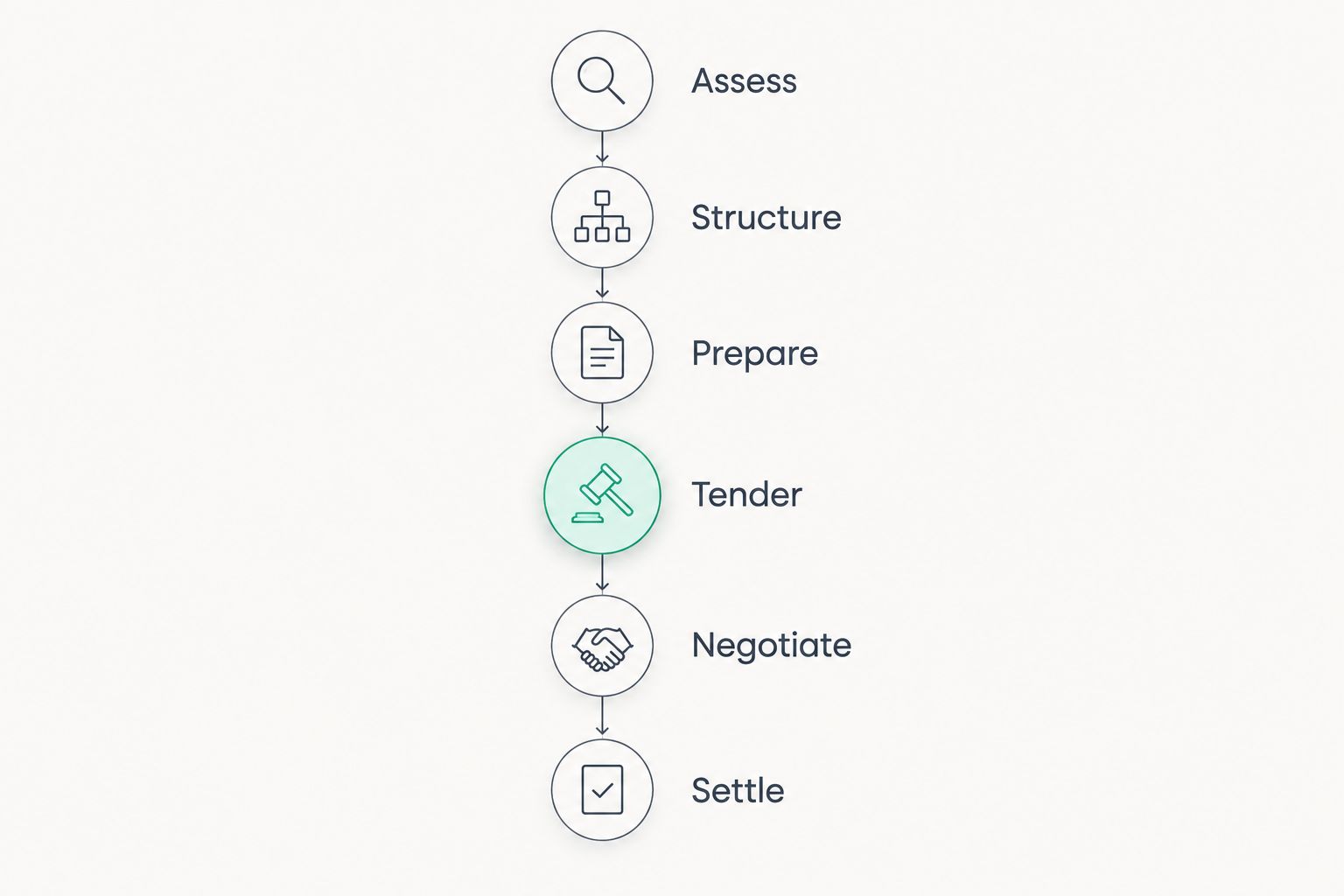
For a 2026 banking review, use these six stages to establish responsibilities before work begins:
- Assess: document existing debt, business performance and the reason for reviewing finance.
- Structure: define the facilities, repayment profile and security arrangements to seek.
- Prepare: assemble financial records, forecasts and supporting explanations.
- Tender: present the borrowing proposal to suitable lenders.
- Negotiate: compare responses and negotiate the relevant commercial terms.
- Settle: coordinate the accepted facility requirements and transition.
The brokerage's panel of 60+ lenders gives the process a defined lender universe. It does not mean every lender suits your transaction or that every lender receives your application.
Ask either provider who owns each stage. Funding discovery, application preparation, lender negotiation and settlement coordination are separate responsibilities; your engagement should make the boundaries clear.
Equipment and property borrowing need the same whole-business test
Equipment finance deserves more than a repayment comparison. Ask how the proposed commitment fits existing debt, operating cash flow and the useful role of the asset in your business.
For a manufacturer, that means connecting machinery funding to the commercial borrowing position. For a transport operator, it means considering vehicle commitments alongside working capital rather than treating each purchase as unrelated.
Commercial property and property development finance need their own assessment. The borrowing purpose, repayment source, security and project information belong in the brief from the outset.
The brokerage approach suits you when these requirements need to be considered together. Swoop Funding suits you when identifying the relevant funding route remains the immediate task. Neither starting point replaces scrutiny of the proposed facility documents.
Do not choose a provider solely because equipment or property appears on a service list. Ask who will handle the transaction, what information they require and how they will compare the available structures.
Neither route removes lender assessment
This is an honest tie. A broker or funding platform can help you explore finance, but the lender decides whether to lend and on what terms.
For business-purpose borrowing, prepare to explain the repayment source, current liabilities, trading performance and security offered. The documents required depend on the lender and transaction. A property development proposal needs a different supporting brief from an equipment purchase or working capital review.
Do not treat an initial indication as a settled facility. Read the conditions attached to any offer and identify what remains outstanding before relying on the funding.
The practical test is straightforward: ask who will explain conditions, resolve information requests and keep responsibility clear. No provider should be selected on an assumed approval outcome.
Neither route wins on terms until you compare offers
A headline interest rate does not describe the entire borrowing arrangement. Compare the facility structure and obligations as well as the rate.
Use the same checklist for each proposal:
- Repayments: scheduled principal, interest and any amount due at maturity.
- Security: assets offered and any guarantees required.
- Conditions: financial covenants, reporting and review requirements.
- Flexibility: early repayment, additional borrowing and changes to security.
- Transition: existing-facility discharge requirements and new-facility conditions.
A lower rate does not automatically compensate for conditions that conflict with your plans. Equally, flexibility has little value if it does not address a real business requirement.
This is another tie: neither the brokerage label nor the platform label establishes better terms. The written offer is the comparison that matters. Ask the provider to explain the differences against your original borrowing brief.
Pricing: separate brokerage from debt advisory
For a 2026 engagement, distinguish how the provider is paid from what the lender charges. They are different parts of the decision.
Glenclair distinguishes lender-paid brokerage from debt advisory, which uses a retainer and success-fee structure. Lender-paid remuneration and a separately commissioned advisory engagement should not be treated as the same service.
A retainer commits you to an agreed advisory scope. A success fee links part of the remuneration to a defined event. Before signing, establish the deliverables, payment triggers and treatment of work if the transaction does not proceed.
For Swoop Funding, request the remuneration terms for the specific service and funding route you intend to use. Do not assume that every route carries the same arrangement or that an initial online enquiry defines the full engagement.
Ask both providers:
- Who pays the provider, and when?
- Is there a separate advisory engagement?
- What event triggers each payment obligation?
- What work is included, and what falls outside scope?
- How are lender relationships and potential conflicts disclosed?
Compare the engagement agreement alongside the lender proposal. Neither document substitutes for the other.
Final verdict: choose the brief before the provider
Choose Glenclair for an established-business banking review
Glenclair commercial finance brokerage is best for established Australian business owners reviewing existing banking arrangements and commercial borrowing. Its stated focus fits refinancing, business loans, equipment and property development finance through a panel of 60+ lenders.
The preferred enquiry is business-purpose finance above A$2 million, assessed case by case. Choose this route when you want the existing debt position examined and a structured tender discussed—not merely a list of potential funding categories.
The trade-off is preparation. Bring the documents needed to explain the business and its current facilities; do not expect a meaningful banking review from a loan amount alone.
Choose Swoop Funding for broader funding exploration
Choose Swoop Funding when your immediate task is to explore loans, grants and equity rather than review an established banking relationship. Its funding-discovery orientation fits an owner still deciding which route deserves investigation.
The trade-off is the need to define the next stage. Establish what assessment, application and negotiation support accompanies the route you select.
For either choice in 2026, commission a specific job. A clear borrowing brief makes it easier to judge whether the proposed service addresses your decision.
| Dimension | Winner |
|---|---|
| Existing banking review | Commercial brokerage brief |
| Undecided funding category | Swoop Funding |
| Structured banking tender | Commercial brokerage brief |
| Equipment and property | Choose by transaction scope |
| Lender assessment | Tie: provider choice does not remove it |
| Lending terms | Tie: compare written offers |
| Remuneration | Choose after reviewing engagement terms |
FAQ
Is a commercial finance broker better than Swoop Funding for refinancing?
A commercial finance brokerage is the more direct fit when you want an existing banking arrangement reviewed and a lender tender discussed. Swoop Funding is a useful starting point when you are still exploring different funding routes.
Can I compare loans, grants and equity through Swoop Funding?
Swoop Funding provides a starting point for exploring loans, grants and equity funding. Each route requires its own eligibility and suitability assessment; identifying an option does not establish that your business qualifies.
Do I need to borrow more than A$2 million?
Borrowing above A$2 million is the preferred client profile for the commercial banking review described here, not a universal eligibility rule. Suitability is assessed case by case against the business and transaction.
Does a panel of 60+ lenders guarantee a better deal?
No. A panel of 60+ lenders describes the brokerage's lender access, not a guaranteed rate, approval or saving. Compare the written offers against your borrowing requirements.
How does lender-paid brokerage differ from debt advisory?
Lender-paid brokerage involves remuneration paid by the lender, while debt advisory uses a retainer and success-fee structure. Confirm the service scope, payment triggers and obligations in the engagement agreement.
What should I prepare for a banking review in 2026?
Prepare your existing facility documents, financial records, liabilities and a clear explanation of what needs to change. The provider should then identify the additional information required for your particular borrowing proposal.
Can either provider guarantee business finance approval?
No. The lender or funding provider assesses the application and sets its conditions. Treat any preliminary indication separately from an accepted facility with its requirements satisfied.
One last thing
Before your next enquiry, write down what you want changed without mentioning an interest rate. Examples include releasing security, aligning repayments with cash flow or separating an equipment requirement from the wider banking review.
Then ask the provider to explain how its proposed process addresses that objective. A specific answer tells you more than a broad claim about lender access.
Related guides
- Equipment finance options for manufacturing businesses
- Equipment finance options for construction businesses
- Income requirements for commercial property finance
By the Glenclair Financial team.