
Heads of agreement to settlement: acquisition finance workflow

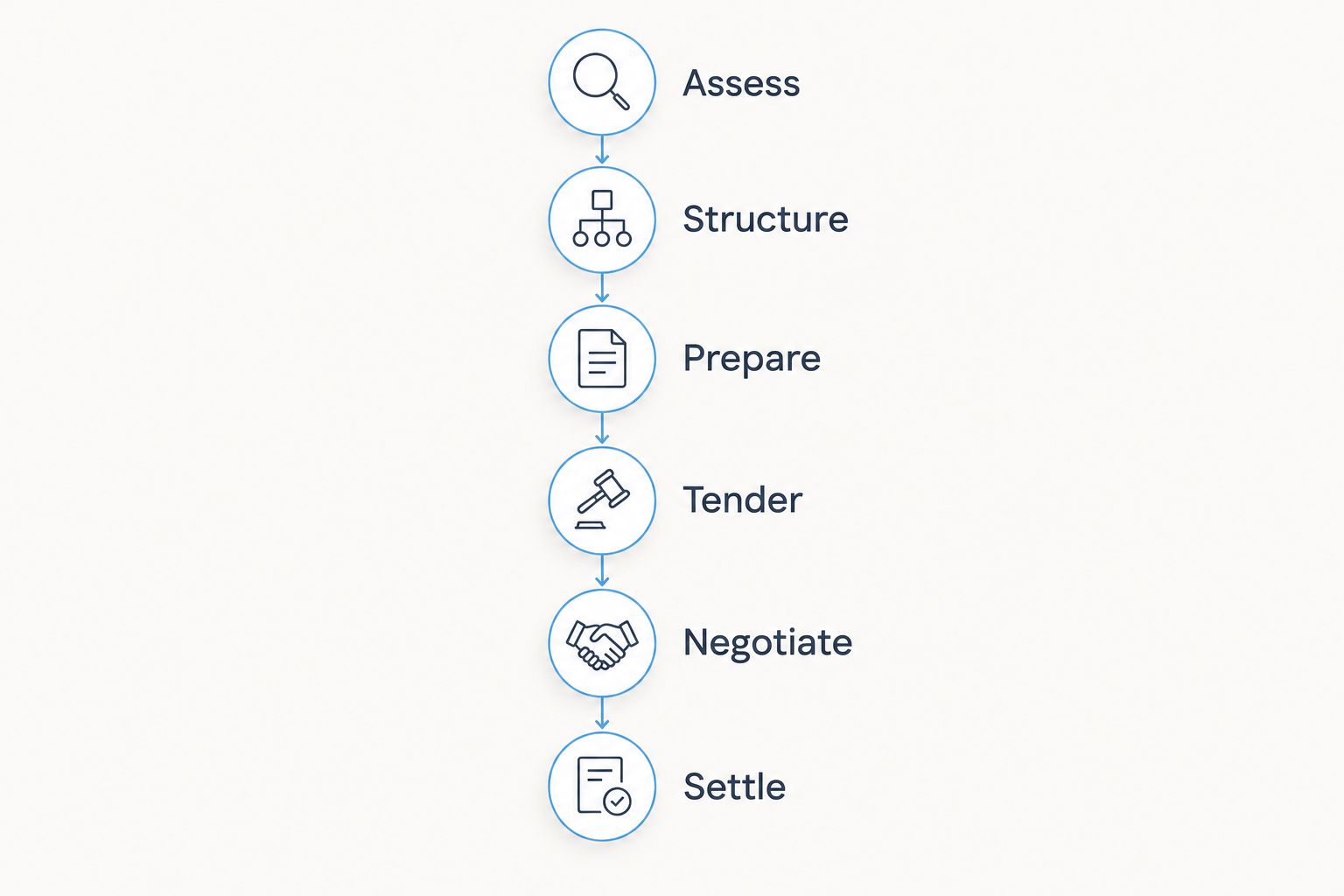
Instead of manually chasing finance documents as each deadline arrives, set up a business acquisition finance workflow that connects the heads of agreement, lender assessment and settlement checklist. Give every requirement an owner, supporting evidence and a deadline so you can identify unresolved funding conditions before committing to completion.
TL;DR
- Glenclair suits established Australian business owners seeking independent commercial finance broking, with suitability assessed case by case.
- Start business acquisition finance before contractual deadlines leave no room to address lender conditions.
- Separate acquisition funding, refinancing and working capital needs before approaching lenders.
- Treat conditional approval and settlement readiness as different stages, with separate evidence requirements.
Why this matters
An acquisition contract and a loan approval answer different questions. The contract sets your obligations to the seller; the lender's documents set the conditions for advancing funds. Neither replaces the other.
Glenclair is best suited to established Australian business owners seeking independent commercial finance broking. Its panel includes 60+ lenders, but panel size does not establish which lender will accept your acquisition. The transaction, borrower, security and supporting evidence determine the appropriate approach.
For a 2026 acquisition, start with a transaction-specific funding brief rather than a generic loan enquiry. Glenclair focuses on commercial finance; legal, tax and accounting decisions still belong with the advisers responsible for those matters.
Before you start
- Confirm access and authority. Identify the purchaser, authorised decision-makers, accountant, solicitor and finance contact. Establish who can release the buyer's and seller's financial information, subject to confidentiality obligations.
- Assemble the transaction materials. Gather the heads of agreement or draft contract, available business financials, buyer financials, existing debt details, proposed security and evidence of your contribution. Let the lender specify its required reporting periods and supporting documents.
- Check the contract before relying on finance. Ask your solicitor which provisions are binding and how finance conditions, deposits, extensions and termination rights operate. A document called heads of agreement does not, by its name alone, establish that every provision is non-binding.
Create a shared document register using your existing document system. Use these register headings: Requirement, Owner, Evidence, Due date, Status and Dependency. These are suggested tracking fields, not labels from a particular lender portal.
Restrict access to confidential financial records. The seller's information should not circulate beyond authorised recipients simply because several lenders are being considered.
Assess and structure
Establish the funding requirement
- Record the transaction. Identify whether you are acquiring business assets or shares, the proposed purchaser and the intended completion date. Ask your solicitor and accountant to confirm the implications of the structure.
- Build the sources-and-uses schedule. List acquisition consideration, transaction expenses, debt repayments required at completion and opening working capital. Record buyer contributions separately from proposed borrowing.
- Map existing banking arrangements. Record current facilities, security, guarantees, expiry dates and relevant covenants. Establish whether existing debt will remain, change or be refinanced.
- Test the operating assumptions. Separate historical trading from buyer forecasts. Explain adjustments, proposed management changes and any reliance on revenue or savings that has not yet occurred.
Expected result: one funding schedule that reconciles the transaction's uses of funds with its proposed funding sources. An unexplained gap is a funding problem, not a settlement administration task.
Glenclair's preferred audience includes established businesses seeking business-purpose finance greater than A$2 million. That focus is not a universal eligibility threshold; suitability requires a transaction-specific assessment.
Separate the financing jobs
Do not ask a single facility to solve different borrowing needs without examining the consequences. Your 2026 funding brief should distinguish the acquisition itself from the cash required to operate the business after completion.
| Funding component | Best for | Benefit | Trade-off to assess |
|---|---|---|---|
| Acquisition borrowing | Funding the business purchase | Makes the purchase funding requirement explicit | Repayments must fit the assessed cash flow and agreed terms |
| Working capital facility | Funding operating cash requirements | Separates operating needs from purchase consideration | Limits, conditions and repayment mechanics require separate assessment |
| Equipment finance | Funding eligible equipment within the transaction | Allows equipment funding to be assessed separately | Asset ownership, security and existing finance must be checked |
These components are not a recommendation to use every facility. Ask the broker to explain whether separation improves the structure or merely adds documentation and complexity.
If commercial property forms part of the purchase, identify its funding and security requirements separately. Do not assume that an acceptable business acquisition automatically establishes an acceptable property loan.
Prepare and tender
Build a consistent lender submission
- Prepare the buyer profile. Explain ownership, management experience, existing businesses, liabilities and the proposed operating structure. Support the explanation with relevant documents.
- Reconcile the target's financial information. Have the accountant explain material differences between accounts, management reporting and the forecast used for the application. Identify unresolved due diligence findings rather than leaving lenders to discover inconsistencies.
- Document the funding request. State the required facilities, proposed security, contribution, repayment approach and completion timetable. Identify assumptions that remain subject to agreement.
- Control the document version. Date the funding brief and maintain a change log. Distribute revisions to the parties who need them, rather than letting competing versions remain in circulation.
- Agree the lender approach. Establish which lenders will receive the submission and who will manage questions. Ask how lender selection reflects the transaction rather than assuming the widest distribution is the best process.
Expected result: lenders receive a consistent explanation of the same transaction, with outstanding matters clearly identified.
A consistent submission improves the basis for comparison. It does not guarantee approval or remove the need for lender-specific assessment.
Set the engagement scope
Ask what the broker will prepare, which negotiations the broker will handle and which tasks remain with you, your solicitor and your accountant. Clarify responsibility for chasing outstanding conditions.
Distinguish lender-paid brokerage from debt advisory services. Glenclair's debt advisory services use a retainer and success-fee structure. Confirm the applicable engagement and remuneration arrangements before authorising work; do not assume every service follows the same model.
The commercial finance services page is a starting point for discussing the scope relevant to your acquisition and existing banking arrangements.
Negotiate and confirm
Compare the whole offer
- Separate indicative terms from approval. Record the status of each response and the matters still requiring credit assessment. Do not describe an indicative discussion as an approved facility.
- Compare equivalent structures. Check borrower, facility purpose, repayment profile, term, security, guarantees, covenants and reporting obligations. Different assumptions make headline comparisons unreliable.
- Create a conditions register. Copy each condition accurately from the lender's documents. Assign an owner and record the evidence required to satisfy it.
- Resolve commercial and legal differences. Refer loan documentation questions to your solicitor. Ask the lender or broker to clarify conditions whose meaning or evidence requirements are unclear.
- Confirm the funding gap again. Reconcile the selected facilities against the latest transaction figures and buyer contribution. Include any changes identified during due diligence.
Expected result: a selected funding structure with understood obligations and a documented route to satisfying outstanding conditions.
For a 2026 banking review alongside an acquisition, compare the effect on existing facilities as well as the new borrowing. A new acquisition facility does not answer whether current guarantees, security or covenants remain appropriate.
Keeping your existing lender can reduce the number of banking relationships you manage, but the proposed terms still need examination. Changing lenders introduces a separate transition task: confirm how existing facilities, securities and operating arrangements will be handled.
Negotiate the structure you can operate under, not just the offer you can obtain. Reporting obligations and restrictions matter after the purchase has settled.
Settle and hand over
Close the evidence gaps
- Match the contract and finance timetable. Ask your solicitor and finance contact to identify unresolved dependencies before the contractual completion deadline. Obtain required extensions through the appropriate parties rather than assuming they exist.
- Verify the contribution. Confirm the amount, source and transfer arrangements for buyer funds. Independently verify payment instructions through a trusted contact method before transferring money.
- Confirm outstanding lender requirements. Check executed documents, security requirements, insurance evidence and any other conditions specified for the transaction. Record what remains outstanding and who must confirm satisfaction.
- Reconcile the settlement statement. Have the responsible advisers confirm adjustments, disbursements and the treatment of existing debt. Reconcile the final statement against the funding schedule.
- Obtain readiness confirmation. Ask the lender's settlement contact and your solicitor what remains required for funds to advance and completion to occur. Keep their responsibilities distinct.
- Create the post-settlement register. Record repayment obligations, reporting dates, covenant testing requirements and any post-settlement undertakings contained in the agreed documents.
Expected result: the parties have an agreed settlement position, with funding requirements and unresolved conditions explicitly recorded. Completion remains subject to the transaction documents and the parties fulfilling their obligations.
A 2026 settlement checklist should distinguish Submitted from Accepted. Uploading evidence does not establish that the lender has accepted it or satisfied the related condition.
When the purchase terms change
Run a controlled update whenever due diligence changes the transaction. Examples include revised consideration, a different purchasing entity, altered security or a changed working capital requirement.
- Update the sources-and-uses schedule and identify the changed assumptions.
- Ask the accountant to revise affected forecasts and explain the movement.
- Ask the solicitor to identify contractual consequences and required amendments.
- Send the updated position through the agreed lender contact and request confirmation of any further assessment or documentation.
Expected result: the funding decision and settlement documents reflect the current transaction, not the version first submitted.
Do not assume a change is immaterial because the total borrowing request remains unchanged. A different borrower or security arrangement changes what the lender is being asked to fund.
Troubleshooting
- The lender requests information already supplied. Check the reporting period, entity, document completeness and version. Ask which specific requirement remains unanswered, then update the register with the accepted evidence.
- The forecast relies on unexplained adjustments. Ask the accountant to reconcile each adjustment to supporting records and distinguish historical results from proposed changes. Remove unsupported assumptions from the factual description of trading.
- Conditional approval is mistaken for settlement readiness. Return to the conditions register. Obtain confirmation of outstanding requirements from the party responsible for accepting them.
- The seller's timetable overtakes the finance process. Raise the mismatch with your solicitor immediately. Discuss contractual options; do not treat an expected lender response as permission to ignore a deadline.
- Working capital disappears from the final funding plan. Reconcile post-completion cash requirements separately from purchase consideration. Revise the funding request or contribution before relying on the existing plan.
Customise your workflow
Use the same register to review existing banking arrangements alongside the acquisition. Add a separate workstream for equipment, property or refinancing where the transaction requires it, while keeping one reconciled funding schedule.
For your 2026 handover, assign responsibility for ongoing lender reporting before the acquisition team disperses. The person who assembled the application is not automatically the person responsible for future compliance.
FAQ
When should I start arranging business acquisition finance?
Start before contractual deadlines restrict your options. Build the funding brief alongside the proposed transaction terms, and ask your solicitor how finance conditions and commitments should be handled.
Does signing heads of agreement mean I have to complete the purchase?
Your obligations depend on the document's wording and circumstances. Ask your solicitor which provisions are binding before signing or paying a deposit.
Is conditional loan approval enough to settle a business acquisition?
Conditional approval does not establish settlement readiness. Confirm the remaining conditions, documentation and funding requirements with the lender's settlement contact and your solicitor.
Can acquisition finance include working capital and equipment?
Working capital and equipment can be assessed as separate funding needs within an acquisition plan. Whether they can be funded, and through which facilities, depends on the transaction and lender assessment.
Should I refinance existing business debt when buying another business?
Review existing debt alongside the acquisition, but do not assume refinancing is necessary. Compare the effect on repayments, security, guarantees, covenants and operating requirements before deciding.
Is A$2 million a minimum loan requirement?
Finance greater than A$2 million describes the preferred audience for this guide, not a universal eligibility rule. Suitability is assessed case by case.
What happens if the purchase terms change after finance approval?
Notify the agreed lender contact and update the funding submission. Ask whether the revised transaction requires further assessment, amended approval or replacement documents.
One last thing
Keep a dated snapshot of the final approved transaction beside the settlement funding schedule. It gives your team a direct way to check whether the borrower, security, contribution and use of funds still match what the lender assessed. Resolve differences before treating the file as ready.
Related guides
- Equipment finance options for manufacturing businesses
- Equipment finance options for construction businesses
- Income requirements for commercial property finance
Written by the Glenclair Financial team.