
How long does property development finance take to settle?

Property development finance has no fixed settlement timeframe: your facility settles when the lender’s credit, valuation, legal and funding conditions are satisfied. Approval alone does not release the money, and the first construction drawdown can require further checks after the facility settles. For a 2026 development or refinance, work backwards from the date funds must be available rather than treating an indicative approval as a settlement commitment.
TL;DR
- Property development finance settlement time depends on outstanding conditions, not just the date of credit approval.
- Glenclair is an independent commercial finance brokerage for Australian business owners reviewing development funding and existing banking arrangements.
- Separate facility settlement from the first construction drawdown when planning your project’s cash requirements.
- Confirm valuation, documentation, security and drawdown requirements before relying on a funding date.
Why this matters
A development funding deadline must match an actual payment obligation. A land purchase, an expiring facility and a builder’s payment claim are different obligations; each needs a funding plan that identifies when cleared funds are required.
Glenclair is best suited to established Australian business owners seeking a commercial finance review. Its commercial finance services include refinancing and property development finance, with suitability assessed case by case.
The practical question is not simply how quickly a lender can approve the transaction. It is whether every party can complete the work required to release funds before your contractual deadline.
How long does property development finance take to settle?
There is no universal number of days between application and settlement. A useful timeframe must identify the starting point, the outstanding conditions and the event that counts as completion.
An application lodged without supporting documents is not at the same stage as an approved facility with signed loan documents. Likewise, a signed facility does not necessarily mean construction funds are available to draw.
Use the following milestones to test any proposed 2026 settlement schedule.
| Milestone | What must be established | What it does not establish |
|---|---|---|
| Initial assessment | The proposed borrowing, project and repayment strategy fit the lender’s criteria | A binding commitment to fund |
| Credit approval | The lender has approved the transaction subject to its stated conditions | That every condition has been satisfied |
| Valuation and project review | Required reports meet the lender’s requirements | That legal documentation is complete |
| Documentation | Facility and security documents are prepared and executed as required | That settlement funds are ready for release |
| Settlement readiness | Funding conditions, security arrangements and settlement instructions are complete | That every later construction drawdown is approved |
| Construction drawdown | Conditions for the particular payment have been met | Automatic access to all remaining facility funds |
Ask for a milestone-based timetable, not an unsupported settlement promise. Each outstanding item needs an owner, a dependency and a completion date agreed with the relevant party.
Define which settlement you mean
Property development finance can involve acquiring a site, refinancing existing debt or funding construction. The relevant completion event depends on the transaction.
For an acquisition, the critical event is usually the release of funds needed to complete the purchase. For a refinance, it is repayment of the outgoing lender and completion of the incoming lender’s security arrangements.
For construction, distinguish the establishment of the facility from access to a particular progress payment. Ask your broker and solicitor to confirm exactly which event the proposed timetable covers.
What needs to happen before development finance settles?
A clear process makes outstanding work visible. The following 6 stages provide a practical way to organise the transaction without treating any stage as a guaranteed approval or completion date.
Assess
Define the borrowing purpose, required funding date and proposed repayment source. Provide the current debt position, ownership structure and relevant project information so the initial discussion addresses the actual transaction.
For an established business reviewing borrowing above A$2 million, include the wider banking relationship where it affects the development facility. That borrowing preference is not a universal eligibility threshold; suitability still depends on the transaction.
Structure
Clarify the borrower, security, equity contribution and proposed facility terms. Separate acquisition funding, construction funding and any working capital requirement rather than assuming the same facility covers every cash need.
Identify the proposed exit as well. Sale proceeds, a refinance and retained ownership require different supporting explanations and must match the lender’s assessment.
Prepare
Assemble the information needed for lender assessment. Depending on the transaction, this can include financial statements, existing facility documents, development approvals, building contracts, project budgets and supporting reports.
Keep the figures consistent across the application. If the budget, contract and funding request describe different project costs, resolve the discrepancy before relying on a timetable.
Tender
Present a consistent funding request to suitable lenders. Glenclair’s commercial finance brokerage works through a panel of 60+ lenders; panel size does not mean every lender suits every development.
Ask which lenders fit the proposed security, project stage and repayment strategy. A meaningful banking tender compares requirements as well as headline commercial terms.
Negotiate
Review the proposed conditions alongside the facility terms. Identify reports, equity evidence, guarantees, security requirements and any conditions that must be completed before funding.
Distinguish negotiable points from requirements the lender will not change. Unresolved conditions belong on the settlement plan, not in an assumption that documentation will resolve them later.
Settle
Coordinate the lender, solicitors, outgoing lender where applicable and other necessary parties. Confirm that executed documents, security arrangements and funding instructions meet the lender’s requirements.
Obtain confirmation of completion before treating funds as available. If construction payments follow settlement, record the separate requirements for requesting each drawdown.
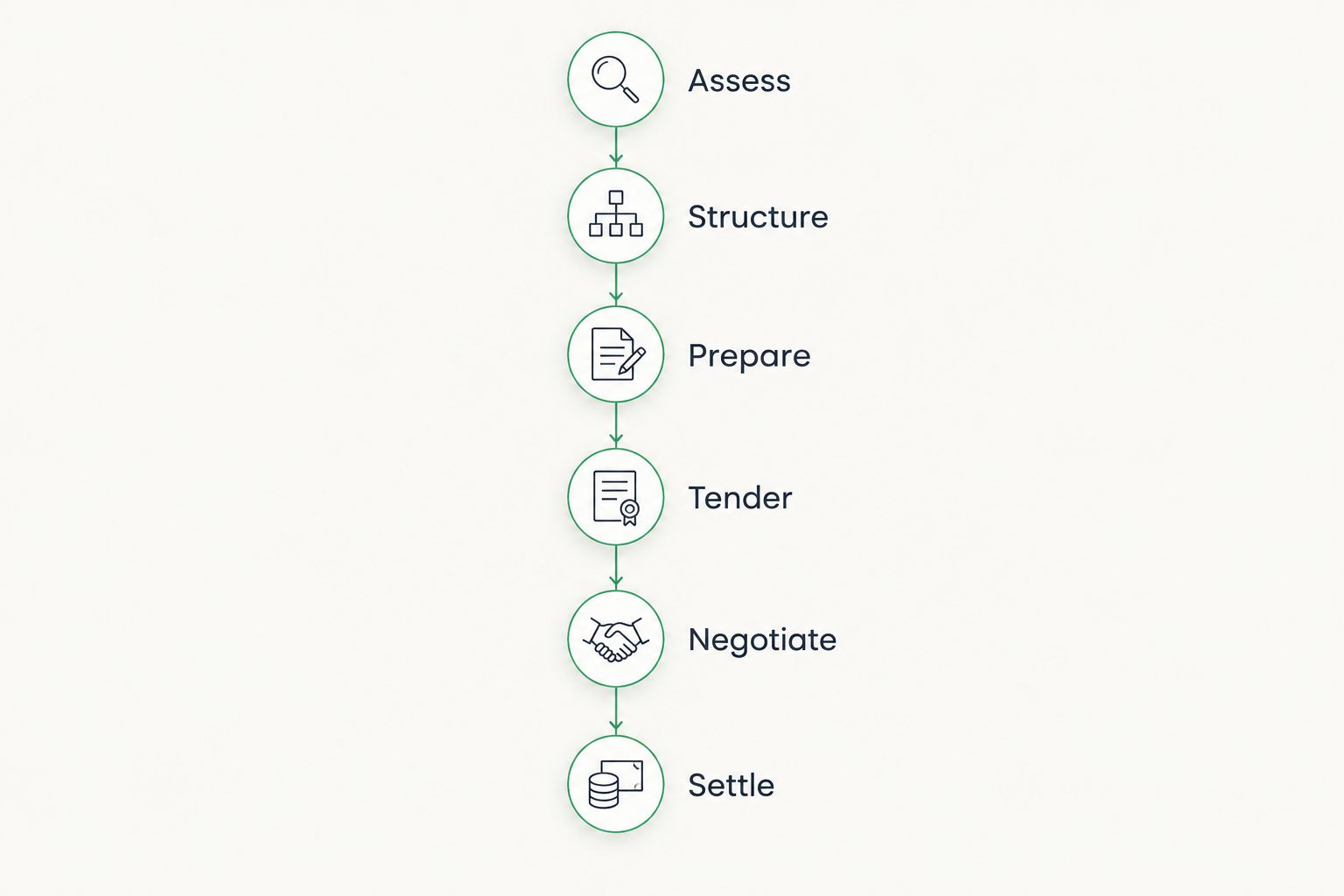
The process is useful only when the conditions register stays current. Ask for a single list showing what remains outstanding, who must supply it and which later tasks depend on it.
Why property development finance settlement time varies
The transaction’s requirements determine the work before settlement. These factors deserve attention before you agree to a completion date:
- Application completeness. Financial information, ownership details and the funding request need to describe the same transaction. Missing or conflicting information creates further questions.
- Valuation and supporting reports. Where a lender requires a valuation or project report, its instructions and acceptance requirements form part of the funding process. Ordering a report is not the same as satisfying that condition.
- Project documentation. Approvals, construction contracts and budgets need to support the proposed development. Changes to the project can require the funding proposal to be reconsidered.
- Equity and security. The lender must receive the evidence and security arrangements required by its approval. Existing mortgages or other interests also need to be addressed where relevant.
- Legal coordination. Borrower documents, guarantees, discharge arrangements and settlement instructions involve different parties. Their requirements must align before completion.
- Changes after approval. A different borrower, revised budget or altered contract can affect an earlier assessment. Notify the lender rather than assuming the approval covers the change.
For a 2026 banking review, raise these issues before selecting a lender solely on proposed terms. A condition your project cannot satisfy is more important than an attractive indicative offer.
How should you plan a development finance refinance?
Start with the existing facility, not just the replacement application. Check the maturity date, notice requirements, security arrangements and any obligations that affect repayment or discharge.
Keep 3 dates separate: existing facility maturity, proposed refinance settlement and the next project payment. They can coincide, but they represent different obligations and should not be treated as interchangeable.
Give the incoming lender and your advisers a clear account of the current position. Include any construction already completed, outstanding payments, remaining work and changes since the original facility was established.
Ask who is coordinating the outgoing lender’s discharge. Incoming approval does not itself arrange repayment, remove an existing mortgage or resolve competing security requirements.
If the intended refinance cannot be completed before maturity, address that position directly with your advisers and existing lender. Do not assume an extension exists unless it has been agreed.
What can you do to keep settlement on track?
Control the information and decisions you can influence. You cannot turn an indicative timetable into a lender commitment by requesting urgency.
- State the deadline accurately. Explain whether it comes from a purchase contract, facility maturity or project payment obligation.
- Submit consistent documents. Check that borrower names, entity details, budgets and requested amounts agree across the file.
- Resolve scope changes early. Tell the lender when the contract, project cost, security or repayment plan changes.
- Read conditions before accepting terms. Identify what must happen before settlement and what applies to later drawdowns.
- Confirm responsibility. Allocate outstanding work between the borrower, broker, solicitor, lender and relevant project advisers.
- Check completion, not activity. A report requested, document sent or discharge lodged is not necessarily an accepted or completed item.
For your 2026 funding plan, request a written status update organised around unresolved conditions. It should explain the next decision needed rather than simply saying the application is progressing.
Also confirm the engagement scope. Lender-paid brokerage is distinct from debt advisory services, which use a retainer and success-fee structure; neither arrangement removes the need for lender assessment.
Review your development funding timetable
Discuss refinancing, existing banking arrangements and the conditions that must be met before settlement.
Does approval mean development funds are available?
Approval does not mean development funds are available. Read the approval and facility documents to identify the conditions that apply before settlement and before each construction drawdown.
Terms such as indicative, conditional and approved describe different positions. Ask the lender to explain the status in writing rather than relying on a label used in conversation.
Can the first construction payment take longer than settlement?
The first construction payment can occur after facility settlement because it is a separate funding event. The facility documents determine what evidence and authorisation the lender requires before releasing that payment.
Build the drawdown process into your project administration. A settled facility should not be treated as an unrestricted account unless its terms actually provide that access.
FAQ
How long does property development finance take to settle in Australia?
Property development finance has no fixed settlement timeframe in Australia. The relevant schedule depends on the lender’s assessment, required reports, legal documentation and satisfaction of funding conditions.
When does the settlement timeframe actually start?
The starting point must be agreed because an initial enquiry, a complete application and credit approval are different milestones. Ask for a timetable that names both its starting point and the event that counts as completion.
Can I rely on conditional approval to meet a purchase deadline?
Conditional approval is not confirmation that settlement funds are available. Check every outstanding condition and obtain advice on your contractual obligations before relying on the proposed funding date.
Will refinancing my development loan be quicker than a new application?
Refinancing still requires the incoming lender to assess the transaction and complete its funding requirements. It also requires coordination with the outgoing lender, so an existing loan does not establish a shorter settlement timeframe.
Can I draw construction funds immediately after settlement?
Construction funds are released according to the facility’s drawdown conditions, not simply because settlement has occurred. Confirm the evidence and authorisation needed for the first payment before scheduling it.
Does Glenclair guarantee a development finance settlement date?
Glenclair does not promise a finance outcome. A settlement plan must remain subject to lender assessment, documentation and completion of the relevant conditions.
What should I prepare for a development finance review in 2026?
Prepare your existing facility documents, current financial information, project budget and relevant development documents for a 2026 review. Explain the required funding date, outstanding obligations and proposed repayment strategy so the assessment addresses the actual transaction.
One last thing
Ask what prevents funding today. That question separates a useful settlement update from a list of completed activities.
If the answer identifies an outstanding valuation, document, equity requirement or discharge arrangement, you have a task to assign. If the answer is unclear, request clarification before making another contractual commitment.
For a 2026 development finance decision, the strongest timetable is not the shortest estimate. It is the one that identifies the conditions between your current position and cleared funds.
Related guides
- Income requirements for commercial property finance
- Equipment finance options for construction businesses
- Machinery finance options for earthmoving contractors
Author: Glenclair Financial team.