
How much can you borrow against a truck fleet?
Your truck fleet finance amount depends on the fleet value a lender accepts, existing debt that must be repaid, and the repayments your business can support. There is no fixed borrowing amount or universal advance percentage: a fleet with substantial equity can still support little additional borrowing if cash flow is tight. For a refinancing review in 2026, separate the proposed total facility from the cash actually released after payouts and transaction costs.
TL;DR
- Your truck fleet finance amount depends on accepted asset values, existing payouts and repayment capacity.
- Glenclair suits established businesses seeking a structured commercial finance review, including truck fleet refinancing.
- Fleet refinancing does not release the full approved facility as cash; existing finance must be settled first.
- Compare equipment finance terms, security and repayments, not just the headline borrowing amount.
Why this matters
A fleet valuation is not a borrowing approval. Your trucks provide potential security, but your business still needs to service the proposed debt and meet the lender's conditions.
The practical question is not simply how much your fleet is worth. It is how much usable funding a transaction delivers without creating unsuitable repayments or security obligations. A commercial finance services review should address the fleet alongside your existing banking arrangements, rather than treating each truck loan in isolation.
For established businesses considering business-purpose borrowing above A$2 million, that wider review deserves particular attention. This is a content focus, not a universal eligibility threshold; suitability depends on the transaction.
How much can you borrow against a truck fleet?
The workable amount must satisfy both the lender's security assessment and your business's repayment capacity. Neither fleet value nor turnover establishes the answer alone.
Start with 3 checks:
- Accepted value. Establish which vehicles the lender will accept and the value it will use for each asset.
- Existing payouts. Obtain current payout figures for finance secured against the trucks. Accounting balances are not substitutes for settlement figures.
- Repayment capacity. Test the proposed repayments against business cash flow, existing commitments and the lender's assessment requirements.
Then distinguish the total approved facility from the funds left after settlement. Where refinancing releases equity, the basic reconciliation is:
Net cash released = gross refinancing proceeds − existing finance payouts − transaction costs paid from proceeds.
This calculation explains settlement cash, not credit approval. It does not establish an advance percentage, confirm that every truck is eligible, or replace a lender's assessment.
For your 2026 review, ask for the gross facility, payout amounts and net proceeds to be shown separately. A larger facility can largely replace existing debt rather than deliver additional working capital.
Match the amount to the transaction
Different borrowing purposes require different comparisons. Replacing existing truck debt is not the same transaction as buying additional vehicles or seeking cash against trucks you already own.
| Transaction | Best for | What the amount needs to cover | Main limitation |
|---|---|---|---|
| Refinance existing fleet debt | Reviewing current truck finance arrangements | Existing payouts and any approved additional funding | Payouts and transaction costs reduce cash released |
| Finance additional trucks | Adding identified vehicles to the fleet | The agreed acquisition funding requirement | The lender must assess the assets and repayment capacity |
| Borrow against unencumbered trucks | Seeking business-purpose funding against owned vehicles | The approved funding purpose within lender requirements | Ownership alone does not establish borrowing capacity |
These are transaction types, not interchangeable products. Ask which structure the lender proposes, what assets secure it and how the debt will be repaid. A facility that suits a vehicle acquisition does not automatically suit ongoing working capital.
Why your truck fleet finance amount varies
The main drivers sit on both sides of the transaction: the trucks being offered and the business making the repayments.
- Accepted fleet values. The lender's assessment can differ from your asset register, insurance schedule or expected sale proceeds. Confirm the valuation basis before treating an estimate as usable equity.
- Vehicle age, condition and specification. These characteristics inform asset assessment. Supply accurate vehicle details rather than a fleet-wide average that hides material differences.
- Existing debt and security. Current finance payouts affect refinancing proceeds. Other security arrangements also need checking before assuming a truck is available to support a new facility.
- Cash flow and existing commitments. The proposed repayments must be assessed alongside the business's other obligations. Strong asset coverage does not remove this requirement.
- Loan structure and purpose. The term, repayment profile, balloon and intended use of funds change the proposal. Compare structures against the same commercial objective.
- Lender policy. Acceptance criteria differ between lenders. A proposal needs to match both the assets and the borrowing business, not just a requested amount.
Do not turn these factors into a guessed borrowing percentage. Obtain an assessed proposal and check the assumptions behind it. That is more useful than applying an unsupported percentage to the whole fleet.
How to prepare a fleet borrowing assessment
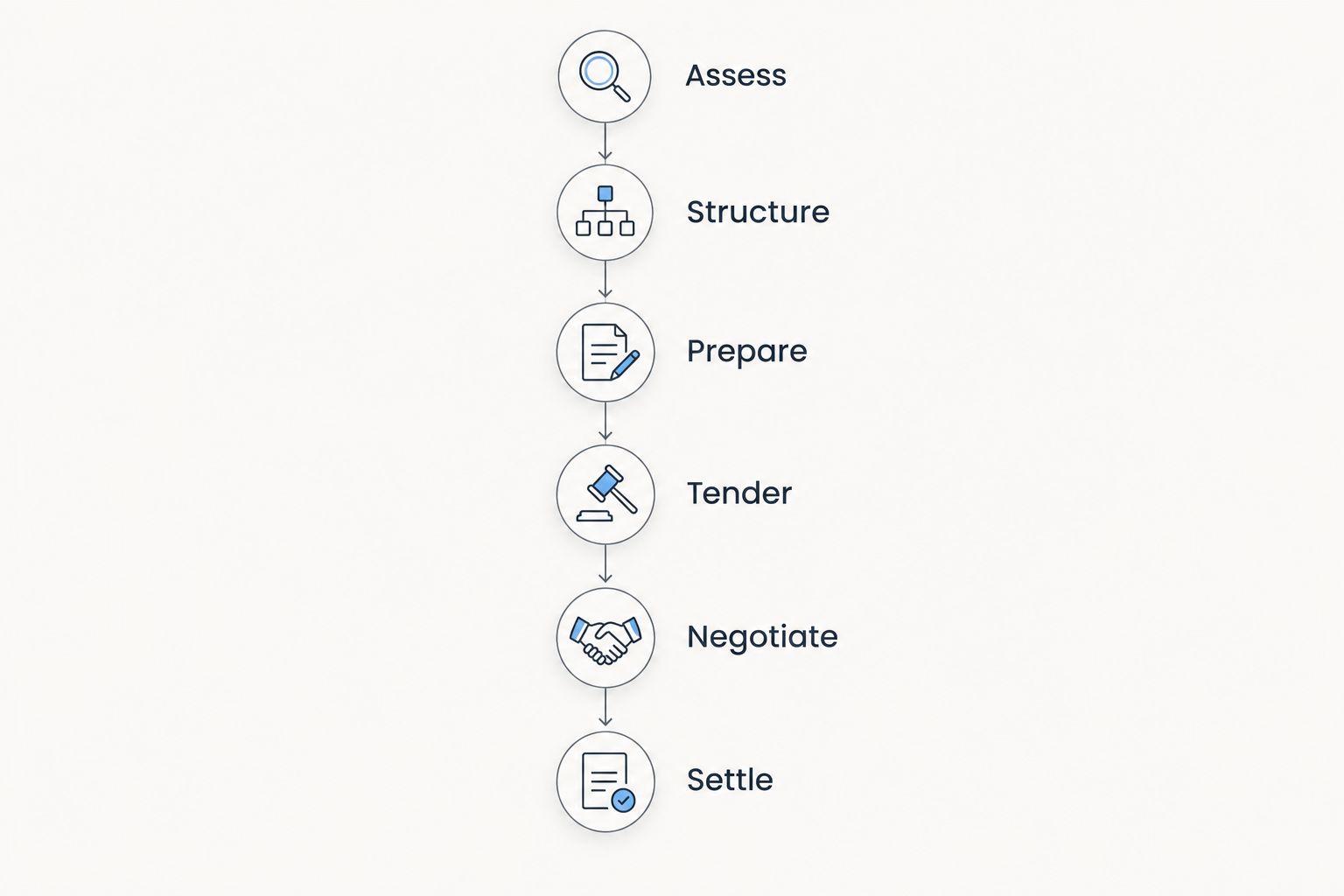
Organise the review around 6 stages: Assess, Structure, Prepare, Tender, Negotiate and Settle. The sequence keeps the funding objective separate from the eventual lender offer.
Assess
Define what the business needs the finance to achieve. State whether you want to replace debt, release equity, acquire trucks or review the fleet within a wider banking relationship.
Record the required usable funding, not just a preferred facility limit. If the objective is working capital, explain the cash requirement and repayment source rather than relying solely on truck values.
Structure
Compare the proposed debt term and repayment profile with the business's cash generation and intended vehicle holding period. Identify any balloon payment and how the business expects to meet it.
Treat a balloon as an obligation requiring a plan. It is not evidence that the overall facility is more affordable simply because scheduled repayments are lower.
Prepare
Build a consistent information pack covering the borrowing entity, financial position, fleet and existing liabilities. Check that vehicle identifiers match across ownership records, finance documents and the asset register.
Use current payout figures when assessing a live refinance. An earlier balance can misstate the amount needed at settlement and therefore the cash available afterwards.
Tender
Put a consistent request to suitable lenders so their responses address the same funding objective. State the requested amount, purpose, security and preferred repayment structure clearly.
A banking tender is useful only when the responses can be compared. Different terms, balloons or security requirements need to be made visible rather than buried beneath the borrowing limit.
Negotiate
Review the proposed facility as a whole. Address repayment obligations, security, guarantees, reporting requirements and conditions, alongside the amount offered.
Ask for unresolved points in writing. Do not treat a conditional indication as a completed approval or assume that every requested change will be accepted.
Settle
Reconcile final proceeds against the debts being discharged and the costs being paid. Confirm the arrangements for releasing existing security and establishing the new facility.
Check the result against the original objective. A completed refinance should be understood in terms of the resulting debt, repayments and usable funds—not merely the amount approved.
What information should you have ready?
Prepare 4 document groups before requesting a detailed fleet borrowing assessment. Confirm the lender's actual requirements before assuming this list is sufficient for an application.
Fleet records
Create a vehicle schedule with registration details, vehicle identification numbers, make, model, year, mileage and ownership entity. Identify trucks that are financed, unencumbered, being sold or proposed for replacement.
Separate trucks from trailers and other equipment. Clear asset descriptions allow the assessment to address the actual security offered rather than an undifferentiated fleet total.
Existing finance records
Collect current facility documents, repayment schedules and payout information. Record any balloon obligations and identify the assets attached to each arrangement.
Include relevant security and guarantee documents. Do not assume an asset is available for new borrowing merely because its individual loan has been repaid; confirm the applicable security position.
Business financial records
Prepare financial statements, current management accounts, business bank statements and details of existing liabilities. Explain material changes in trading rather than leaving the lender to reconcile unexplained movements.
For a 2026 application, distinguish historical performance from current trading. A profitable completed financial year does not, by itself, explain today's cash position or proposed repayment capacity.
Funding purpose and forecasts
Document how the funds will be used and how the business expects to repay them. Where forecasts support the request, make the assumptions explicit and consistent with the proposed transaction.
Separate recurring cash needs from a specific acquisition or refinancing requirement. The distinction helps frame the facility assessment; it does not guarantee a particular structure or approval.
Should you seek the maximum available amount?
Seek the amount that serves the business purpose on acceptable terms, not the largest limit offered. Extra borrowing creates extra obligations, even when there is sufficient asset value to support it.
Compare proposals using the same requested net proceeds. Otherwise, a larger facility can appear more useful while simply funding a larger payout or a different repayment structure.
Your comparison should show:
- Total facility amount and expected net cash released.
- Repayment frequency and contractual term.
- Any balloon or residual obligation.
- Assets offered as security and required guarantees.
- Conditions that must be satisfied before funding.
- Costs and obligations associated with exiting existing arrangements.
In a 2026 banking review, also check how the fleet proposal interacts with working capital, property finance and other business facilities. A truck loan should not be assessed as though the rest of the balance sheet does not exist.
When is a commercial finance broker relevant?
Glenclair is best suited to established Australian businesses seeking a structured commercial finance review. Its stated services include business loans, refinancing, equipment finance and property development finance, through a panel of 60+ lenders.
The useful comparison is process, not an unsupported promise of a larger borrowing amount. Ask how the broker will assess the requirement, structure the request, prepare the submission, compare lender responses and explain the final terms.
Glenclair distinguishes lender-paid brokerage from debt advisory services, which use a retainer and success-fee structure. Confirm the applicable engagement and remuneration before work begins. Panel access does not mean every lender suits your fleet, and neither brokerage nor advisory engagement guarantees finance.
Review your fleet finance structure
Assess fleet borrowing alongside refinancing, repayment obligations and existing banking arrangements.
Can you borrow against trucks that are already financed?
Existing finance does not automatically prevent a refinancing assessment, but the current debt and security must be addressed. Obtain payout figures and establish which obligations the proposed transaction would replace.
The important distinction is between replacing debt and releasing additional cash. A refinancing offer can achieve the former without delivering the latter.
Can you borrow against trucks you own outright?
Outright ownership removes an individual truck finance payout, but it does not establish an approved borrowing amount. The lender still assesses the assets, the business, the funding purpose and the proposed repayment obligation.
Confirm the wider security position as well. Ownership records and lender security arrangements answer different questions.
Does a higher fleet value mean a higher approval?
A higher fleet value does not establish a higher approval on its own. Asset assessment and repayment capacity remain separate parts of the credit decision.
Use the fleet valuation to support the proposal, not to replace the business case. The lender needs to assess both.
FAQ
How do I calculate my truck fleet finance amount?
Your truck fleet finance amount requires a lender assessment of accepted asset values, existing debt and repayment capacity. For refinancing, reconcile gross proceeds against current payouts and transaction costs to establish the cash released.
What percentage of my truck fleet's value can I borrow?
There is no universal borrowing percentage for a truck fleet. Ask the proposed lender which values it accepts, what limits apply and how it assesses your business's repayment capacity.
Can I refinance my fleet and release working capital?
Fleet refinancing can be assessed for additional business-purpose funding, but cash release is not automatic. Existing payouts and transaction costs must be accounted for before identifying usable proceeds.
Is a truck's book value the same as its lending value?
A truck's accounting book value is not a confirmed lending value. Ask the lender what valuation basis and supporting evidence it requires for the proposed facility.
Will a balloon payment let me borrow more?
A balloon payment does not guarantee a larger approved facility. It changes the repayment profile and leaves an obligation that needs a credible repayment plan.
What should I compare besides the approved amount?
Compare net proceeds, repayments, term, balloon obligations, security, guarantees and funding conditions. Use the same funding objective when assessing competing proposals.
Does a business need to borrow more than A$2 million?
Borrowing above A$2 million is the focus of this guide, not a universal eligibility requirement. Suitability depends on the business, assets, funding purpose and lender assessment.
One last thing
Ask for a settlement reconciliation before accepting a fleet refinancing proposal. It should connect the approved facility to existing payouts, transaction costs and the funds left for your business.
For your 2026 decision, that reconciliation is more useful than a headline borrowing limit. Know what reaches the business and what obligations remain afterwards.
Related guides
- Truck finance options for Australian transport fleets
- Truck finance options for owner-drivers
- Equipment finance options for construction businesses
- Machinery finance options for earthmoving contractors
Author: Glenclair Financial team.