
How much can you borrow to buy an established business?

Your business purchase loan amount depends on the established business’s sustainable cash flow, the debt it must support, your contribution and the security available; there is no universal borrowing limit. The purchase price is not the whole funding requirement: transaction expenses, existing debt and working capital also need to fit the structure. For a 2026 acquisition, establish a supportable debt amount before committing to a purchase contract.
TL;DR
- Your business purchase loan amount must fit sustainable cash flow, not just the seller’s asking price.
- Allow for working capital and transaction expenses when calculating acquisition finance requirements.
- Security supports an application; it does not replace evidence that the business can repay debt.
- Glenclair is suited to established Australian business owners seeking commercial finance and a review of existing banking arrangements.
Why this matters
A business can be profitable on paper and still lack the cash needed to service acquisition debt. Stock purchases, customer payment terms, tax obligations and equipment replacement all compete with loan repayments.
Glenclair provides independent commercial finance brokering through a panel of 60+ lenders. Its commercial finance services cover business loans, refinancing, equipment and property development finance; acquisition suitability needs a case-by-case assessment, not an assumed lending percentage.
Start with repayment capacity, then test the funding structure. Treating the seller’s price as your borrowing capacity reverses that process.
How much can you borrow to buy an established business?
You can borrow the amount a lender approves after assessing the acquisition, the borrower and the proposed facilities. That amount is not automatically equal to the purchase price, the value of available property or a multiple of the business’s reported profit.
For a 2026 purchase, build the assessment around these questions:
| Assessment area | What it establishes | What to prepare |
|---|---|---|
| Sustainable cash flow | Capacity to meet repayments after operating requirements | Financial statements, management accounts and cash-flow forecasts |
| Buyer contribution | Funds available without adding undisclosed repayment obligations | Evidence of funds and their source |
| Purchase structure | What is being acquired and which liabilities remain | Heads of agreement, draft contract and transaction structure |
| Existing debt | Repayments and security commitments already in place | Facility statements, repayment schedules and security details |
| Security | Assets available to support the proposed facilities | Asset details, ownership records and existing charges |
| Post-settlement liquidity | Cash available to keep trading after completion | Working capital forecast and settlement funding schedule |
These are assessment inputs, not a borrowing calculator. Different lenders apply different credit policies, and an acceptable structure still requires approval.
A useful starting calculation is:
Funding requirement = purchase consideration + transaction expenses + debt to be repaid + opening working capital − buyer funds committed.
Keep each item separate. Reconcile any seller adjustments or liabilities assumed under the contract so that you do not count them twice. The resulting figure is the amount you need to fund, not proof that a lender will advance it.
Establish the cash flow that will support repayments
Reported profit is a starting point. The lending assessment needs to distinguish recurring earnings from accounting entries, exceptional income and expenses that will change after the sale.
Ask your accountant to reconcile the seller’s reported results with the proposed ownership structure. If the seller works in the business, allow for the cost of replacing that work rather than treating the seller’s remuneration as entirely available for debt service.
Test earnings adjustments
Seller-provided adjustments need evidence. A claimed one-off expense requires a clear explanation; an expense that continues under your ownership belongs in the forecast.
Separate established trading performance from plans to increase sales or reduce costs. A purchase that only services its debt after unproven improvements carries a different risk from one supported by existing cash generation.
Convert profit into available cash
A profitable contract does not pay loan instalments until the customer pays. Growth can also absorb cash through stock, wages and receivables before it produces additional cash receipts.
Prepare a cash-flow forecast that includes tax, owner remuneration, maintenance expenditure and all proposed repayments. Show the seasonal low points, not just the annual total. The business needs liquidity throughout the repayment cycle, not merely a positive year-end result.
Test a weaker trading period
Reduce forecast receipts, extend customer payment times and include necessary equipment replacement. Use assumptions grounded in the business’s records and contractual obligations.
This exercise does not predict a lender’s decision. It shows whether your proposed borrowing leaves enough room to operate when trading differs from the acquisition forecast.
Separate acquisition debt from other funding needs
Buying the business, funding its trading cycle and replacing equipment are different uses of finance. Separating them makes the application easier to assess and the repayment obligations easier to understand.
The options below describe funding purposes, not recommendations for a particular lender or product. Select a structure only after assessing the whole transaction.
| Funding approach | Best for | Main benefit | Main limitation |
|---|---|---|---|
| Acquisition term debt | Funding an agreed business purchase consideration | Sets out a repayment structure for the acquisition | Repayments must fit the business’s cash generation |
| Working capital facility | Managing documented timing gaps in trading cash flow | Addresses operating liquidity separately from the purchase | Does not correct an acquisition that cannot service its debt |
| Equipment finance | Funding eligible equipment with an identifiable business use | Matches a facility to a specific asset | Asset eligibility, ownership and lender terms need checking |
| Review of existing banking | Buyers with current commercial facilities and security commitments | Assesses the acquisition alongside existing debt | Requires a wider review of facilities, guarantees and security |
Do not use the same cash twice. Money committed to the deposit cannot also serve as the working capital reserve unless the settlement structure expressly replenishes it.
If the acquisition includes commercial property, separate the property assessment from the trading business assessment. Property value and business repayment capacity answer different credit questions, even when they form part of the same transaction.
Why your business purchase loan amount varies
The business purchase loan amount reflects the transaction’s risks and the lender’s policy. For a 2026 application, focus on the evidence behind these factors rather than searching for a universal maximum.
- Earnings quality. Recurring, documented earnings support a clearer assessment than unexplained adjustments or forecasts dependent on unproven changes.
- Debt service commitments. Acquisition repayments sit alongside existing loans, equipment commitments and other obligations. Assess the combined burden.
- Buyer contribution and liquidity. Show what you will contribute, where it comes from and what remains available after settlement.
- Security and guarantees. Identify assets already committed to lenders and the obligations attached to proposed guarantees. Obtain legal advice before accepting them.
- Business dependencies. Customer concentration, key-person reliance, lease conditions and supplier arrangements affect the continuity of cash flow after purchase.
- Transaction structure and lender policy. An asset purchase and a share purchase require different due diligence. Each lender also determines what it will finance and on what terms.
Stronger security does not make weak trading cash flow disappear. Equally, a sound business does not remove the need to document the buyer’s contribution, liabilities and purchase arrangements.
Prepare a lending assessment before agreeing to finance terms
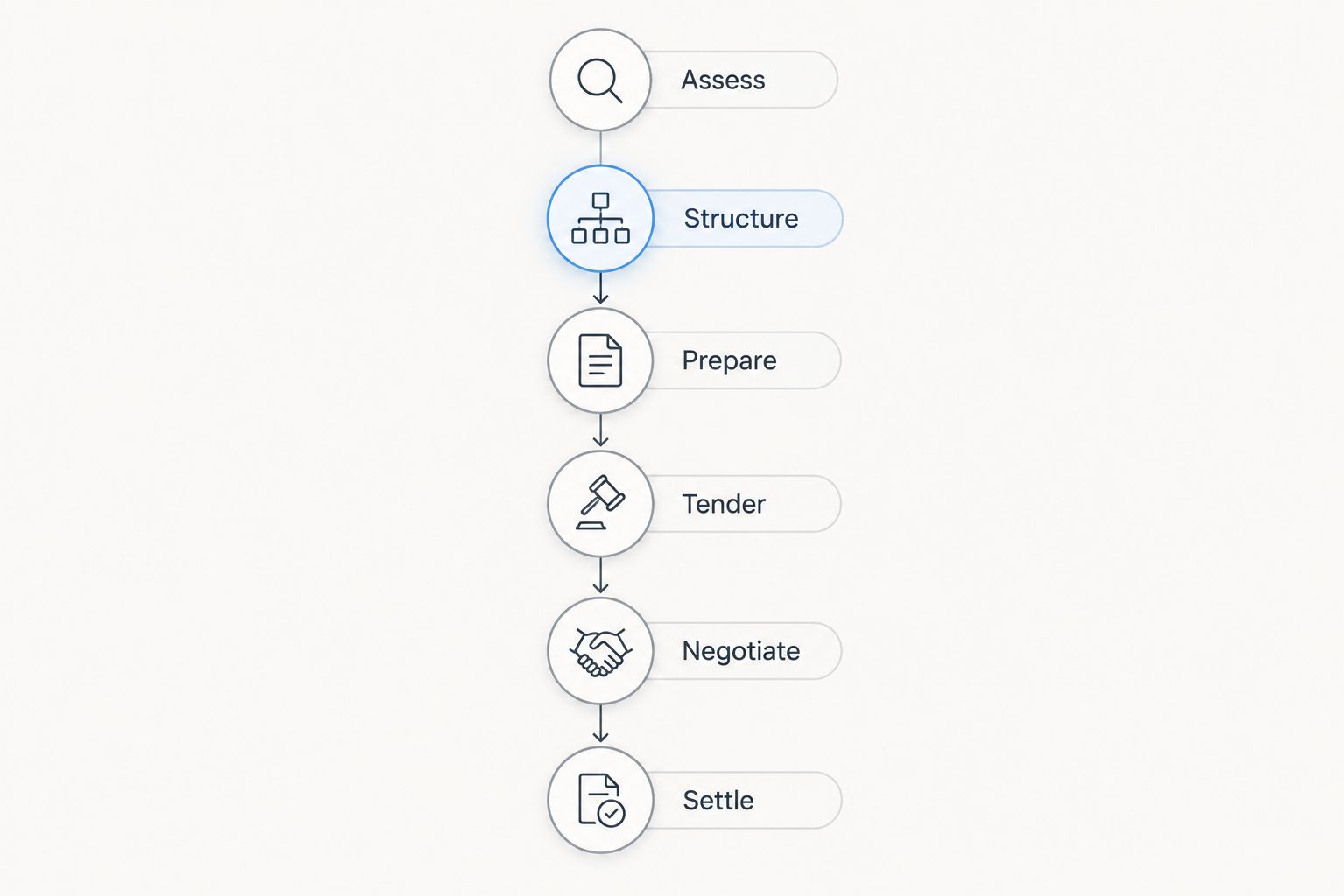
Use a clear sequence for your 2026 acquisition. The aim is to compare a defined funding request, not circulate different versions of the transaction to different lenders.
- Assess. Review historical trading, current management accounts, buyer experience and existing liabilities. Identify gaps before relying on a borrowing estimate.
- Structure. Separate the purchase consideration, working capital, equipment and any property component. Confirm which existing facilities need to remain or be repaid.
- Prepare. Assemble the financial records, forecasts, contribution evidence and draft purchase documents. Reconcile differences between the seller’s information and your application.
- Tender. Present a consistent proposal to suitable lenders. Ask for comparable information on repayment terms, security, guarantees, covenants and conditions.
- Negotiate. Assess the complete facility terms rather than the headline interest rate alone. Resolve material conditions before treating an offer as executable.
- Settle. Coordinate lender requirements with legal documents and the purchase timetable. Confirm the funds required from you and the liquidity remaining after completion.
A lender’s indicative response is not the same as an unconditional commitment to fund. Read the conditions, expiry provisions and settlement requirements with your advisers before making contractual commitments that depend on finance.
Compare terms beyond the borrowing amount
A larger approval is not automatically the better arrangement. Compare repayment timing, amortisation, maturity, review conditions, reporting obligations, guarantees and security requirements.
Check whether the structure leaves a repayment balance at maturity and how that balance would be addressed. Do not treat a future refinance as guaranteed. Your decision needs to work with the obligations in the proposed agreement.
Can you borrow the full purchase price?
Borrowing the full purchase price is a transaction-specific credit decision, not a standard entitlement. The lender still needs to assess repayment capacity, security, the buyer’s position and the total funding requirement.
Even if a proposed facility covers the purchase consideration, you still need a plan for transaction expenses and operating liquidity. Ask for a complete funding schedule rather than interpreting purchase-price funding as a cash-free acquisition.
Does property security increase how much you can borrow?
Property security can support an application, but it does not establish the business’s ability to repay acquisition debt. The lender assesses the security position alongside cash flow and existing commitments.
If property already secures another facility, establish what consent, discharge or restructuring is required. Understand which assets support which debts before adding the acquisition to your banking arrangements.
Should you refinance existing loans when buying a business?
Refinancing belongs in the assessment when existing debt affects cash flow, available security or the proposed acquisition structure. It is not automatically necessary or beneficial.
Compare retaining existing facilities with a consolidated proposal, including contractual obligations and transition requirements. For a 2026 banking review, assess the acquisition and the existing business together rather than optimising one loan in isolation.
When commercial finance advice fits
Glenclair’s commercial finance work is relevant to established Australian business owners reviewing borrowing and banking arrangements. The preferred audience is seeking business-purpose finance greater than A$2 million; that is a focus, not a universal eligibility rule.
Glenclair suits owners who want an independent commercial finance assessment across existing debt and a proposed acquisition. The limitation is straightforward: a broker does not replace financial due diligence, legal advice or the lender’s credit decision, and no finance outcome is promised.
Distinguish lender-paid brokerage from debt advisory services. Debt advisory uses a retainer and success-fee structure; confirm the engagement scope, who pays and what triggers any obligation before proceeding. A remuneration explanation is not a substitute for written engagement terms.
FAQ
How do I work out my business purchase loan amount?
Start with the complete acquisition funding requirement, then test it against sustainable cash flow, existing debt, your contribution and available security. The amount required and the amount a lender approves are separate figures.
Is there a standard deposit for buying an established business?
There is no universal deposit requirement across Australian business acquisitions. The required contribution depends on the lender, transaction structure, repayment capacity and security position.
Can I use the business’s future profits to support the loan?
Forecast profits need support from historical trading, current performance and documented assumptions. Separate established earnings from improvements that have not yet occurred.
Can equipment finance help fund a business acquisition?
Equipment finance can form part of an acquisition structure where the assets and transaction meet lender requirements. It does not replace funding for goodwill, working capital or other purchase components.
Do I need working capital as well as the purchase loan?
You need a funding plan for post-settlement trading as well as the purchase itself. Forecast customer receipts, stock, wages, tax and repayments to establish the operating cash requirement.
Does a broker’s lender panel guarantee approval?
A lender panel does not guarantee approval. Each lender assesses the borrower, business, transaction and proposed facilities under its own credit policy.
What should I prepare before asking for acquisition finance?
Prepare financial statements, current management accounts, cash-flow forecasts, existing debt details, contribution evidence and the proposed purchase documents. Confirm additional requirements for the specific transaction before lodging an application.
One last thing
An approved loan amount is not the same as a fully funded settlement. Ask your accountant and solicitor to reconcile the lender’s proposed advance with the settlement statement, your contribution and the cash remaining for trading.
That reconciliation is your final check against an avoidable funding gap. Complete it before settlement obligations become binding, not when the purchase funds are due.
Related guides
- Income requirements for commercial property finance
- Equipment finance options for manufacturing businesses
- Equipment finance options for construction businesses
Author: Glenclair Financial team.