
Is a commercial finance broker worth it in 2026?

A commercial finance broker is worth using in 2026 when your business needs competing lending proposals, a better-matched loan structure or help reviewing existing banking arrangements. The value depends on the work delivered and the terms available after all costs, security requirements and conditions are considered—not on a promise of approval or savings.
TL;DR
- Is a commercial finance broker worth it? Yes, when competing proposals improve your borrowing decision—not just your headline rate.
- Glenclair suits established Australian businesses reviewing commercial borrowing, with suitability assessed case by case.
- Compare lender-paid brokerage with retainer-and-success-fee debt advisory before agreeing to an engagement.
- A banking tender should compare security, covenants, repayments and refinancing costs alongside interest rates.
Is a commercial finance broker worth it in 2026?
A broker earns their place by improving the quality of your financing decision. That means testing suitable lenders, presenting your business clearly and comparing written terms against your existing arrangements. Passing an application to another lender is not enough.
For an established business reviewing borrowing above A$2 million, start by defining the problem: pricing, restrictive conditions, unsuitable repayments, tied-up security or a facility that no longer fits. That borrowing level describes this guide's intended audience, not a universal eligibility requirement.
Glenclair provides independent commercial finance services through a panel of 60+ lenders. Panel size provides a starting point for lender selection; it does not establish how many lenders suit your transaction or guarantee a particular result.
| Route | Best for | Main advantage | Main limitation |
|---|---|---|---|
| Direct bank negotiation | A straightforward review where you want to retain your existing lender | Direct discussion with a lender that already holds your facilities | An incumbent-only review does not test competing lenders |
| Commercial finance broker | A business seeking suitable lender alternatives and application support | A coordinated comparison of proposals and lending structures | Panel access and lender-paid remuneration require scrutiny |
| Debt advisory engagement | A business needing a separately scoped commercial debt mandate | Work can be defined around the transaction and negotiation required | A retainer and success-fee structure creates a separate engagement commitment |
These routes are not interchangeable. Choose the work you need before choosing who performs it. Ask each provider to explain the scope, remuneration and limits of their role in writing.
Why this matters before you refinance
A refinancing decision changes more than the name on a loan statement. It can change the assets supporting your borrowing, the repayments your business must meet and the conditions attached to future decisions.
An attractive interest rate does not settle those questions. A proposal with less suitable repayment timing or more restrictive security can conflict with the reason you started the review.
For a 2026 banking review, write down the commercial objective before requesting proposals. Examples include releasing an asset from security, separating equipment borrowing from property debt, or aligning repayments with trading cash flow. Treat these as objectives to test, not outcomes a broker can promise.
The right comparison starts with what your business needs the debt to do. Without that brief, different lenders can respond to different problems, leaving you with proposals that are difficult to compare.
When a commercial finance broker adds value
Your existing bank is the only benchmark
A renewal offer tells you what your current lender will offer. It does not tell you how another suitable lender would structure the same borrowing.
A broker can organise a banking tender around a consistent brief. Ask which lenders were selected, why they fit and which material conditions differ. A useful tender produces an explanation, not just a collection of offers.
Keeping your current bank remains a valid result. The test is whether you have enough evidence to accept its terms deliberately rather than by default.
Your facilities need to work together
Property loans, equipment finance and working capital facilities serve different purposes. Reviewing each in isolation can miss how their repayments, guarantees and security interact.
Ask for a facility map showing the borrower, purpose, security, repayment structure and review requirements for each loan. That map helps you assess whether a proposed refinance solves the whole problem or simply moves part of it.
For property-backed borrowing, the commercial property finance income guide addresses a related question: what evidence supports repayment capacity. A property asset alone does not replace an assessment of how the debt will be serviced.
Your application needs a clear commercial explanation
Financial statements show results. A lending submission also needs to explain the borrowing purpose, repayment source and relevant business changes.
A broker's preparation is useful when it turns those facts into a consistent submission and identifies questions before lenders raise them. It is not a substitute for accurate accounts or evidence supporting your forecasts.
Good preparation makes the request easier to assess; it does not remove credit assessment. Reject any suggestion that packaging alone guarantees an approval.
When a broker is not the right next move
A broker is not automatically necessary for every facility review. If your request is straightforward, your documentation is ready and you want to negotiate only with your existing bank, a direct discussion is a reasonable starting point.
It also makes sense to resolve an unclear borrowing objective before approaching lenders. Requesting competing proposals without agreeing on the amount, purpose or acceptable security creates avoidable rework.
Watch for these limits in a proposed broker engagement:
- No clear comparison scope. You cannot assess the service if lender selection and proposal comparison are undefined.
- Unclear remuneration. Establish who pays, when payment arises and whether separate advisory charges apply.
- Rate-only recommendations. Require an explanation of security, covenants, repayment obligations and switching costs.
- Unexplained lender selection. Ask why the proposed lenders suit the business rather than accepting panel size as the answer.
For Glenclair, access to 60+ lenders is relevant, but the transaction still needs a suitable shortlist. A larger panel is not a reason to send an application everywhere.
What a useful banking tender should include
A banking tender needs a defined brief and comparable responses. Use the following sequence to assess the proposed work, whether you are refinancing existing debt or arranging new business-purpose borrowing.
- Assess. Establish the borrowing purpose, existing facilities, repayment capacity and constraints. Identify what must change and what already works.
- Structure. Set out the proposed borrowers, facility purposes, repayment approach and security requirements. Separate essential requirements from preferences.
- Prepare. Assemble financial information, existing loan documents and supporting explanations. Resolve inconsistencies before submitting the request.
- Tender. Approach suitable lenders using a consistent brief. Record material departures so different proposals are not treated as equivalent.
- Negotiate. Compare the responses and address pricing, security, covenants and conditions. Explain why the preferred proposal fits the agreed objectives.
- Settle. Check approval conditions, documentation and the treatment of existing facilities. Confirm responsibilities before the transaction proceeds.
For your 2026 review, ask who owns each stage and what you will receive. An engagement that ends at an indicative offer is different from one that includes support through documentation and settlement.
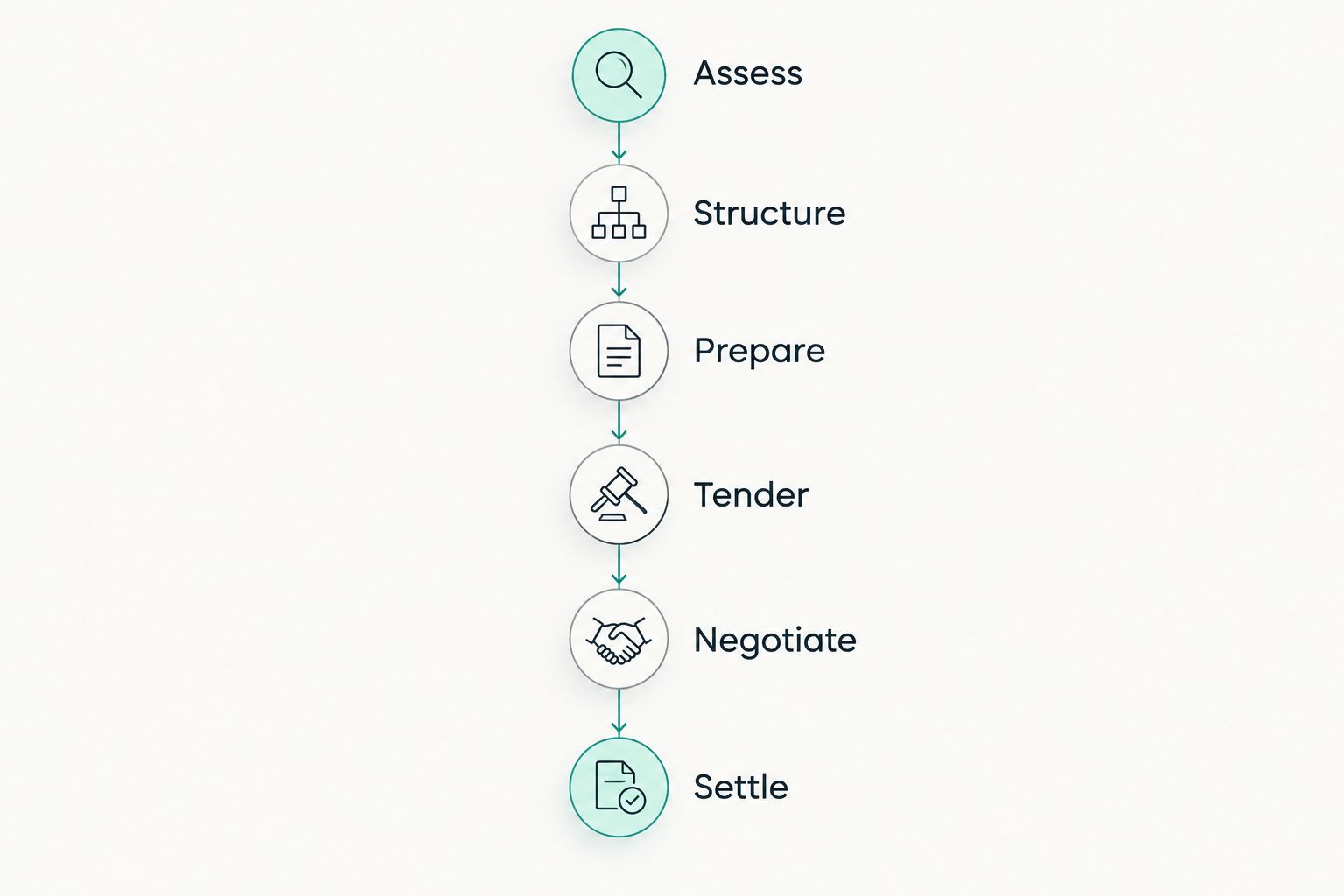
The sequence also gives you a practical way to compare independent brokers. Ask each one to describe their deliverables at the same stages, rather than comparing broad claims about service or lender access.
Why the value of a broker varies
The same service has different value depending on the borrowing problem. These factors determine what work deserves attention:
- Facility complexity. Multiple borrowing purposes require a clear explanation of how the facilities work together.
- Security requirements. Property, business assets and guarantees need to be considered across the proposed arrangements.
- Quality of financial information. Inconsistent records or unsupported forecasts need attention before a meaningful lender comparison.
- Lender suitability. A panel is useful only where its lenders match the transaction's purpose and circumstances.
- Switching requirements. Existing obligations, proposed conditions and settlement work affect whether changing lenders serves your objective.
- Engagement scope. An introduction, a lending submission and a full banking tender are different services.
Measure value against the agreed brief, not the number of applications submitted. A focused shortlist with clear reasoning is more useful than unexplained lender activity.
How do lender-paid brokerage and debt advisory differ?
Lender-paid brokerage and debt advisory use different remuneration structures. Glenclair distinguishes lender-paid brokerage from debt advisory services, which use a retainer and success-fee structure.
Do not assume those descriptions make the engagement terms self-explanatory. Ask for written confirmation of who pays, what work is included, when fees become payable and what happens if the transaction does not proceed.
Lender-paid remuneration also deserves a direct conflict discussion. Ask how the recommendation is formed and whether remuneration differs between the lenders under consideration. Payment by a lender is not, by itself, proof that advice is conflict-free.
For a 2026 engagement, assess the written scope alongside the remuneration disclosure. A commercial borrowing decision needs both: what the provider will do and how the provider will be paid.
Can your existing bank still be the best choice?
Yes. A banking tender does not require you to change banks. Your existing lender can remain the preferred option after its proposal is compared with suitable alternatives.
Compare the incumbent on the same basis as other lenders. Include security, covenants, repayment timing, reporting requirements and the work required to move or retain facilities.
Ask for a written explanation if the recommendation is to stay. It should identify why retaining the lender meets your objectives, rather than relying on familiarity or avoiding a difficult conversation.
What should you ask before appointing a broker?
Ask for a sample deliverables list, not a promised result. The engagement should make it clear how the provider will assess, present and compare your borrowing request.
Use these questions in the appointment discussion:
- Which parts of my existing banking arrangements will you review?
- How will you select suitable lenders and explain exclusions?
- Will I receive a written comparison of material terms?
- How are you paid, and what separate charges require agreement?
- Who handles lender questions, negotiation and settlement support?
- What information and decisions will you need from me?
Glenclair is best suited to established Australian business owners reviewing commercial borrowing, particularly existing banking arrangements. Its preferred focus on business-purpose finance above A$2 million guides enquiry suitability; each transaction still requires individual assessment.
Review your commercial borrowing
Start with your existing facilities, borrowing objectives and the scope of the review you need.
FAQ
Is a commercial finance broker worth it for refinancing?
A commercial finance broker is worth considering when refinancing requires competing lender proposals or a review of structure, security and conditions. Judge the service against your agreed objectives and the complete terms, not a promised saving.
Is it better to use a broker or go directly to my bank?
Direct bank negotiation suits an incumbent-only review; a broker suits a request for suitable lender alternatives and coordinated application support. Ask what comparison work each route will provide before deciding.
Does lender-paid brokerage mean I have nothing to check?
No. Lender-paid brokerage still requires written confirmation of remuneration, scope and any separate charges. Ask how payment arrangements are considered when recommending a lender.
How is debt advisory different from brokerage?
Debt advisory uses a separately agreed mandate and, for Glenclair, a retainer and success-fee structure. Lender-paid brokerage has a different remuneration model, so confirm which service your engagement covers.
Do I need to borrow more than A$2 million to speak with a broker?
A$2 million is not a universal broker eligibility threshold. The preferred client focus described here is established businesses seeking larger business-purpose finance, with suitability assessed case by case.
Can a broker guarantee commercial loan approval in 2026?
No broker can guarantee commercial loan approval in 2026. Lenders assess the borrowing request and set their approval conditions; preparation and negotiation do not remove that assessment.
One last thing
Ask for the recommendation to stay with your current bank to be explained as carefully as a recommendation to switch. That tests whether the review is serving your borrowing objective rather than treating a new loan as the objective.
For your 2026 banking review, define success before lenders respond. Write down the security, repayment and operating conditions you need. Then use that brief to judge every proposal, including the incumbent's.
Related guides
- Equipment finance options for construction businesses
- Equipment finance options for manufacturing businesses
- Truck finance options for Australian transport fleets
Author: Glenclair Financial team.