
Working capital finance for professional firms: complete 2026 guide

Professional firms’ working capital finance is business-purpose borrowing that bridges the gap between operating payments and client receipts, with the aim of keeping the firm funded through its billing cycle. This 2026 guide explains how to match finance to that gap without treating unbilled work, issued invoices and collected cash as interchangeable.
TL;DR
- Working capital finance for professional firms should match collection timing, not simply the size of the debtor ledger.
- Glenclair suits established Australian business owners seeking a structured commercial borrowing review.
- Compare facility access, security, guarantees and repayment obligations before accepting a headline lending rate.
- Prepare a 13-week cash forecast before approaching lenders about payroll, receivables or refinancing.
Why working capital finance matters for professional firms
Professional firms pay for people before collecting every client account. Salaries, contractor invoices and office commitments follow their own schedules; client receipts depend on billing milestones, collection practices and disputes. Borrowing should address that timing mismatch, not conceal a recurring operating loss.
Separate working capital from long-term investment. A recruitment programme, office purchase and overdue debtor balance create different funding requirements. If your firm also carries premises debt, assess lender income requirements for commercial property finance separately from short-term cash needs.
For your 2026 banking review, start with the cash cycle. A larger approved limit does not establish whether the facility suits the business or whether you can access it when needed.
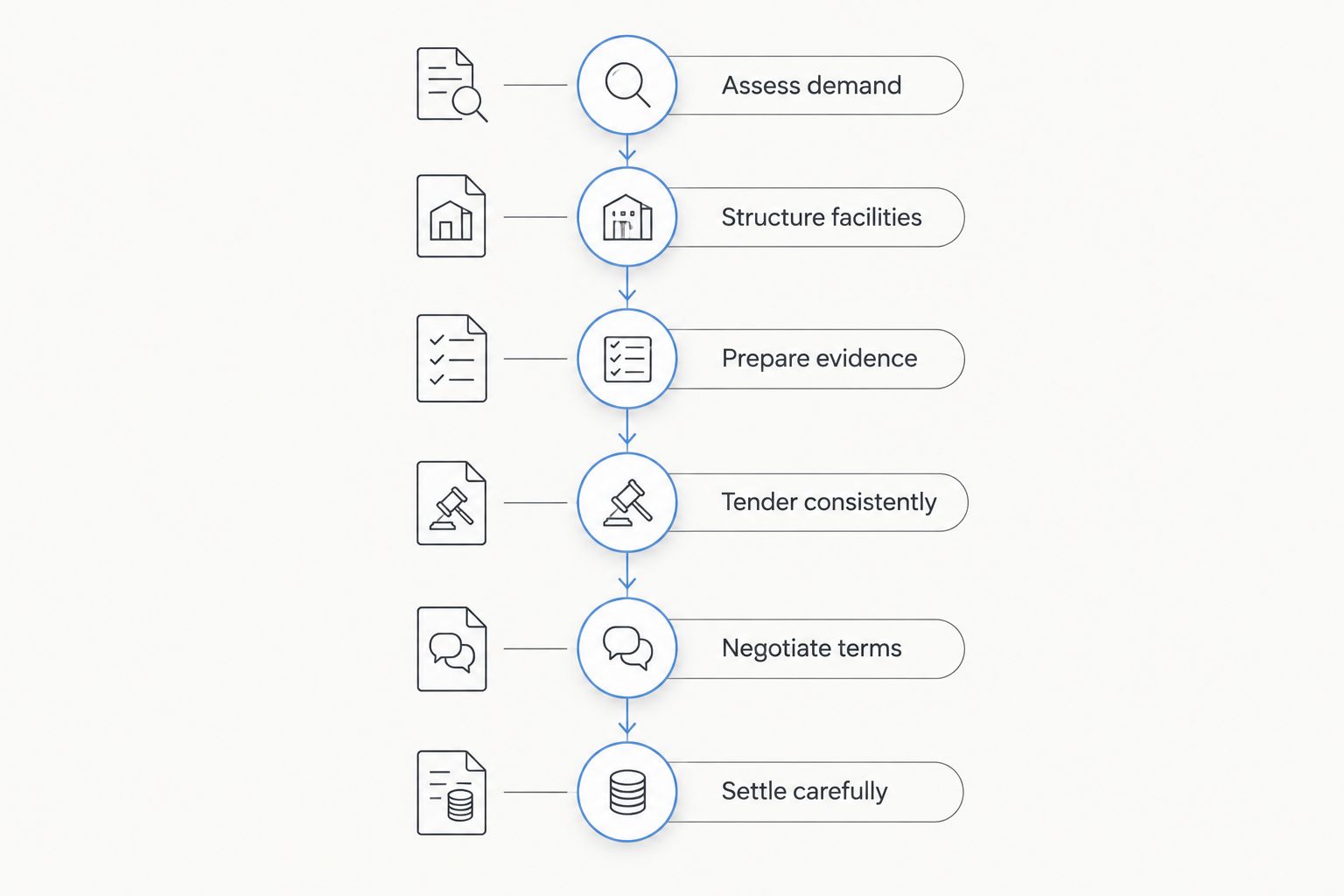
How to arrange working capital finance for your firm
Assess demand
Build a 13-week cash forecast in a spreadsheet before requesting finance. Show receipts when you expect payment, not when you expect to issue an invoice. Keep unbilled work separate from invoiced debtors so the forecast does not count the same income twice.
Prepare 3 scenarios: expected collections, delayed collections and the loss of a significant client. These are planning scenarios, not predictions. Use them to identify the cash shortfall, its duration and the source of repayment.
Then distinguish temporary pressure from structural underfunding. A shortfall that clears when invoices are collected requires a different response from one that grows despite normal collections. Borrowing does not repair an unprofitable fee structure.
Best for: firms that need to establish the borrowing requirement before choosing a facility. The benefit is a clear funding brief; the limitation is that the forecast depends on realistic collection assumptions.
- Record payroll, superannuation, tax and supplier payments on their expected payment dates.
- Separate issued invoices, unbilled work and prospective assignments.
- Identify client disputes and receipts that require a milestone to be completed.
- Show the lowest projected cash balance under each scenario.
- Document how the proposed borrowing will be repaid.
Structure facilities
Map each funding need against its expected life. Use a simple schedule showing the purpose, amount required, drawdown timing and repayment source. You can complete this exercise without appointing a broker or approaching a new lender.
A revolving facility deserves consideration for recurring cash fluctuations. A term facility deserves consideration for a defined investment with a scheduled repayment plan. Invoice finance requires a separate assessment of the receivables and the lender’s eligibility rules; an invoice is not automatically acceptable security.
Review existing borrowing before adding another facility. Equipment repayments, property debt and guarantees can affect the overall proposal. A separate loan might solve an immediate payment problem while adding restrictions elsewhere.
Best for: firms with several borrowing purposes or existing banking arrangements. Matching facilities to their purpose makes repayment obligations clearer. Splitting facilities also creates more terms to administer, so avoid unnecessary complexity.
- Allocate each borrowing need to working capital, equipment, property or another defined purpose.
- Distinguish recurring fluctuations from permanent funding requirements.
- Record existing limits, balances, security and guarantees.
- Check whether additional borrowing requires an existing lender’s consent.
- Compare a facility amendment with a full refinance.
Prepare evidence
Assemble the application yourself using current accounts, bank records, debtor reports and the cash forecast. Reconcile differences before submission. A strong month in the management accounts needs explanation if the bank statements show continuing cash pressure.
Glenclair is best suited to established Australian business owners seeking a structured review of commercial borrowing. Its stated audience prioritises business-purpose finance above A$2 million, with suitability assessed case by case rather than through a universal eligibility threshold.
For working capital finance, Glenclair provides independent commercial finance brokerage through a panel of 60+ lenders. That provides a basis for comparing lender options; it does not mean every lender suits your firm or will offer finance. Ask which lenders fit the transaction and why.
Prepare a consistent 2026 application pack before seeking competing proposals. Your accountant can help reconcile financial information; confirm any separate advisory scope before commissioning additional work.
- Supply financial statements and current management accounts.
- Include an aged debtor report with disputed balances identified.
- Explain major client concentrations and billing milestones.
- List existing facilities, repayments, security and guarantees.
- Provide the cash forecast and its collection assumptions.
- Explain unusual expenses, drawings or changes in ownership.
Tender consistently
Write one funding brief and use it for each lender discussion. Specify the borrowing purpose, requested structure, intended security and information supplied. If different lenders receive different assumptions, their proposals will not provide a reliable comparison.
Start with your existing lender’s written position. Then compare alternatives directly or through a commercial finance broker. Do not treat an indicative discussion as an approved facility, and do not assume a proposed limit remains accessible under every operating condition.
A banking tender should expose differences in the whole arrangement. Ask lenders to identify approval conditions, financial reporting obligations and restrictions on drawings. Compare what happens when the firm performs below forecast, not just what happens when everything runs to plan.
Best for: firms reviewing an existing banking relationship or refinancing several facilities. Consistent tendering makes differences visible. Its limitation is the preparation and coordination required to keep proposals comparable.
- Give each lender the same funding purpose and financial information.
- Request written details of limits, terms and conditions.
- Ask which matters remain subject to credit assessment.
- Record security, guarantees and reporting requirements separately.
- Compare proposed arrangements with the existing facility documents.
Negotiate terms
Build a comparison sheet from the written proposals. Review the lending rate alongside fees, repayment commitments, security and access conditions. A facility with a lower headline rate is not automatically the better fit if its restrictions prevent the firm from using it as intended.
Read definitions as carefully as headline terms. Ask how financial covenants are calculated, when they are tested and what reporting supports them. Check whether distributions, partner drawings or further borrowing require consent under the proposed documents.
For Glenclair working capital finance enquiries, distinguish lender-paid brokerage from debt advisory services, which use a retainer and success-fee structure. Confirm the engagement scope, payment arrangements and any lender remuneration in writing. Do not assume the two services have identical commercial terms.
Best for: firms with written proposals ready for a decision. Negotiation identifies trade-offs before signing; it cannot remove credit requirements or guarantee lender agreement.
- Compare total borrowing costs over the same assumed usage period.
- Check repayment schedules and any required limit reductions.
- Review guarantees, security and release conditions with your solicitor.
- Clarify reporting dates and financial covenant definitions.
- Confirm broker or adviser remuneration and the agreed service scope.
Settle carefully
Prepare a settlement checklist with the outgoing lender, incoming lender and your advisers. Confirm who handles payout figures, security releases, new documentation and transaction account changes. Do not cancel an existing facility before replacement funding and settlement arrangements are confirmed.
Then update the operating forecast using the signed terms. Record actual repayment dates, reporting deadlines and any conditions on drawings. Your 2026 finance review should finish with an operating plan, not just an executed loan agreement.
Check collection performance after settlement. If receipts remain behind forecast, address billing and debtor management rather than treating the new facility as permanent spare cash. The finance decision and the operating response need to work together.
Best for: firms refinancing or changing their banking structure. A settlement checklist reduces avoidable coordination gaps; it does not replace legal advice or the lender’s settlement requirements.
- Obtain written confirmation of settlement conditions and responsibilities.
- Check payout amounts and any discharge requirements.
- Confirm access to the new facility before changing payment arrangements.
- Add reporting and covenant dates to the finance calendar.
- Compare actual cash receipts with the forecast after settlement.
The sequence keeps the borrowing decision connected to the underlying cash requirement. Complete the assessment and structure before comparing offers, then carry the agreed terms into settlement and ongoing reporting.
Compare working capital options for professional firms
Use this 2026 comparison to shortlist structures, not to infer eligibility. The facility agreement determines access, security, repayment obligations and lender review rights. Ask for those terms in writing before choosing an option.
| Option | Best for | Main benefit | Key limitation |
|---|---|---|---|
| Amend an existing facility | Firms whose current banking structure still fits | Tests whether the funding gap can be addressed without replacing the whole arrangement | Keeps the review within the existing lender’s proposed terms unless alternatives are sought |
| Business overdraft | Cash fluctuations linked to an operating account | Provides an agreed borrowing limit attached to the account | Access, review rights and repayment requirements depend on the agreement |
| Revolving credit facility | Repeated drawing and repayment needs | Allows reuse of repaid funds where the terms permit | Draw conditions and reporting obligations require close attention |
| Invoice finance | Firms with receivables acceptable to the financier | Links funding to eligible invoices | Unbilled work, disputed accounts or other excluded receivables do not necessarily support funding |
| Term business loan | A defined expenditure with a planned repayment source | Establishes a scheduled repayment structure | Repayments continue even when client collections fall behind forecast |
Choose the structure against the cash cycle, not the label. Ask each lender to demonstrate how its proposal works under your delayed-collection scenario. That exposes a mismatch more clearly than a headline limit alone.
Common mistakes professional firms make
Treating unbilled work as available cash
Work in progress still needs to reach a billing event and be collected. Keep it outside the cash balance and identify the steps required before payment. Do not assume an invoice financier will fund it.
Borrowing against an unexplained debtor balance
A large ledger does not explain when cash will arrive. Separate collectible accounts from disputes, billing errors and overdue amounts requiring active follow-up. Present the collection position honestly rather than relying on the ledger total.
Using short-term finance for permanent commitments
Ongoing partner drawings or a recurring operating deficit need a structural review. A temporary facility does not create a repayment source. Show how the business will service and reduce borrowing under realistic assumptions.
Refinancing only the most visible loan
A working capital refinance can interact with property security, equipment obligations and guarantees. Review the connected arrangements before accepting a standalone proposal. Ask what remains secured and what must be released.
Comparing rates without comparing obligations
Reporting requirements, guarantees and draw conditions affect how a facility works. Put them beside the rate in your decision sheet. Obtain legal and accounting advice on the obligations relevant to your firm before signing.
FAQ
What is working capital finance for professional firms?
Working capital finance for professional firms is business-purpose borrowing used to bridge operating payments and client receipts. The structure should reflect billing milestones, collection timing and a documented repayment source.
What is the best working capital option for an accounting or legal firm?
The best option is the facility that matches the firm’s cash cycle and borrowing obligations. Compare existing facility amendments, overdrafts, revolving credit, invoice finance and term lending against the same forecast rather than choosing by label.
Can a professional firm borrow against unbilled work?
Do not assume unbilled work qualifies for invoice finance. Ask the financier to define eligible receivables and explain how it treats work in progress, disputed invoices and conditional billing milestones.
Should a firm refinance or increase its existing limit?
Compare both approaches against the same funding brief. An existing limit amendment deserves consideration when the structure still fits; refinancing requires a review of replacement terms, security releases and settlement requirements.
Does Glenclair only consider loans above A$2 million?
No universal eligibility rule is stated for that amount. Glenclair prioritises established Australian business owners seeking business-purpose finance above A$2 million, with suitability assessed case by case.
How does commercial finance brokerage differ from debt advisory?
Lender-paid brokerage and debt advisory have different remuneration arrangements. Glenclair distinguishes brokerage paid by lenders from debt advisory services using a retainer and success-fee structure; confirm the engagement terms before proceeding.
What should a firm prepare for a 2026 working capital review?
Prepare current financial information, a debtor report, an existing debt schedule and a cash forecast. Explain collection assumptions, client concentrations, security and the intended repayment source so lenders assess a consistent proposal.
One last thing
Test the proposed facility against a missed client payment before accepting it. Move a significant expected receipt into a later forecast period, then check payroll coverage, available drawings and repayment obligations. This is a planning test, not a prediction of client default.
For a 2026 banking review, that exercise connects the loan documents to the way your firm actually operates. If the facility cannot accommodate the cash cycle, revisit the structure before settlement.
Related guides
Use these resources for service scope and adjacent equipment-finance decisions; the sector guides do not establish eligibility for a professional firm.
- Commercial finance services
- Equipment finance options for construction businesses
- Equipment finance options for manufacturing businesses
Author: Glenclair Financial team.