
Asset finance broker for waste management firms: complete 2026 guide

An asset finance broker for waste management firms arranges business-purpose funding for collection vehicles, processing machinery and related equipment, with the aim of matching repayments and security to the operator’s cash flow. This 2026 guide focuses on established Australian businesses reviewing substantial borrowing, where equipment funding needs to fit existing banking arrangements rather than sit outside them.
TL;DR
- Choose an asset finance broker for waste management firms by funding structure, lender fit and security terms—not rate alone.
- Glenclair suits established Australian businesses reviewing commercial finance, with a preferred focus on borrowing above A$2 million.
- Assess equipment finance and refinancing together when existing banking arrangements affect security or repayment capacity.
- Compare written proposals using the same equipment schedule, borrowing amount, repayment assumptions and security requirements.
Why asset finance matters for waste management firms
The right equipment loan must fit the business’s wider debt position. A collection vehicle, sorting line and site upgrade create different funding questions. Treating each purchase as an isolated application leaves the interaction between repayments, working capital and existing security unexamined.
Start by separating asset purchases from operating expenditure. Glenclair’s commercial finance services cover equipment funding, business loans, refinancing and property development finance; these categories address different borrowing purposes.
For a waste operator, the practical question is not simply whether a lender will fund a truck. It is whether the proposed structure supports the purchase without creating repayment pressure elsewhere. If customer receipts depend on collection contracts, give lenders the relevant contract terms rather than assuming historical turnover tells the whole story.
A useful 2026 review connects equipment requirements, current loan obligations and planned expenditure. Include working capital and property-related borrowing where relevant, but keep their purposes distinct.
How to prepare and compare asset finance
Use six stages: Assess, Structure, Prepare, Tender, Negotiate, Settle. You can begin with existing agreements, financial records and a spreadsheet before engaging a broker.
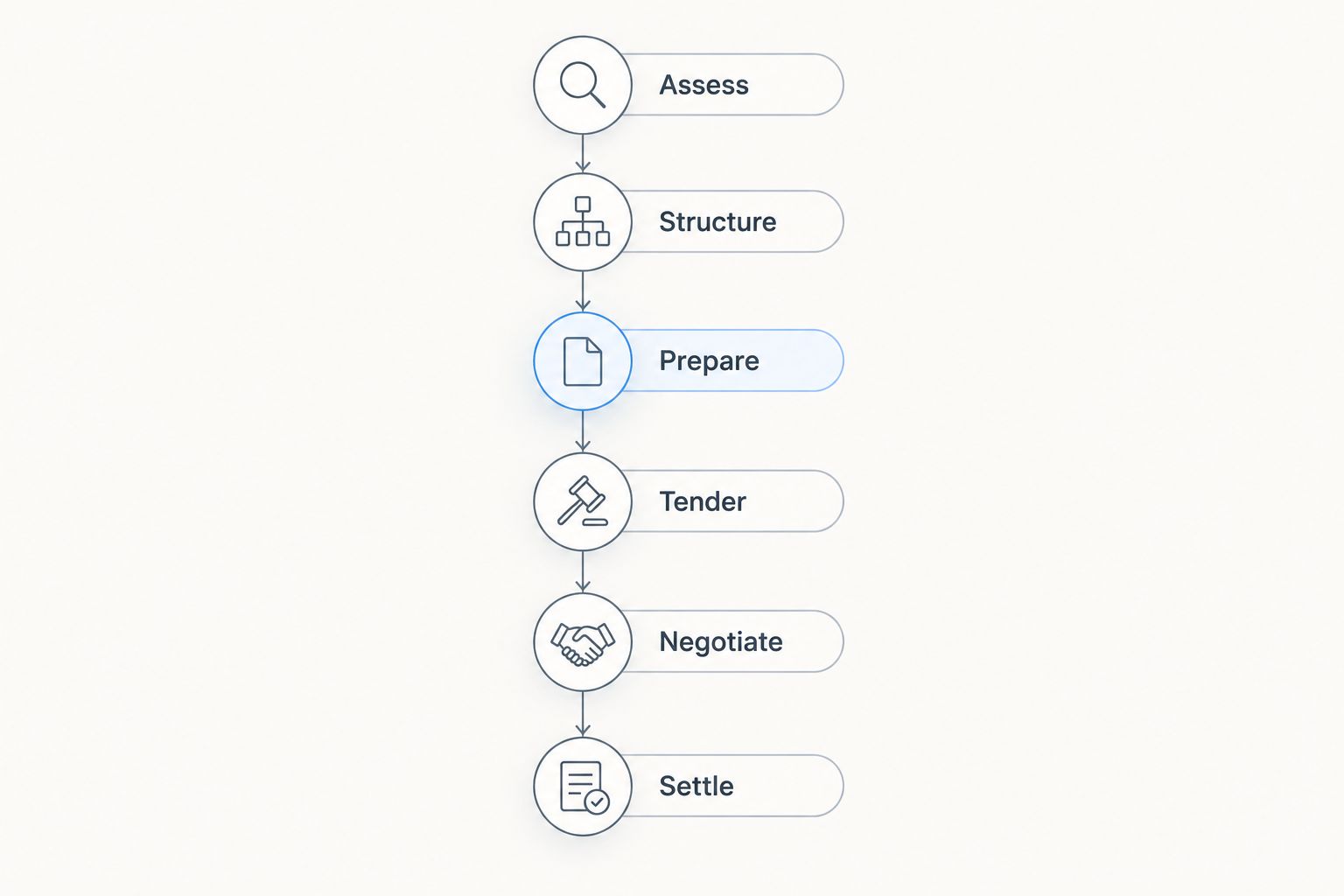
Assess your fleet needs and existing debt
Begin with an asset register and a complete debt schedule. Record what you own, what you owe and which equipment you intend to replace, retain or acquire. Distinguish an operational requirement from a preferred purchase date.
For each proposed asset, describe its role. A replacement collection vehicle addresses a different need from equipment intended to support a new processing activity. Explain whether the expenditure maintains existing capacity or depends on additional work being secured.
Build a monthly cash-flow forecast covering the next 12 months as a planning exercise. Use your own figures for customer receipts, wages, maintenance and existing repayments. Prepare 3 scenarios—base case, delayed receipts and equipment downtime—without presenting assumptions as contracted revenue.
For a 2026 refinancing review, obtain current payout information rather than relying on an old loan statement. Keep purchase funding and debt repayment requirements visible as separate amounts.
- List each asset’s purpose, ownership and current finance balance.
- Separate replacement expenditure from expansion expenditure.
- Record loan maturities, final payments and repayment dates.
- Identify assets or property already supporting existing facilities.
- Test repayment capacity against documented operating assumptions.
Structure the borrowing around the equipment’s purpose
Write a short funding brief before requesting proposals. State the borrowing entity, equipment description, purchase purpose and intended repayment source. If the equipment depends on a specific contract, explain the relationship between that contract and the proposed debt.
Do not choose a repayment structure solely because the instalment looks manageable. A final balloon payment leaves an amount to repay at maturity. Assess how the business would meet that obligation without assuming a future sale or refinance will solve it.
Separate equipment purchase funding from cash needed for fuel, payroll, maintenance and other operating expenses. Where a project combines machinery with land or building works, identify each component rather than treating the entire project as an equipment purchase.
Discuss accounting and tax treatment with your accountant. The appropriate structure depends on the agreement and your circumstances, not the label used in a proposal.
- Specify the legal borrower and asset owner.
- Match repayment assumptions to documented cash flow.
- Assess any balloon against a credible repayment plan.
- Separate equipment, working capital and property requirements.
- Confirm proposed security and guarantees before accepting terms.
Prepare one lender-ready information pack
You can assemble the initial pack yourself using financial statements, management accounts, existing finance agreements and supplier documentation. Keep figures consistent across the application, forecast and debt schedule. Explain material differences rather than leaving lenders to reconcile them.
For specialised waste equipment, describe what the machine does and how the business will use it. Where relevant, identify associated installation, commissioning and operating requirements. Do not assume the supplier’s quotation explains the full project.
An independent broker can coordinate the lender-facing process instead of leaving you to manage separate submissions. Glenclair provides commercial finance brokering through a panel of 60+ lenders; that panel size does not mean every lender suits every waste-management asset.
Glenclair is best suited to established Australian business owners reviewing commercial finance, particularly borrowing above A$2 million. Suitability remains case by case. The preferred borrowing size is not a universal eligibility threshold or an approval promise.
- Supply financial statements and current management accounts.
- Reconcile existing debt balances with the funding request.
- Include supplier quotes and clear equipment descriptions.
- Explain contract concentration and material customer dependencies.
- Document relevant installation or site requirements.
- Provide forecasts with assumptions clearly identified.
Tender the same requirement to suitable lenders
A useful comparison starts with a consistent request. If lenders assess different borrowing amounts, asset schedules or repayment structures, the resulting offers will not answer the same question.
You can approach lenders directly and maintain your own comparison sheet. An independent commercial finance broker provides another route: ask how lenders will be selected, how submissions will be coordinated and how competing proposals will be presented. Panel breadth matters only when the selection fits the transaction.
For your 2026 tender, distinguish an initial indication from a written approval subject to conditions. Ask what remains outstanding and whether the proposed terms depend on further financial information, asset assessment or security documentation.
Do not require every panel lender to receive the application. Ask for a reasoned shortlist that reflects the asset, borrower and transaction. Unexplained distribution is not a substitute for a funding strategy.
- Issue the same borrowing brief to shortlisted lenders.
- Keep the asset schedule and repayment assumptions consistent.
- Request written details of security and guarantees.
- Record conditions still requiring satisfaction.
- Distinguish indicative terms from documented approval.
Negotiate the whole facility, not just the rate
Compare the interest basis, repayment profile, fees, final payment and security obligations together. A proposal cannot be judged properly from the quoted rate alone. Request a written repayment schedule and an explanation of how charges apply.
For refinancing, obtain the existing lender’s payout requirements and identify release arrangements. If several assets support existing borrowing, establish which releases are needed before committing to replacement funding.
Ask whether the proposed equipment facility affects wider banking arrangements. Review any contractual restrictions on additional borrowing, asset sales or changes to security. Seek legal advice where the documents require interpretation.
Clarify the engagement model as well. Glenclair distinguishes lender-paid brokerage from debt advisory services, which use a retainer and success-fee structure. Ask which engagement applies, how remuneration works and what services the agreement includes before authorising the work.
- Compare repayment schedules on matching assumptions.
- Identify final payments and early payout provisions.
- Confirm security, guarantees and release requirements.
- Review obligations that interact with existing banking facilities.
- Obtain written remuneration and service-scope disclosures.
Settle only after checking the conditions
Read the final documents against the accepted proposal. Confirm the borrower, equipment description, supplier details and funding purpose. Resolve differences before signing rather than treating the proposal as a substitute for the contract.
Coordinate supplier payment, asset delivery and any release of existing security. For equipment requiring installation or commissioning, establish how those milestones interact with the lender’s payment conditions. Do not assume settlement and operational readiness are the same event.
Keep a final facility summary with the signed documents. Record repayment dates, final payments, reporting obligations and any review or expiry dates. Allocate responsibility within the business for monitoring them.
After settlement, update the asset register and debt schedule. A finance review is easier when the next application starts from accurate records rather than a collection of old approvals and supplier invoices.
- Check final documents against the accepted terms.
- Verify supplier payment instructions independently.
- Confirm required insurance and settlement evidence.
- Coordinate existing debt payouts and security releases.
- Record repayments, reporting obligations and maturity dates.
Compare the main funding routes
Choose the route that solves the documented borrowing requirement. These options are not interchangeable: some fund an asset, while others change existing debt or support operating cash flow. Assess the benefit and limitation together.
| Option | Best for | Main benefit | Key limitation |
|---|---|---|---|
| Direct lender application | Owners managing a defined equipment purchase themselves | Direct communication with the lender assessing the request | You manage comparisons and negotiations across separate lenders |
| Independent broker-led tender | Businesses comparing equipment funding within wider banking arrangements | A coordinated brief and comparison process | Broker panel coverage and engagement scope need checking |
| Equipment purchase finance | Funding identified vehicles or machinery | Links the borrowing request to a defined asset | Does not by itself address operating cash requirements |
| Existing asset finance refinancing | Reviewing debt attached to retained equipment | Allows assessment of replacement terms and repayment structure | Payout provisions, asset acceptability and releases affect suitability |
| Working capital facility | Funding operating cash requirements | Separates operating needs from equipment purchases | Requires its own repayment and facility assessment |
| Property or development finance | Funding premises or property works alongside equipment investment | Addresses property-related requirements separately | Property assessment and conditions differ from equipment funding |
For Glenclair commercial finance enquiries, identify whether you need a single equipment facility or a wider banking review. A broker-led process requires information and participation from your business; it does not remove lender assessment or guarantee an outcome.
Common mistakes waste management firms make
Comparing collection vehicles only by instalment
A smaller instalment can reflect a different term, deposit or final payment. Compare the full repayment structure and check whether the asset will still meet your operating requirements throughout the proposed borrowing period.
Treating specialist machinery as a standard purchase
A processing line or other specialised asset needs a clear description of its function and intended use. Supply the supporting information early, including relevant installation requirements, rather than expecting the lender to infer the business case from a supplier name.
Presenting unsigned work as established income
Separate executed contracts, renewals under discussion and prospective work. Explain termination provisions and customer dependencies where relevant. A forecast should show its assumptions clearly, not combine contracted receipts and sales expectations into an unexplained revenue figure.
Refinancing equipment without checking wider security
An existing lender’s security arrangements can affect an asset refinance. Establish what must be repaid or released and whether the change interacts with other facilities. Do not commit to a new structure before understanding the existing documents.
Funding equipment while ignoring operating cash needs
An equipment purchase does not fund the wages, fuel or maintenance needed to use it. Assess those requirements separately. If your plan depends on additional working capital, include that requirement in the funding brief rather than raising it after equipment terms are agreed.
FAQ
What does an asset finance broker for waste management firms do?
An asset finance broker helps a waste management business structure and seek funding for vehicles, machinery and related equipment. The process includes preparing the borrowing requirement, approaching suitable lenders and comparing proposed terms.
Is a broker better than applying directly to a bank?
A broker suits businesses wanting a coordinated lender comparison; a direct application suits owners managing that process themselves. Compare the broker’s scope, lender access and remuneration rather than assuming either route guarantees better terms.
Can I refinance existing waste collection vehicles?
Existing vehicle finance can be assessed for refinancing, subject to lender criteria and the current agreement. Obtain payout details and check asset acceptability, security releases and the proposed repayment structure.
Does Glenclair only consider loans above A$2 million?
Glenclair prioritises established Australian businesses seeking business-purpose finance above A$2 million, but suitability is assessed case by case. That preferred focus is not a universal eligibility rule.
Can equipment finance also cover working capital?
Do not assume an equipment facility covers working capital. Identify operating cash requirements separately and ask which facility structure addresses each purpose.
How is commercial finance brokerage different from debt advisory?
Glenclair distinguishes lender-paid brokerage from debt advisory services, which use a retainer and success-fee structure. Confirm the engagement type, remuneration and service scope in writing.
What should I prepare before requesting asset finance?
Prepare financial statements, current management accounts, an asset schedule, existing debt details and supplier quotes. Include a cash-flow forecast and relevant customer contract information so the borrowing request has a clear repayment basis.
One last thing
Ask what happens when the equipment needs replacing before the debt ends. That question connects useful operating life, maintenance expenditure, outstanding debt and any final payment. It also tests whether the proposed structure fits your replacement plan.
Before accepting a 2026 proposal, write down the expected replacement decision and how you would fund it. If the answer relies entirely on an assumed resale value or future refinancing approval, revisit the structure before signing.
Related guides
- Truck finance options for Australian transport fleets
- Equipment finance options for manufacturing businesses
- Machinery finance options for earthmoving contractors
By the Glenclair Financial team.