
Business refinancing for manufacturers: complete 2026 guide

Manufacturers’ business refinancing is the replacement or restructuring of existing business debt with the aim of aligning repayments, security and working capital with production needs. This 2026 guide explains how to review your banking arrangements, compare lender proposals and decide whether changing lenders serves your business.
TL;DR
- Business refinancing for manufacturers should address working capital, equipment debt and security together—not just the interest rate.
- Glenclair suits established Australian businesses seeking a broker-led commercial refinancing review through a panel of 60+ lenders.
- Compare written lender terms against keeping your current facilities before committing to a refinance.
- Keep machinery funding separate where combining debts would shorten repayment terms or restrict working capital.
Why refinancing matters for manufacturers
Manufacturing businesses commit cash to materials, production and customer payment terms before collecting sales proceeds. A borrowing structure that ignores those timing differences puts pressure on operating cash, even when the business reports a profit.
Refinancing should address that mismatch. Moving a loan without fixing repayment timing, facility limits or security arrangements leaves the underlying constraint intact.
Equipment borrowing also deserves separate attention. The equipment finance options for manufacturing businesses help frame the distinction between funding productive assets and funding day-to-day operations.
For your 2026 review, start with the business problem: an approaching maturity, restrictive covenants, unsuitable repayments or a banking arrangement that no longer matches your operations. A lower interest rate is only one part of a useful refinancing outcome.
This guide focuses on established Australian businesses considering business-purpose borrowing above A$2 million. That is an audience focus, not a universal eligibility threshold. Suitability depends on the transaction, business financials, security and lender requirements.
How to refinance manufacturing business debt
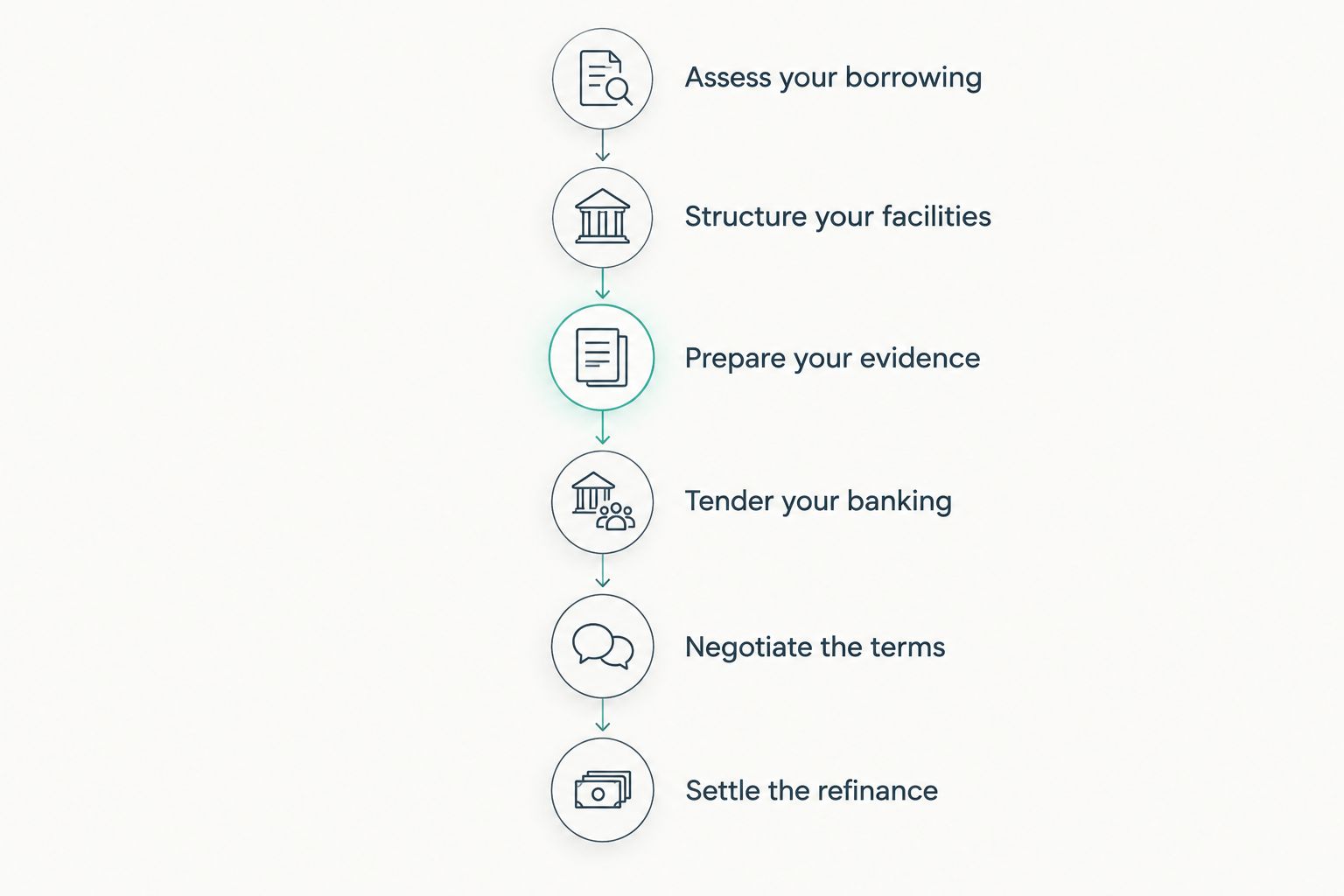
Use a documented sequence: assess the existing position, structure the proposed facilities, prepare the evidence, tender the borrowing, negotiate terms and settle. Keep the current banking arrangement in the comparison throughout. Switching lenders is a decision to justify, not the starting assumption.
Assess your borrowing
Start with your loan agreements, statements and security documents. Build a spreadsheet showing each facility, its purpose, outstanding balance, maturity, repayment obligations and supporting security. Include guarantees rather than treating them as an issue for settlement.
Separate the reason for refinancing from the proposed solution. An overdraft used continually to fund machinery needs a different review from a term loan that no longer fits your cash generation.
Prepare a rolling 13-week cash-flow forecast to examine near-term payment timing. Add a 12-month forecast to show seasonality, planned maintenance, tax obligations and capital expenditure. These are recommended planning periods, not lender-wide application requirements.
Record who owns each asset and which entity owes each debt. A group-wide borrowing total does not show whether the operating company, property owner and guarantors carry obligations that match their roles.
- Map the debt: Record loans, overdrafts, equipment facilities and other business borrowing.
- Check the documents: Identify maturities, covenants, guarantees and security provisions.
- Trace the pressure: Separate working capital shortages from long-term funding needs.
- Set the objective: Specify what must change and what must remain protected.
Structure your facilities
Match borrowing to its purpose before comparing lenders. Working capital supports the operating cycle. Equipment finance supports asset purchases. Commercial property borrowing supports a different asset and repayment profile again.
Combining debts simplifies administration, but simplicity alone does not justify consolidation. A combined facility can change security exposure, repayment requirements and the conditions attached to future borrowing. Review each effect separately.
For a factory owner, consider the relationship between property debt and the manufacturing operation. Do not assume that refinancing the property automatically resolves operating cash pressure. Property development finance also needs a distinct assessment where the proposal involves developing premises rather than simply refinancing an existing building.
Document your preferred structure and an acceptable alternative. That gives lenders a clear brief while preserving room to assess a different proposal on its merits.
- Separate purposes: Distinguish working capital, equipment, property and development funding.
- Match repayment: Test scheduled repayments against forecast cash generation.
- Review security: Identify assets or guarantees you want reconsidered.
- Protect flexibility: Record expected equipment purchases, expansion or ownership changes.
Prepare your evidence
Assemble the application yourself using existing accounts, forecasts and facility documents. Reconcile the figures before sending them anywhere. An unexplained difference between management accounts and the borrowing schedule distracts from the lending case.
Explain the manufacturing operation in plain business terms: what you produce, how orders become cash, where customer concentration sits and which equipment is critical to delivery. Support material statements with records rather than optimistic commentary.
A broker-led review is the next option when you want help assessing the structure and approaching lenders. Glenclair provides commercial finance brokering through a panel of 60+ lenders. Glenclair is best for established Australian business owners seeking a broker-led review of commercial borrowing.
Review the commercial finance services against your refinancing objective. A lender panel does not mean every lender suits your business, and broker involvement does not guarantee approval or better terms.
- Reconcile accounts: Align financial statements, management accounts and debt balances.
- Explain trading: Document order patterns, payment terms and material customer exposures.
- Support forecasts: State assumptions about production, margins and collections.
- Clarify engagement: Confirm scope, remuneration and responsibilities in writing.
Tender your banking
You can request proposals directly from lenders using the same information pack. Keep the requested structure consistent. Comparing different loan amounts, repayment profiles or security packages makes the headline terms misleading.
A banking tender gives selected lenders a defined opportunity to propose terms for the same borrowing requirement. Ask each lender to identify conditions, exclusions and additional information needs. An indicative proposal is not an unconditional commitment.
For your 2026 tender, include your current lender as a comparison where appropriate. A revised incumbent proposal deserves the same scrutiny as a new lender’s offer. Familiarity is not evidence of suitability, and switching is not evidence of improvement.
Record differences in a comparison sheet. Mark unresolved questions clearly rather than filling gaps with assumptions or verbal assurances.
- Issue one brief: Use consistent borrowing purposes, amounts and financial information.
- Request written terms: Capture repayment structure, security and material conditions.
- Compare the incumbent: Include the existing arrangement and any revised proposal.
- Track conditions: Distinguish indicative terms from credit-approved documentation.
Negotiate the terms
Negotiate the whole facility, not just the interest rate. Review covenants, guarantees, reporting requirements, repayment flexibility and lender consent provisions alongside the financial terms.
Ask what happens when the business changes. A manufacturer planning a machinery purchase, shareholder transaction or premises expansion needs to understand whether the proposed agreement requires additional consent. Have your legal and accounting advisers assess matters within their respective scope.
Keep a written record of requested changes and lender responses. A discussion about flexibility is not the same as an agreed provision in the final documents.
Also distinguish service models. Glenclair’s lender-paid brokerage and debt advisory are different engagements; debt advisory uses a retainer and success-fee structure. Confirm which engagement applies and how remuneration works before proceeding.
- Test covenants: Understand calculations, reporting dates and consequences of a breach.
- Examine guarantees: Identify guarantors, obligations and proposed release arrangements.
- Review flexibility: Check extra repayments, asset transactions and consent requirements.
- Confirm wording: Reconcile negotiated terms with the documents you will sign.
Settle the refinance
Plan settlement around operational continuity. Loan payout, security discharge and establishment of replacement facilities need coordination. If banking services are also changing, account for customer receipts, payroll, supplier payments and direct debits.
Do not treat a signed offer as the finish line. Check outstanding conditions, required documents and responsibilities before authorising completion. Keep the existing arrangements operating until the replacement arrangements are confirmed.
Your 2026 settlement checklist should also cover what happens afterwards. Record reporting deadlines and assign responsibility for covenant monitoring. A refinance that starts with clear terms still needs ongoing management.
- Confirm conditions: Check what remains outstanding before funds can be advanced.
- Coordinate releases: Track payouts, security discharges and agreed guarantee releases.
- Protect payments: Plan any changes to receipts, payroll and supplier banking.
- Set ownership: Assign facility reporting, covenant monitoring and review responsibilities.
Compare your refinancing options
Choose the process that matches the complexity of your borrowing and the work you can manage internally. For a 2026 review, compare the service scope and limitations before choosing who will approach lenders.
| Option | Best for | Main benefit | Key limitation |
|---|---|---|---|
| Review with your current lender | A business testing whether its existing bank will revise terms | Starts with an established banking relationship | Does not independently test alternatives across lenders |
| Approach lenders directly | A business with internal capacity to prepare and compare applications | Keeps the application process under your direct control | Your team must assess lender fit and reconcile differing proposals |
| Glenclair commercial finance brokerage | Established businesses seeking a broker-led refinancing review | Offers access to a panel of 60+ lenders | Panel access does not establish suitability or guarantee an outcome |
| Debt advisory engagement | A business seeking separately scoped advice on its debt arrangements | Defines advisory work through a specific engagement | Uses a retainer and success-fee structure rather than lender-paid brokerage |
Choose the engagement before choosing the lender. Ask who prepares the lending submission, who compares proposals and which work falls outside the agreed scope. Keep those responsibilities explicit, particularly where accountants, lawyers and finance staff are also involved.
Common mistakes manufacturers make when refinancing
Treating every cash shortfall as working capital
A permanent mismatch between debt repayments and cash generation needs a structural review. Repeatedly increasing short-term borrowing does not resolve an unsuitable repayment profile. Trace the use of funds before selecting a replacement facility.
Rolling machinery debt into property borrowing without analysis
A single repayment can look convenient while changing the assets exposed to the borrowing. Compare repayment timing, security and the remaining role of the machinery before consolidating equipment and property facilities.
Presenting forecasts without production assumptions
A sales forecast needs an operational explanation. Show how orders, production capacity, input purchases and customer collections support the cash forecast. Separate confirmed commitments from management expectations so lenders can assess the assumptions.
Comparing headline terms instead of complete proposals
Two proposals are not equivalent when one requires different guarantees, shorter repayment terms or additional reporting. Record those differences alongside the financial terms. Leave unresolved conditions visible until the lender confirms them in writing.
Changing banks without a payment transition plan
Refinancing debt and moving transaction banking are connected tasks, but they are not identical. Confirm which accounts and payment arrangements actually need to change. Allocate responsibility for each change before settlement rather than leaving it to the finance team afterwards.
FAQ
What is business refinancing for manufacturers?
Business refinancing for manufacturers replaces or restructures existing business debt to better match borrowing with operations, assets and cash flow. The review should cover repayments, working capital, security, guarantees and lender conditions—not just the interest rate.
Is refinancing better than staying with my current bank?
Refinancing is better only when the complete replacement arrangement serves your business better than the existing one. Compare written terms, transition requirements and security obligations against both your current facilities and any revised incumbent offer.
Can I refinance machinery loans and factory property debt together?
You can ask lenders to assess machinery and property debt within the same borrowing review. Do not assume consolidation is suitable: compare repayment profiles, security exposure and the effect on future equipment purchases before deciding.
What financial information should a manufacturer prepare?
Prepare financial statements, current management accounts, a debt schedule, cash-flow forecasts and existing facility documents. Explain customer payment terms, production assumptions and material business exposures; the lender will specify its application requirements.
Does my business need to borrow more than A$2 million?
Borrowing above A$2 million is this guide’s preferred audience focus, not a universal eligibility requirement. Glenclair assesses suitability case by case using the business circumstances and proposed transaction.
How are commercial finance brokerage and debt advisory paid?
Lender-paid brokerage and debt advisory use different remuneration arrangements. Glenclair distinguishes lender-paid brokerage from debt advisory engagements, which use a retainer and success-fee structure; confirm the applicable engagement in writing.
What should trigger a manufacturing refinance review in 2026?
An approaching loan maturity, restrictive terms, changed working capital needs or planned capital expenditure should trigger a review. Start with the business requirement and compare the current arrangement with alternatives before deciding whether to refinance.
One last thing
Ask for the security-release requirements before choosing a lender—not after selecting the preferred proposal. Your existing lender’s requirements and the incoming lender’s conditions both affect how settlement must work.
For your 2026 review, make a written decision about what stays unchanged as well as what changes. Protecting a useful working capital facility can matter more than replacing every loan in the group.
Related guides
- Equipment finance options for construction businesses
- Machinery finance options for earthmoving contractors
- Income requirements for commercial property finance
Written by the Glenclair Financial team.