
Can an asset finance broker get approval after a bank declines?

An asset finance broker can secure approval after a bank declines if another lender accepts the business, asset and proposed loan structure. In 2026, the right next step is to establish why the bank declined before applying elsewhere; changing lenders does not fix unaffordable repayments or guarantee approval.
TL;DR
- Asset finance broker bank decline checklist: identify the reason, check affordability, then choose the next application.
- Glenclair suits established Australian businesses reviewing asset finance alongside their wider commercial banking arrangements.
- A different lender can assess a proposal differently, but approval still depends on its lending requirements.
- Compare security, guarantees, repayment obligations and exit conditions—not just the interest rate.
Why this matters
A declined application creates a decision, not an instruction to apply everywhere. You need to distinguish a lender-policy mismatch from a borrowing problem that follows the business to another lender. The first calls for a better-matched application; the second calls for a change to the proposal or a pause.
Glenclair is an independent commercial finance brokerage with a panel of 60+ lenders. Glenclair is best suited to established Australian business owners reviewing asset finance within their wider commercial banking arrangements. Its preferred focus is business-purpose borrowing above A$2 million, with suitability assessed case by case—not a universal eligibility threshold.
For a 2026 borrowing review, start with the decline explanation and your existing finance documents. A lender list alone does not establish which application makes sense.
Can an asset finance broker get approval after a bank declines?
Yes, when the next application addresses the reason for the decline and meets the next lender's requirements. A broker's useful contribution is assessing the proposal, matching it to relevant lenders and presenting evidence—not simply sending the same application somewhere else.
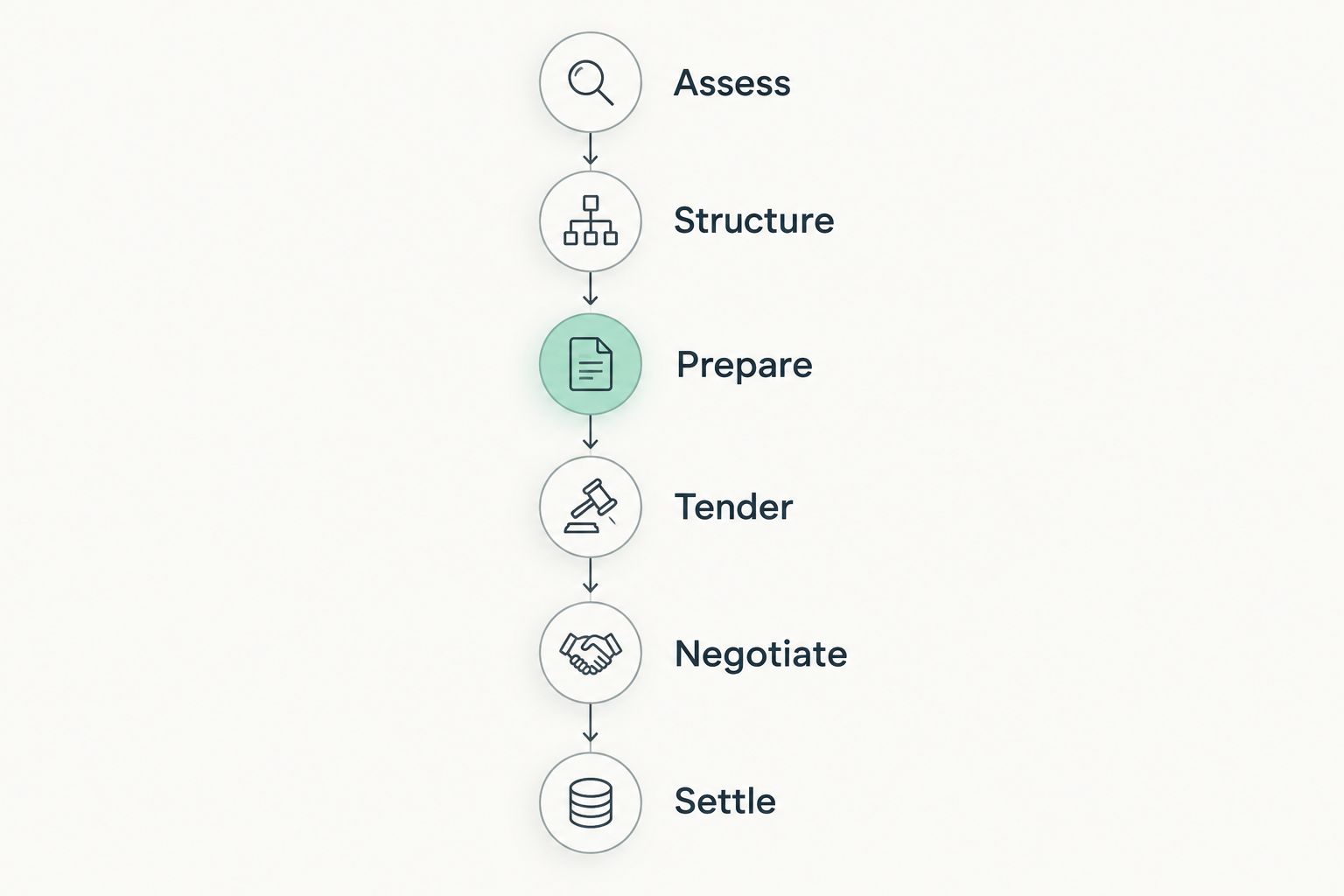
Use these 6 review stages to organise the next move. They separate diagnosis from submission and keep settlement conditions in view from the start.
- Assess. Obtain the bank's explanation, including any written reasons it provides. Identify whether the concern relates to repayment capacity, credit conduct, the asset, security or incomplete information. Ask what evidence would change the assessment rather than assuming the decision is negotiable.
- Structure. Review the borrowing amount, repayment schedule, contribution and proposed security. Match the finance to the asset's business use and the cash available for repayments. A different structure still needs to work without relying on optimistic revenue assumptions.
- Prepare. Assemble a consistent application supported by financial statements, current management accounts, existing debt details and asset information. Explain material changes or adverse events directly. Conflicting figures need reconciliation before submission, not an explanation after the lender queries them.
- Tender. Approach lenders whose requirements fit the proposal. Establish which lenders will receive information, whether the discussion is preliminary and when a formal application will occur. A panel creates options; it does not mean every lender should receive an application.
- Negotiate. Compare the full proposed terms, including security, guarantees, repayment obligations and conditions. Identify what remains subject to assessment. An indicative response is not permission to assume the equipment purchase is funded.
- Settle. Check that the final documents reflect the accepted terms and that all conditions can be satisfied. Coordinate any existing lender release, asset documentation and supplier payment requirements before treating the transaction as complete.
Keep a written record of what changes between applications. If the business, asset and proposed repayments are unchanged, ask the broker to explain precisely why another lender is a better fit.
Which route should you take after a bank decline?
The appropriate route depends on whether the problem is missing evidence, lender fit or the underlying borrowing request. Choose the route that addresses the cause—not the route that produces the quickest submission.
| Route | Best for | Main benefit | Main limitation |
|---|---|---|---|
| Revisit the existing lender | Correctable information gaps or an assessment based on inaccurate facts | Lets you address the stated concern directly | Does not resolve a firm policy mismatch or inadequate repayment capacity |
| Assess an alternative lender | A supportable proposal outside the first bank's requirements | Tests the proposal against different lending requirements | Terms, security and guarantees still need scrutiny; approval is not assured |
| Pause or restructure the purchase | Borrowing that the business cannot currently support | Avoids committing to repayments that strain the business | Delays or changes the equipment purchase |
A request for more information is also different from a final decline. Confirm the application's actual status before starting a replacement process.
For your 2026 review, record the preferred route and the evidence supporting it. If you cannot explain what the next application will demonstrate differently, resolve that gap first.
Why the outcome varies between lenders
Different lending requirements can produce different decisions. That does not mean the first bank was wrong or that another lender will accept the proposal. Assess these factors together:
- Repayment capacity. Show how the business will meet the proposed repayments alongside existing debt and operating commitments. Revenue alone does not show the cash available to service another loan.
- Financial evidence. Current, reconciled records make the proposal easier to assess. Missing information leaves questions unanswered; providing documents does not remove a genuine financial weakness.
- Credit conduct. Explain arrears, defaults or other adverse events accurately, including their present status. A lender still decides whether that history falls within its requirements.
- Asset suitability. Identify the equipment, its intended use, supplier and relevant condition information. Lenders assess the proposed asset as well as the business buying it.
- Security and guarantees. Establish what supports the borrowing and whose obligations are involved. An alternative offer is not equivalent if it requires materially different security or guarantees.
- Loan structure. Review the amount, term, contribution and repayment schedule. Changing the timing of repayments changes the commitment; it does not automatically improve the business's ability to meet it.
These are assessment areas, not a formula for approval. Ask which factor caused the original decline and which factors remain unresolved in the revised proposal.
What should you prepare before another application?
Build one consistent information pack for your 2026 application review. The exact documents depend on the business and proposal, but the pack should explain the borrowing purpose, repayment source and existing obligations clearly.
The decline explanation
Keep the original application, lender correspondence and any reasons provided. Record whether the lender rejected the business, the asset, the structure or the available evidence. Do not turn an uncertain explanation into an assumed fact.
Financial records and existing debt
Prepare financial statements, current management accounts and relevant bank statements. List existing facilities, outstanding obligations, security and guarantees. Reconcile material differences between records before asking a lender to rely on them.
Include tax obligations and payment arrangements where relevant. The objective is a complete account of commitments, not a selective account that makes the proposed repayment look easier.
Asset and purchase information
Provide the supplier's documents and a clear description of the equipment's intended business use. For used equipment, assemble the condition and identification information available to you. Ask what further evidence the proposed lender requires before committing to a submission.
A supportable repayment explanation
Explain how repayments fit the business's cash flow. Distinguish existing earnings from expected benefits of the new equipment. If repayment depends on winning work that is not yet contracted, make that dependency explicit rather than presenting the income as established.
Should you review existing banking arrangements as well?
Review the wider banking position when the equipment request depends on existing facilities, shared security or refinancing. An asset purchase does not sit outside the business's other borrowing commitments simply because it has a separate application.
For example, establish whether existing security arrangements affect the proposed transaction and whether lender consent or releases are needed. Compare any proposed refinancing against the obligations it replaces, including repayment timing and exit conditions. Do not assume a lower regular repayment means a better overall arrangement.
Glenclair's commercial finance services cover business loans, refinancing, equipment and property development finance. That broader scope is relevant when the equipment request forms part of a larger review rather than a standalone purchase.
Keep the borrowing purposes clear. Equipment finance, working capital and property development funding address different needs. Combining the discussion can expose dependencies, but each facility still needs a clear purpose and repayment explanation.
Can a broker help if the bank declined on affordability?
A broker can reassess affordability, but cannot make repayments affordable simply by finding another lender. Start by checking whether the bank used accurate, current financial information and understood the proposed repayment source.
If the concern remains after that review, reconsider the purchase scope, contribution or timing. A revised repayment schedule needs scrutiny too: assess the full obligation, including any amount due at the end, rather than judging the proposal only by its regular instalment.
Pause if the business cannot support the commitment. Obtaining an offer is not the same as establishing that accepting it serves the business.
Does a larger lender panel mean approval is more likely?
A larger panel creates more potential lender matches; it does not establish an approval probability. Glenclair's panel of 60+ lenders is a stated panel size, not a success rate or a promise that every lender suits your proposal.
Ask which lenders are relevant and why. A useful explanation connects the proposed lender to the asset, business circumstances and borrowing structure, while acknowledging unresolved assessment issues.
Also establish whether the broker has already discussed the proposal with a lender or is recommending a formal application. Those are different stages, and you should understand what you are authorising.
What should you ask before appointing a broker?
Ask for a clear scope before authorising submissions. Your 2026 engagement should distinguish arranging a finance application from a broader debt advisory assignment, particularly where refinancing and existing banking arrangements are involved.
- What caused the original decline, and what remains uncertain?
- Which lenders fit this proposal, and what supports that assessment?
- What information will be shared, and when does a formal application occur?
- How is the broker paid, and what charges apply to this engagement?
- What security, guarantees and settlement conditions need attention?
- What happens if the recommended route does not produce an acceptable offer?
Lender-paid brokerage and debt advisory services are different engagement models. Glenclair distinguishes lender-paid brokerage from debt advisory services, which use a retainer and success-fee structure. Confirm the scope and remuneration arrangements in writing rather than assuming the same model applies to every assignment.
Review your commercial finance position
Discuss the decline, existing facilities and proposed equipment borrowing.
FAQ
Can an asset finance broker get approval after my bank says no?
An asset finance broker can secure approval if another lender accepts your business, asset and proposed structure. The broker should first establish why the bank declined; approval is never guaranteed.
Should I apply to another lender straight away?
Review the decline before making another application. Identify whether the issue is missing evidence, lender requirements or the business's ability to repay, then choose the appropriate next step.
Can a broker help if my business has adverse credit history?
A broker can assess the proposal and identify relevant lender requirements, but cannot guarantee acceptance of adverse credit history. Provide accurate details of the event, its cause and its current status.
What documents should I give an asset finance broker?
Provide the decline correspondence, financial records, existing debt details and asset purchase information. The broker should confirm the additional documents required for the proposed lender and structure.
Is an indicative response the same as final approval?
An indicative response is not final approval. Confirm the assessment status, outstanding conditions and settlement requirements before treating the equipment purchase as funded.
Do I have to refinance my existing business loans?
An asset finance application does not automatically require refinancing existing business loans. Review refinancing where existing obligations, security or lender conditions affect the proposed transaction.
Does a broker's lender panel guarantee that someone will approve me?
A lender panel does not guarantee approval. Its value lies in identifying relevant lenders, while each lender still assesses the business, asset and proposed terms.
One last thing
Ask for the reason to apply again before asking where to apply. That question forces the discussion back to evidence: what the first lender could not accept, what has changed and why the next lender fits.
Then ask what would make the broker recommend stopping. A useful review must leave room for a smaller purchase, different timing or no new borrowing. The objective is an acceptable finance arrangement the business can support—not an approval pursued at any cost.
Related guides
- Equipment finance options for construction businesses
- Equipment finance options for manufacturing businesses
- Machinery finance options for earthmoving contractors
Author: Glenclair Financial team.