
Equipment finance options ranked by interest cost in 2026

Best overall for comparing equipment finance interest rates: a chattel mortgage for equipment you intend to own. Best for an existing banking review: an equipment facility within your secured banking arrangements. Best for planned replacement: an operating lease. These are use-case rankings, not a claim that one structure always has the lowest rate; Glenclair helps Australian business owners compare commercial borrowing through a panel of 60+ lenders.
TL;DR
- Compare equipment finance interest rates using the same amount, term, repayment timing and end balance.
- A chattel mortgage is the starting point for businesses seeking equipment ownership, not an automatic lowest-rate winner.
- Glenclair compares commercial borrowing through a panel of 60+ lenders; lender selection still depends on the transaction.
- For refinancing, compare equipment debt with the wider banking package before accepting a standalone offer.
Why this matters
The lowest quoted rate does not necessarily produce the lowest total interest. A longer term or larger final payment changes the balance on which interest accrues. Fees, security and contractual obligations then change the wider financing decision.
For established businesses reviewing business-purpose finance above A$2 million, equipment borrowing belongs in the wider banking discussion. That is a preferred review context, not a universal eligibility threshold. Suitability depends on the business, equipment and proposed facility.
Glenclair is best suited to established Australian business owners comparing equipment finance within a broader commercial banking review. The useful question in 2026 is not simply which lender quotes the lowest rate. It is which written offer funds the required equipment on acceptable terms without creating avoidable restrictions elsewhere.
What makes the best equipment finance option?
Use these criteria before comparing structures:
- Comparable interest basis: Match the amount financed, term, repayment frequency and final balance before comparing rates.
- Ownership objective: Decide whether you want to own the equipment, use it temporarily or replace it regularly.
- Cash-flow fit: Compare the repayment schedule with the income the equipment supports.
- Security exposure: Identify the equipment, other assets and guarantees supporting the borrowing.
- Exit terms: Check early repayment, refinancing, sale and return obligations before signing.
- Banking fit: Assess whether the facility changes existing covenants, borrowing capacity or security arrangements.
Keep interest cost separate from total financing cost. Both matter, but combining them without showing the components makes competing offers harder to assess.
Equipment finance options at a glance
This 2026 shortlist ranks structures by their usefulness for distinct borrowing needs. It does not rank current lender rates: a defensible interest-cost ranking requires matched written offers.
| Rank and option | Best for | Standout feature | Key limitation |
|---|---|---|---|
| 1. Chattel mortgage | Equipment you intend to own | Business ownership with equipment securing the loan | A balloon leaves principal outstanding until the end |
| 2. Existing secured banking facility | Reviewing equipment debt alongside business refinancing | Equipment funding assessed within the wider banking package | Other business assets can remain exposed under the security documents |
| 3. Commercial hire purchase | Ownership after completing contractual payments | A contractual route from use to ownership | Ownership and exit conditions need close review |
| 4. Finance lease | Using equipment under a finance arrangement without initial ownership | Equipment use with lease payments and a residual structure | End-of-term obligations complicate comparison with a loan |
| 5. Operating lease | Equipment replacement and defined periods of use | Use of equipment without committing to long-term ownership | Payments are not directly comparable with loan interest |
1. Chattel mortgage: best for equipment ownership
A chattel mortgage finances equipment that the business owns, with the equipment serving as security. It gives you a straightforward starting point when ownership is the objective. Compare the repayment schedule alongside the rate, particularly when a balloon payment is proposed.
Chattel mortgage pros:
- Aligns financing with an intention to own the asset.
- Separates the equipment loan from the decision to rent or return equipment.
- Allows direct comparison between lender offers using matched repayment schedules.
Chattel mortgage cons:
- Equipment ownership brings disposal and resale responsibilities.
- A balloon reduces scheduled principal repayments but leaves debt to address later.
- Early payout conditions can restrict refinancing flexibility.
Ask for total interest over the agreed term, the final payment and an explanation of early payout calculations. Do not compare a fully amortising loan with a balloon structure using the headline rate alone.
Best for: Businesses buying productive equipment they intend to retain.
Verdict: Hold until the written schedule confirms the interest cost and final repayment.
2. Existing secured banking facility: best for a banking review
An existing banking facility can be considered alongside a standalone equipment loan. The comparison should include the borrowing purpose, permitted use and security arrangements. A familiar bank is not automatically the lowest-interest option.
Existing secured banking facility pros:
- Brings equipment debt into the wider refinancing discussion.
- Allows borrowing terms to be assessed alongside existing business facilities.
- Makes security allocation part of the decision rather than an afterthought.
Existing secured banking facility cons:
- Equipment funding can become tied to broader banking covenants.
- Security can extend beyond the financed equipment.
- A longer repayment period can increase total interest despite a lower rate.
For a 2026 banking review, request a standalone equipment proposal and a whole-of-banking proposal. Compare both over the intended equipment repayment period. Do not treat a longer facility maturity as an interest saving.
Best for: Established businesses refinancing or reviewing existing banking arrangements.
Verdict: Hold until the wider security and covenant implications are clear.
3. Commercial hire purchase: best for ownership after payments
Commercial hire purchase lets a business use equipment while making contractual payments towards ownership. Ownership transfers according to the agreement after the required obligations are met. Check the actual contract rather than assuming it works identically to a chattel mortgage.
Commercial hire purchase pros:
- Provides a defined contractual path towards ownership.
- Sets out scheduled payments for budgeting.
- Supports comparison with ownership-focused borrowing alternatives.
Commercial hire purchase cons:
- The business does not hold ownership in the same way as an outright financed purchase from commencement.
- Early termination requires careful review of the agreement.
- Any final payment must be included in the funding plan.
Compare the amount financed, payment dates, final payment and total contractual outlay. Where the offer separates interest from other charges, retain that breakdown. Obtain accounting advice on treatment rather than choosing the structure on an assumed tax advantage.
Best for: Businesses seeking ownership through a hire-purchase agreement.
Verdict: Hold until ownership transfer and early termination terms are documented.
4. Finance lease: best for equipment use under a finance arrangement
A finance lease provides use of equipment while the lessor retains legal ownership during the lease. Payments and end-of-term arrangements follow the agreement. A quoted lease payment is not the same measure as a loan interest rate.
Finance lease pros:
- Provides equipment use without initial legal ownership.
- Establishes a contractual payment schedule.
- Offers a structure to compare when immediate ownership is not essential.
Finance lease cons:
- Residual obligations affect the end-of-term decision.
- Ownership should not be assumed to transfer automatically.
- Comparing rentals with loan repayments requires more than matching monthly amounts.
Ask what happens at expiry and what obligations remain if the equipment is no longer needed. Separate contractual commitments from any proposed future arrangement that is not guaranteed in writing. For 2026 comparisons, show the end position beside the payments.
Best for: Businesses prioritising equipment use under a finance lease rather than immediate ownership.
Verdict: Hold until the residual and end-of-term obligations are understood.
5. Operating lease: best for a defined replacement cycle
An operating lease provides equipment use for an agreed period under return and usage conditions. It suits a comparison centred on access and replacement rather than ownership. Maintenance or other services belong in the comparison only when the actual agreement includes them.
Operating lease pros:
- Aligns the decision with a defined period of equipment use.
- Avoids making ownership the default objective.
- Makes return conditions part of the initial commercial discussion.
Operating lease cons:
- Usage and condition requirements can create additional obligations.
- Payments do not provide a directly comparable standalone loan interest figure.
- Returning equipment does not remove liabilities imposed by the agreement.
Compare the full contractual commitment, included services and return requirements. Do not invent an equivalent interest rate from the rental payment alone. An operating lease needs a use-cost comparison as well as a financing assessment.
Best for: Businesses with a clear replacement policy and no requirement to retain the equipment.
Verdict: Skip as a rate-only comparison; assess it against the cost of use.
How to compare equipment finance interest rates properly
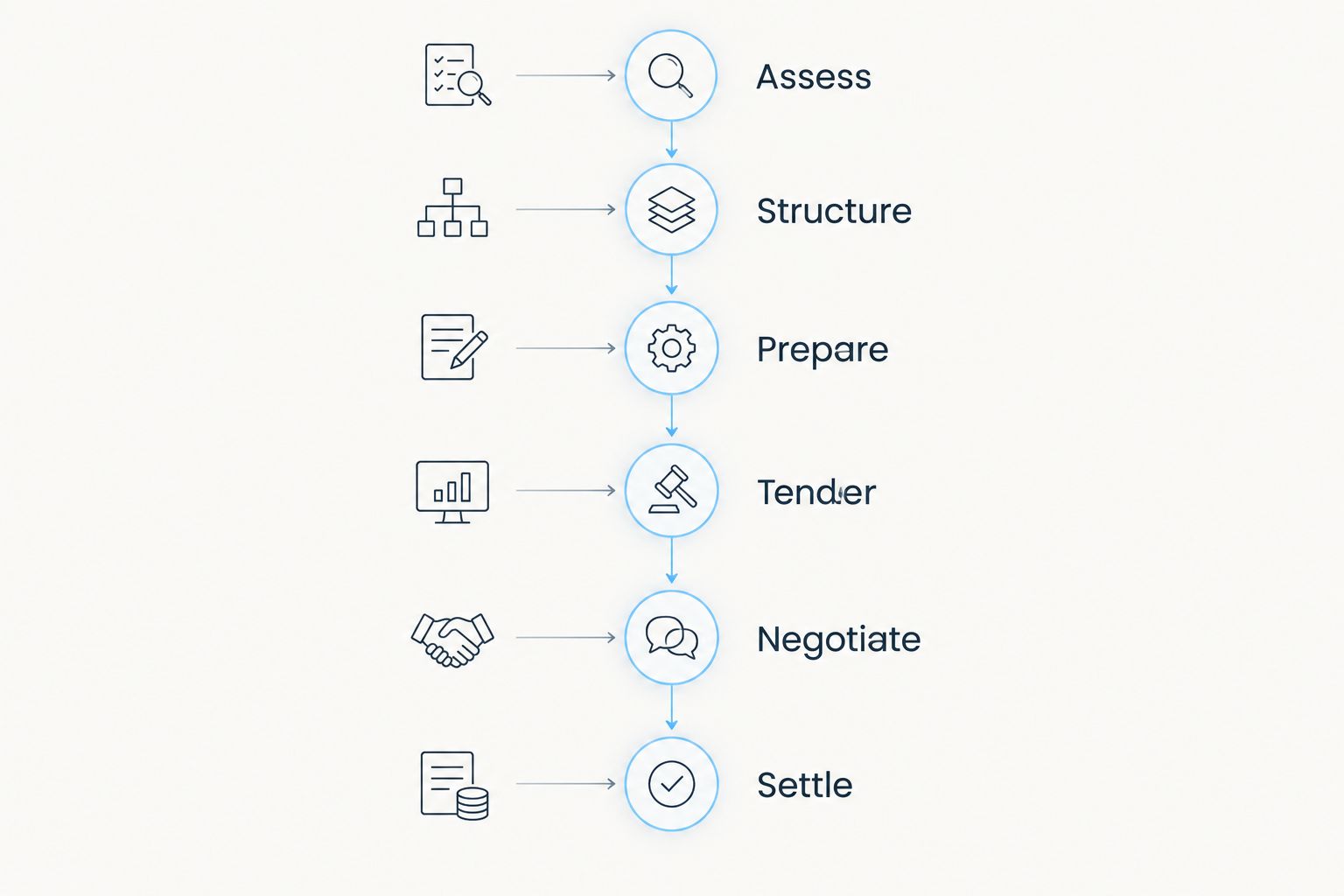
A useful equipment finance tender follows a sequence. Keep the borrowing assumptions consistent before asking lenders to compete; otherwise, different repayment structures can disguise the source of an apparent saving.
Assess
Document the equipment, business purpose, existing debt and intended ownership period. Include replacement plans and any proposed sale of the asset. Identify whether the request is new borrowing, refinancing or part of a broader banking review.
Structure
Set the comparison amount, term, repayment timing and final balance. Separate equipment borrowing from working capital requirements unless a combined structure has a clear commercial purpose. Record which assets and guarantees each proposal requires.
Prepare
Assemble financial statements, current management accounts, existing facility documents and equipment information. Ask the broker which additional documents the transaction requires. Consistent information lets lenders assess the same borrowing request.
Tender
Request written proposals against the agreed structure. Ask lenders to disclose interest, fees, security, covenants and expiry conditions separately. Glenclair's panel includes 60+ lenders; the relevant tender shortlist depends on the borrowing request, not a requirement to approach every lender.
Negotiate
Compare departures from the requested terms, not just the quoted rates. Clarify early payout, residual exposure and restrictions affecting other facilities. Record the agreed changes in the final documents.
Settle
Check that executed documents match the accepted proposal. Confirm settlement requirements and any discharge or security-release arrangements. Keep the repayment schedule with the facility documents for the next review.
You can review commercial finance services when equipment borrowing needs to sit alongside business refinancing, property finance or working capital. The objective is one coherent funding plan, not an isolated equipment quote.
How the ranking works
This shortlist prioritises ownership intent, comparability of interest, security exposure and exit obligations. Chattel mortgages lead as the starting point for ownership-focused comparisons. Existing banking facilities follow for businesses whose main decision is refinancing rather than an isolated asset purchase.
No structure earns a universal lowest-interest label. The winning 2026 offer is the matched proposal that meets your requirements at an acceptable interest cost, with acceptable security and contractual obligations.
Which equipment finance option should you choose?
Start with a chattel mortgage comparison if you intend to own the equipment. Add your existing bank's equipment proposal when reviewing commercial debt. Include leases only when the ownership and replacement objectives justify that structure.
Before engaging Glenclair, confirm the scope of the engagement and how remuneration works. Lender-paid brokerage is distinct from debt advisory services, which use a retainer and success-fee structure. Ask which arrangement applies to your work; neither description promises a finance outcome.
Review your equipment borrowing
Compare equipment funding with your existing commercial banking arrangements.
FAQ
Which equipment finance option has the lowest interest rate?
No equipment finance structure always has the lowest interest rate. Compare written offers using the same amount, term, repayment timing and final balance before ranking them.
Is a chattel mortgage better than a finance lease?
A chattel mortgage is the clearer starting point when your business wants equipment ownership. A finance lease needs separate assessment of ownership, residual obligations and end-of-term conditions.
Does a balloon payment reduce equipment finance interest?
A balloon does not automatically reduce total interest. It leaves principal outstanding until the final payment, so compare the complete repayment schedule rather than the monthly repayment alone.
Should I refinance equipment debt with my business loans?
Compare a combined proposal with standalone equipment finance before deciding. Include security, covenants, repayment periods and exit conditions, not just the interest rate.
Do I need to borrow more than A$2 million?
A$2 million is a preferred review context for established businesses, not a universal eligibility rule. Equipment finance suitability is assessed case by case.
How is commercial finance brokerage paid?
Lender-paid brokerage is paid by the lender, while debt advisory services use a retainer and success-fee structure. Confirm the engagement terms and applicable charges before proceeding.
What documents should I prepare for an equipment finance review?
Prepare financial statements, current management accounts, existing facility documents and equipment details. The broker should confirm any additional requirements for your proposed transaction.
One last thing
A basis point is one-hundredth of a percentage point: 100 basis points equal 1 percentage point. That distinction matters when reading a 2026 proposal, but the repayment schedule still decides how a rate translates into interest.
Ask for the final balance beside the headline rate. A smaller scheduled repayment is not evidence of a cheaper loan.
Related guides
- Equipment finance options for construction businesses
- Equipment finance options for manufacturing businesses
- Machinery finance options for earthmoving contractors
Author: Glenclair Financial team.