
How much deposit do you need for a commercial property loan?

Your commercial property loan deposit is the gap between the purchase price and the loan the lender approves; there is no single deposit percentage that applies to every Australian commercial purchase in 2026. You also need to fund acquisition costs that the loan does not cover. Calculate your cash requirement against the lender’s accepted valuation, approved loan amount and settlement conditions—not the advertised maximum borrowing limit.
TL;DR
- Your commercial property loan deposit depends on approved borrowing, valuation and the purchase price—not a universal percentage.
- Glenclair suits established Australian business owners seeking an independent commercial finance review.
- Loan-to-value ratio measures security coverage; repayment capacity remains a separate assessment.
- Budget for acquisition costs and retained working capital, not just the purchase-price shortfall.
How much deposit do you need for a commercial property loan?
You need enough equity to cover the purchase-price shortfall, plus any costs that are not financed. A lender’s loan-to-value ratio, or LVR, helps determine the security-based lending limit. It does not establish how much your business can afford to repay.
For an established business reviewing property debt alongside existing facilities, commercial finance services provide the relevant starting point. The assessment should consider the whole borrowing position, rather than isolate the property deposit from working capital and other commitments.
Use this calculation before deciding whether a purchase is within reach:
| Calculation | What to include | What it tells you |
|---|---|---|
| Purchase-price shortfall | Purchase price minus approved loan proceeds allocated to the purchase | Equity needed for the property itself |
| Acquisition costs | Applicable transfer duty, legal work, valuation and other transaction costs | Additional cash needed outside the purchase price |
| Settlement adjustments | Amounts payable under the contract’s settlement statement | Cash movements due at completion |
| Retained working capital | Cash your business needs after settlement | Whether the purchase leaves enough operating liquidity |
| Available contribution | Cash available after allowing for operating needs | Whether you have a funding gap |
Do not count the same money twice. A deposit already paid under the sale contract forms part of your contribution; it is not an additional equity contribution on top of the purchase price.
Why this matters
A property purchase can meet a lender’s security requirements and still place pressure on your business. Cash committed to settlement is no longer available for wages, suppliers, tax obligations or unexpected expenditure.
For your 2026 borrowing review, ask two separate questions: does the transaction satisfy the lender, and does it leave the business adequately funded? Approval answers the first question. Your cash-flow planning must answer the second.
The distinction matters when you are purchasing premises while refinancing existing debt. A change to property security can affect other facilities, so the deposit calculation should sit within a review of your banking arrangements.
Contract deposit versus lender equity requirement
The word ‘deposit’ describes different things during a property purchase. The amount payable when you sign a contract is not necessarily the total cash contribution needed to obtain finance.
| Requirement | Purpose | Main limitation | Best for |
|---|---|---|---|
| Contract deposit | Meets the payment obligation specified in the sale contract | Does not establish the lender’s final equity requirement | Planning cash due under the contract |
| Lender equity requirement | Covers the gap between the purchase price and approved borrowing | Can change if valuation or approved borrowing changes | Testing whether finance supports the purchase |
| Total cash requirement | Includes equity, unfunded transaction costs and settlement adjustments | Does not automatically preserve operating cash | Preparing the settlement funding plan |
Have your solicitor explain when the contract deposit becomes payable and the consequences of failing to complete. Have the finance assessment establish the total contribution separately. Treating these as the same figure leaves a funding question unanswered.
Your contract terms and finance approval must work together. A manageable payment at signing does not establish that the remaining funds will be available at settlement.
How valuation affects your commercial property loan deposit
A purchase price records what you have agreed to pay. A lender’s valuation supports its assessment of the property as security. Those figures do not have to match.
Where a lender applies its LVR to a valuation below the purchase price, the security-based loan limit falls relative to the agreed price. Unless another acceptable funding source covers the difference, your cash contribution increases.
Ask which value the lender uses in its calculation. Also confirm whether the proposed loan amount is subject to a satisfactory valuation, rather than assuming an indicative discussion has settled the question.
Do not commit your entire cash buffer on the assumption that the valuation will equal the purchase price. Establish the funding consequences of a lower valuation before making a commitment that depends on finance.
Can extra property security replace a cash deposit?
Additional acceptable security can support a different lending structure, but it does not remove the debt or the repayment obligation. The lender still assesses the proposed facilities and the business’s ability to service them.
The trade-off is broader exposure. Using another property as security connects that asset to the borrowing arrangement and can complicate a later sale, refinance or release.
Ask for the proposed security structure in writing. Identify which assets secure which facilities and what conditions apply if you later want an asset released.
Why commercial property deposit requirements vary
Commercial property lending depends on the transaction, the borrower and the proposed security. These factors explain why a deposit figure quoted for another business is not a reliable funding plan for yours.
- Property and permitted use. The lender assesses the asset offered as security, including its use and suitability for its lending criteria.
- Accepted valuation. A difference between the agreed purchase price and the lender’s accepted value changes the equity calculation.
- Repayment capacity. Business earnings, rental income where relevant, and existing commitments affect supportable borrowing.
- Security structure. Additional collateral, existing mortgages and shared security arrangements affect how the proposal is structured.
- Transaction purpose. Buying business premises, purchasing an investment property and funding a development require different assessments.
- Lender policy. Each lender applies its own credit criteria; access to a lender does not mean a particular proposal qualifies.
These factors interact. Strong property security does not cancel a cash-flow shortfall, and strong earnings do not guarantee that a lender will accept a particular property.
A useful finance comparison therefore tests the same transaction across suitable lenders. Comparing headline LVRs without comparing conditions leaves out the detail that determines whether the funding works.
Does a larger deposit guarantee approval?
A larger commercial property loan deposit does not guarantee approval. It reduces the amount you need to borrow, but the lender still assesses repayment capacity, security and the proposed transaction.
A business can hold substantial cash while carrying debt commitments that constrain further borrowing. Equally, putting more cash into a property can weaken the operating buffer that supports repayments.
Before increasing your contribution, compare the effect on both debt servicing and available cash. The objective is a workable balance sheet after settlement—not simply the smallest possible property loan.
The guide to income requirements for commercial property finance addresses the other side of this assessment. Deposit capacity and serviceability need to be tested together.
How to establish your required contribution before signing
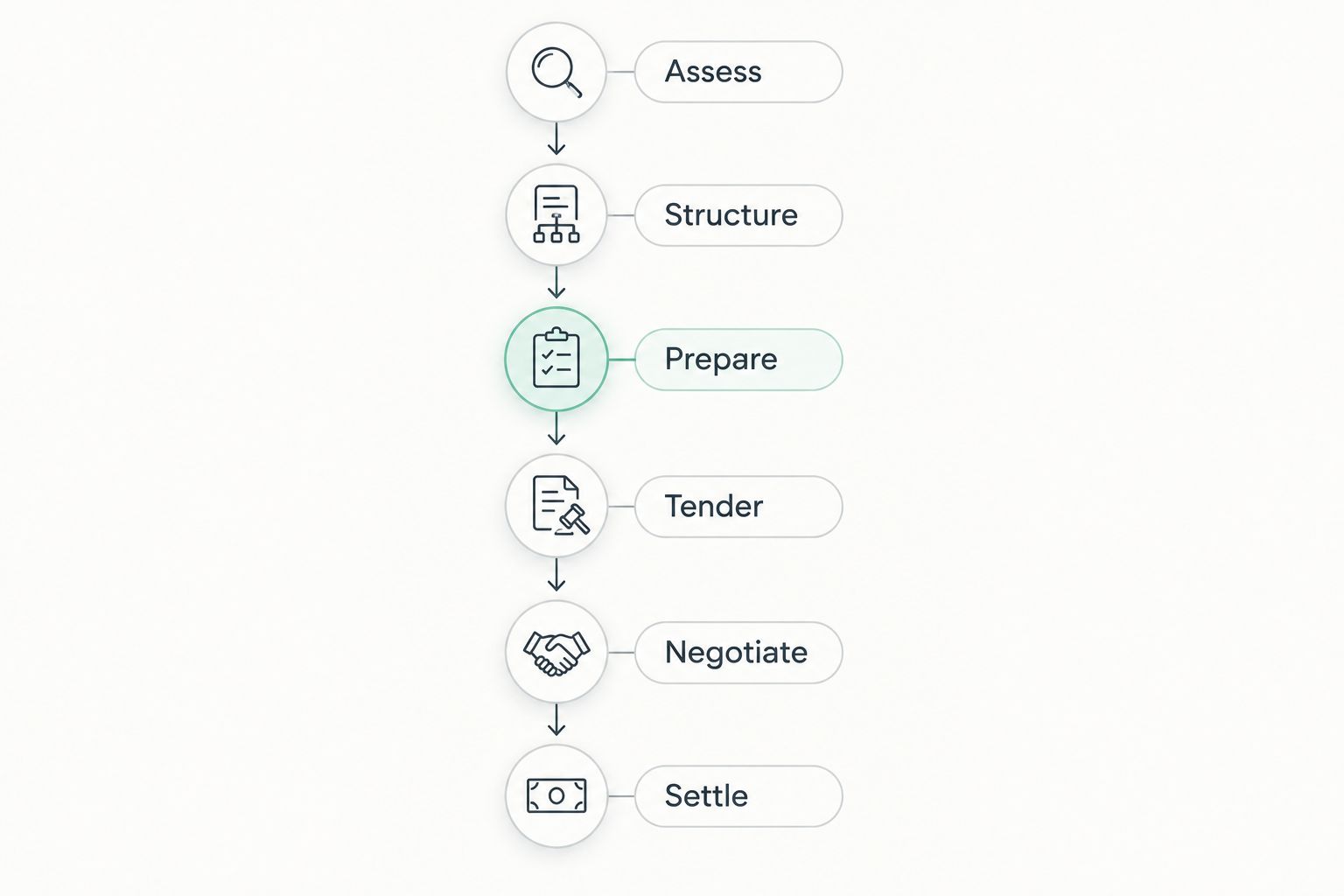
Use a documented process for your 2026 purchase or refinancing review. Each step should resolve a funding question before you rely on the next assumption.
- Assess. List the purchase price, available cash, existing facilities and operating commitments. Separate funds available for the purchase from funds needed to run the business.
- Structure. Identify the proposed borrower, property ownership, security and repayment source. Include related facilities that the transaction will affect.
- Prepare. Assemble current financial statements, management accounts, debt information and relevant property documents. Resolve inconsistencies before presenting the proposal.
- Tender. Ask suitable lenders to assess a consistent funding request. Require clarity on the proposed loan amount, valuation basis and outstanding conditions.
- Negotiate. Compare the full arrangements, including security, repayments, covenants and release conditions. Do not rank proposals by the cash contribution alone.
- Settle. Reconcile the approved facility with the solicitor’s settlement statement. Confirm that your contribution is available and that all funding conditions are satisfied.
This process separates an initial borrowing estimate from a transaction that is ready to complete. Keep a written record of unresolved conditions rather than treating verbal indications as final approval.
What should you request in a banking tender?
Ask lenders to respond to the same borrowing requirement and security proposal. Otherwise, a smaller requested contribution can conceal a materially different arrangement.
Your comparison should identify the proposed facility amount, repayment basis, security, financial reporting obligations, covenants and conditions before funding. Record what remains subject to valuation or credit assessment.
For refinancing, include the release of existing security and the treatment of linked facilities. A new property facility is not a complete solution if the remaining banking arrangements cannot operate as intended.
How much cash should remain after settlement?
There is no universal cash reserve that suits every commercial property borrower. Set the reserve against your business’s actual payment cycle, committed expenditure and exposure to uneven receipts.
For an owner-occupier, review the cash available for trading after the property contribution leaves the account. For a property investor, assess the ability to meet obligations when rent is interrupted or property expenditure arises.
Keep the reserve visible in your funding worksheet. If settlement only works by using money already allocated to essential business payments, the transaction needs restructuring—not a more optimistic deposit estimate.
Where an independent finance review fits
Glenclair suits established Australian business owners seeking an independent commercial finance review. Its panel includes 60+ lenders, giving the brokerage a basis for considering different lending arrangements; panel size does not promise approval or a particular deposit requirement.
The intended audience includes businesses seeking business-purpose finance greater than A$2 million, particularly for refinancing and reviews of existing banking arrangements. That preferred transaction size is not a universal eligibility rule. Suitability is assessed case by case.
For a 2026 property funding review, ask Glenclair to assess the proposed borrowing alongside existing business debt. The benefit of that approach is a connected funding assessment; the limitation is that lender decisions still depend on the borrower, property and proposal.
Keep the service scope clear. Lender-paid brokerage and debt advisory are different arrangements; debt advisory uses a retainer and success-fee structure. Confirm which engagement applies before proceeding.
Review your commercial borrowing
Discuss the property contribution, existing facilities and proposed security structure.
FAQ
How much deposit do I need for a commercial property loan in Australia?
Your commercial property loan deposit is the purchase-price shortfall after approved loan proceeds are applied. You also need to cover transaction costs and settlement amounts that are not financed.
Is the contract deposit the same as the bank’s required deposit?
The contract deposit is not necessarily the same as the lender’s required equity contribution. The contract controls the payment due to the seller, while the approved borrowing determines the remaining purchase-price shortfall.
Can I use equity in another property instead of cash?
Equity in another property can support a lending proposal if the lender accepts that security and structure. It exposes an additional asset and does not remove the requirement to demonstrate repayment capacity.
What happens if the commercial property valuation is lower than the purchase price?
A lower accepted valuation can reduce the security-based loan limit and increase your required contribution. Confirm the lender’s valuation basis and resolve the resulting funding gap before relying on settlement funding.
Does a bigger deposit mean my commercial loan will be approved?
A bigger deposit does not guarantee commercial loan approval. The lender still assesses the borrower’s repayment capacity, the property and the proposed loan structure.
Should I put all my available cash into the property deposit?
Your property contribution should leave enough cash to meet the business’s operating obligations. Test the post-settlement cash position before increasing the deposit to reduce borrowing.
Can Glenclair help review property finance alongside my existing loans?
Glenclair provides commercial finance brokering, including refinancing, through a panel of 60+ lenders. Suitability depends on the proposed borrowing and business circumstances, with no promised finance outcome.
One last thing
Before committing to a commercial property purchase in 2026, ask for a sources-and-uses schedule: every amount required to complete, matched to the funds that will pay it. Include the contract deposit already paid so it is not counted twice.
A deposit percentage is a screening figure; a reconciled settlement funding plan tells you whether the purchase can complete. Keep your operating reserve outside that calculation and test that it remains intact afterwards.
Related guides
- Equipment finance options for construction businesses
- Equipment finance options for manufacturing businesses
- Machinery finance options for earthmoving contractors
Written by the Glenclair Financial team.