
How much does equipment finance cost in 2026?

Your equipment finance interest rate is only part of what you pay in 2026: the total also depends on fees, the repayment term, any balloon payment and the cost of ending an existing agreement. Compare written offers against the same borrowing amount, repayment schedule and end-of-term balance before choosing a lender. A lower repayment does not establish a lower total cost.
TL;DR
- Compare your equipment finance interest rate alongside fees, total repayments and any balloon payment.
- A balloon reduces scheduled principal repayments but leaves debt payable at the end.
- Glenclair offers commercial finance brokering through a panel of 60+ lenders.
- For equipment refinancing, compare settlement and exit costs against keeping the existing agreement.
Why this matters
An equipment purchase can affect more than the asset itself. Repayments draw on working capital, security arrangements affect financing flexibility, and a balloon creates a future funding obligation. Assess those commitments together.
For established businesses reviewing substantial commercial borrowing, equipment debt also belongs in the wider banking discussion. Glenclair's commercial finance services cover equipment finance, business loans, refinancing and property development finance. The relevant question is whether the proposed equipment facility fits your business and its existing debt commitments.
How much does equipment finance cost in 2026?
There is no single equipment finance cost that applies to every Australian business. The useful answer is the total payable under a written offer, separated into interest, fees, scheduled repayments and the final balance.
Ask each lender to show the following components. Keep the amount financed and repayment assumptions consistent so differences in structure do not obscure differences in cost.
| Cost component | What to obtain | What it tells you |
|---|---|---|
| Interest | Quoted rate, calculation method and fixed or variable basis | How interest is charged on the borrowing |
| Establishment charges | Itemised charges and whether they are financed | What entering the agreement adds to the commitment |
| Ongoing charges | Account or administration fees and when they apply | What sits outside the advertised interest rate |
| Scheduled repayments | Amount, frequency and total across the term | The regular cash-flow commitment |
| Balloon payment | Contractual amount due at the end | The debt remaining after scheduled repayments |
| Exit and settlement | Payout calculation, discharge charges and settlement requirements | The cost of refinancing or ending the agreement |
| Advisory arrangements | Who pays the broker or adviser and under what agreement | Which professional charges sit outside the lender's offer |
For a cash-outflow comparison, add upfront amounts paid separately, all scheduled repayments and the final balloon. Include compulsory charges that are not already counted. Do not add interest again when it is already included in repayments.
That calculation measures contractual cash outflow, not your after-tax cost. Keep tax assumptions separate and have your accountant assess the treatment relevant to your business and agreement.
Compare the same transaction, not just the same asset
A lender financing a different amount is not quoting the same transaction. An offer that includes fees in the financed balance also differs from one requiring those fees upfront.
Record the equipment purchase amount, deposit, financed charges, repayment frequency and final balance before comparing offers. If any assumption changes, ask for a revised schedule. Otherwise, an apparently cheaper offer can simply involve more cash paid at settlement.
Fully amortising repayments versus a balloon payment
Neither structure is automatically cheaper. For your 2026 comparison, ask for both structures on consistent assumptions and examine the total payable as well as the repayment amount.
| Structure | Best for | Main benefit | Main limitation |
|---|---|---|---|
| Fully amortising repayments | Businesses prioritising repayment of the financed principal across the agreed term | Scheduled payments repay the principal without a contractual balloon | More principal must be repaid during the term than under an otherwise equivalent balloon structure |
| Repayments with a balloon | Businesses with a documented plan for the final payment | Defers part of the principal until the end | Leaves a final obligation and can increase interest compared with an otherwise equivalent fully amortising structure |
Fully amortising repayments: focus on the operating commitment
A fully amortising structure spreads repayment of principal across the loan term. It suits a business that wants the equipment debt repaid through scheduled payments rather than relying on a separate final payment.
The trade-off is cash flow during the term. Check whether repayments remain manageable alongside wages, suppliers, tax obligations and other debt. Do not judge affordability from a strong trading month alone.
Balloon repayments: document the final payment plan
A balloon is deferred principal, not a discount on the equipment. It reduces the principal repaid through regular instalments but leaves an amount due at maturity.
Document whether the business intends to pay that amount from cash, asset sale proceeds or a future finance application. A future refinancing application requires a fresh lending decision; it is not a guaranteed exit. Likewise, an expected resale value is not a contractual promise from a buyer.
Choose the balloon only after testing the final payment plan, not because the regular repayment looks easier.
Why your equipment finance interest rate varies
The rate reflects the proposed transaction and the lender's assessment, not just the equipment invoice. These factors belong in a 2026 equipment finance review:
- Business financial position. Profitability, cash generation and existing debt commitments help a lender assess repayment capacity. Give lenders consistent financial information so their assessments address the same business position.
- Equipment characteristics. The asset's type, age, condition and resale market affect how a lender assesses its security. Describe the actual equipment rather than requesting an indicative quote for a broad category.
- Borrowing structure. The financed amount, term, repayment timing and balloon affect the proposed obligation. A different structure can change both the repayment and the interest charged over the agreement.
- Security and guarantees. Ask which assets secure the facility and whether personal guarantees are required. Assess those obligations separately from the headline rate.
- Documentation and transaction complexity. A straightforward replacement asset and a broader restructuring request require different analysis. Explain how the equipment will be used and how repayments will be funded.
- Lender assessment. Lenders apply their own credit policies and asset criteria. A panel creates scope for comparison; it does not mean every lender will assess or accept every application.
Avoid treating an advertised rate as an approved offer. The decision rests on the written terms available for your business, equipment and requested structure.
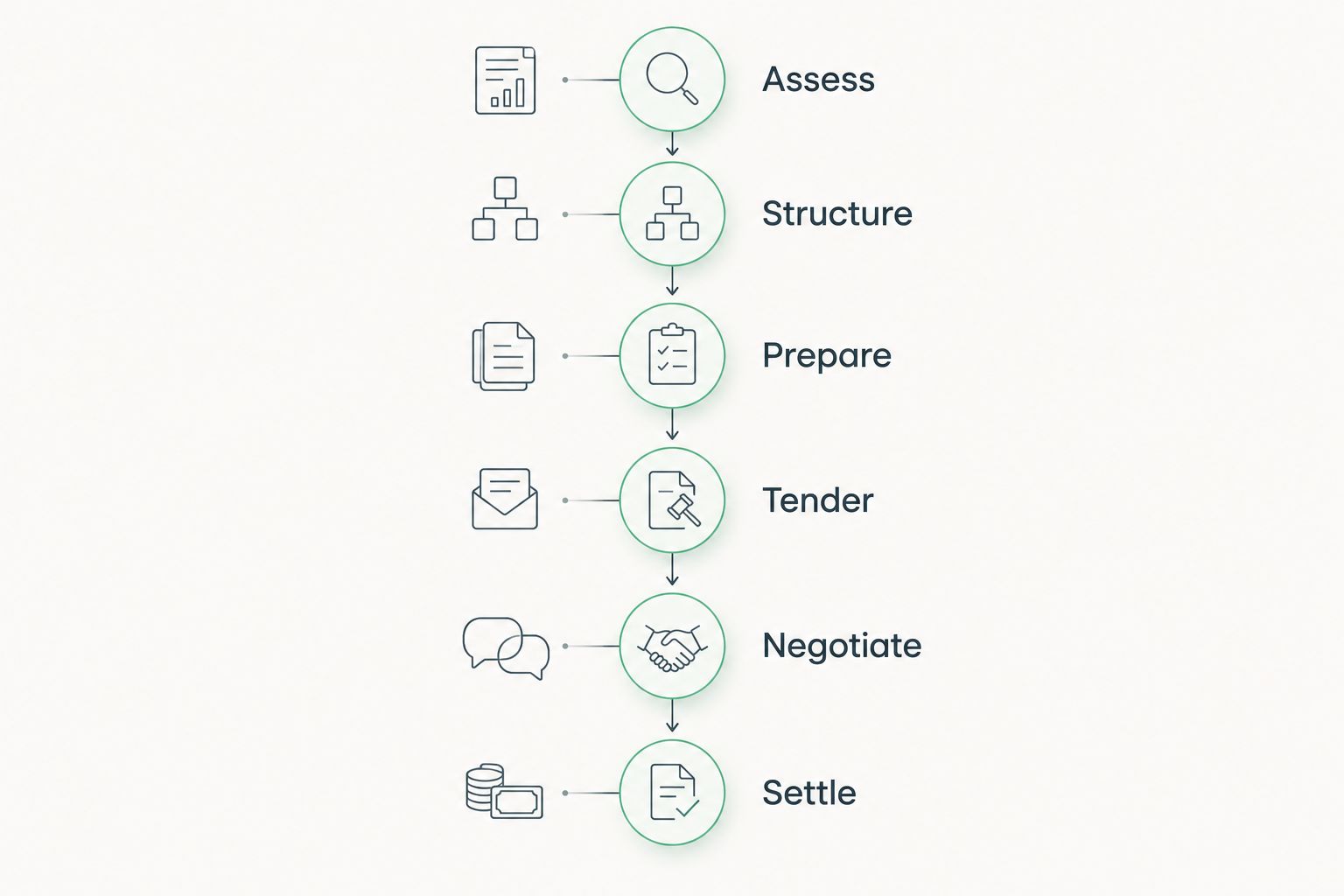
How to compare equipment finance offers
Use a structured process before committing to a purchase or refinancing existing equipment debt. The objective is a decision based on comparable terms, not a collection of unrelated repayment figures.
- Assess. Establish why the business needs the equipment and how it supports operations. Review cash flow, existing repayments and the business's capacity to carry the proposed commitment.
- Structure. Specify the borrowing amount, deposit, term and proposed balloon. Consider whether the equipment facility needs to remain separate from, or be assessed alongside, wider banking arrangements.
- Prepare. Assemble the equipment quotation, business financial information and current debt details. For refinancing, obtain the existing lender's payout information rather than relying on the statement balance.
- Tender. Request written offers against a consistent brief. Ask lenders to identify fees, repayment schedules, security requirements, guarantees and conditions that remain outstanding.
- Negotiate. Address differences in total cost and contractual obligations. A discussion limited to the interest rate leaves fees, security and exit terms unresolved.
- Settle. Reconcile the final documents against the selected offer before signing. Confirm the financed amount, repayment dates, balloon, required security and any conditions for releasing funds.
The comparison should finish with a clear explanation of why the selected structure suits the business. It should also record its disadvantages, including any larger final payment, security commitment or restriction on early repayment.
Review equipment debt alongside the wider banking position
If equipment repayments constrain working capital, compare the proposed facility with the business's other commitments. Check whether security arrangements or guarantees connect the equipment facility to other borrowing. Do not assume that separate account numbers mean separate obligations.
Glenclair is best suited to established Australian business owners seeking a broker-led review of commercial borrowing. Its stated audience prioritises business-purpose finance greater than A$2 million, with suitability assessed case by case rather than through a universal loan-size rule.
That focus is relevant when equipment finance forms part of a broader refinancing or banking review. It does not establish that every equipment purchase needs a full banking tender.
Is a lower equipment finance interest rate always cheaper?
A lower equipment finance interest rate does not establish a lower total borrowing cost. A longer term, different financed amount, additional fees or larger balloon changes the comparison.
Ask for total scheduled repayments and the final payment under each offer. Compare cash-flow timing separately: a structure can reduce regular payments while leaving you with a larger commitment later.
Should you refinance existing equipment finance in 2026?
Refinance when the complete proposed arrangement meets your objectives better than keeping the existing agreement. Compare the current lender's payout amount, exit charges and remaining payments with the proposed facility's full repayment schedule and fees.
Keep the remaining term visible. Extending repayments over a new term can lower the regular payment without reducing total cash outflow. Also check what happens to existing security and guarantees at settlement.
Distinguish brokerage from debt advisory
Glenclair distinguishes lender-paid brokerage from debt advisory, which uses a retainer and success-fee structure. Confirm which service applies to your engagement and obtain the payment terms in writing.
Lender-paid remuneration and a separately engaged advisory service are different arrangements. Ask who pays, when payment becomes due and what work the agreement covers. Do not assume that a brokerage arrangement determines the terms of a debt advisory engagement.
FAQ
What equipment finance interest rate should my business expect in 2026?
Your equipment finance interest rate depends on the lender's assessment of your business, equipment and proposed structure. Obtain a written offer that identifies the rate, fees, repayment schedule and final balance rather than treating an advertised rate as approval.
How do I calculate the total cost of equipment finance?
Add upfront amounts paid separately, all scheduled repayments and any final balloon, including compulsory charges not already counted. Do not add interest again if it is already included in the repayment schedule.
Does a balloon payment make equipment finance cheaper?
A balloon payment defers principal; it does not establish a lower total cost. Compare total interest, fees and the final payment against an otherwise equivalent fully amortising structure.
Can I refinance equipment that is already financed?
Equipment refinancing requires the proposed lender to accept the business, asset and transaction. Obtain the existing lender's payout information and compare settlement costs, new terms and security requirements before proceeding.
Will applying through a broker guarantee equipment finance approval?
Using a broker does not guarantee equipment finance approval. The lender makes the credit decision and sets the conditions attached to its offer.
Should I choose the lowest equipment finance repayment?
Choose a repayment structure that fits your cash flow and total borrowing objectives, not simply the lowest instalment. Check whether a longer term or larger balloon accounts for the difference.
What should I ask about guarantees before signing?
Ask who must provide a guarantee, which obligations it covers and when it can be released. Read the guarantee documents and obtain legal advice on their effect before committing.
One last thing
Ask for the end-of-term position before discussing the monthly repayment. Knowing the final debt, security obligations and payout terms makes the regular repayment easier to judge. For a 2026 refinancing decision, place the existing agreement and proposed offer side by side with both final balances visible.
A useful instruction to your broker is to compare total contractual cash outflow, repayment timing and security obligations separately. That keeps a cash-flow improvement from being mistaken for a reduction in borrowing cost.
Related guides
- Equipment finance options for construction businesses
- Equipment finance options for manufacturing businesses
- Machinery finance options for earthmoving contractors
- Truck finance options for Australian transport fleets
Author: Glenclair Financial team.